

What if the most persuasive review is the least useful one? When searching for PEA supplement reviews Australia, it’s easy to find glowing testimonials, but harder to tell whether they’re genuine, medically meaningful or about the exact product you’re considering. A personal account can describe someone’s experience, but it can’t establish that a supplement will work for you.
It’s reasonable to want clear answers before choosing, especially when product claims and Australian regulatory details aren’t always easy to interpret. A careful review of the evidence, label and reviewer’s experience can help you separate useful information from promotion without treating ratings as medical proof.
This guide explains how to assess whether reviews are specific, verifiable and relevant, and how to compare them with scientific evidence. You’ll also learn which product details to check, how to interpret Australian Register of Therapeutic Goods information, and when to discuss PEA with a healthcare professional. The aim is to help you make a considered decision, not promise results.
Key Takeaways
- Use PEA supplement reviews Australia to identify questions worth checking, not as proof a product will suit you.
- Separate research on PEA as an ingredient from evidence about a specific finished supplement.
- Look beyond star ratings. Check whether a review names the exact product, describes the experience and discloses relevant connections.
- Before choosing, verify the product label, seller details, directions, warnings and Australian regulatory information for that exact product.
- Compare confirmed details for Relieve Therapeutics’ 60, 120 and 180 capsule options, and seek professional advice when appropriate.
What PEA supplement reviews in Australia can and cannot tell you
Choosing a supplement can feel uncertain when reviews and product claims point in different directions. PEA supplement reviews Australia shoppers find online may help them understand what a seller discloses and what an individual says they experienced, but those are separate kinds of information. A product review assesses available product details or documents a user’s experience. It is not proof that the product caused a particular outcome.
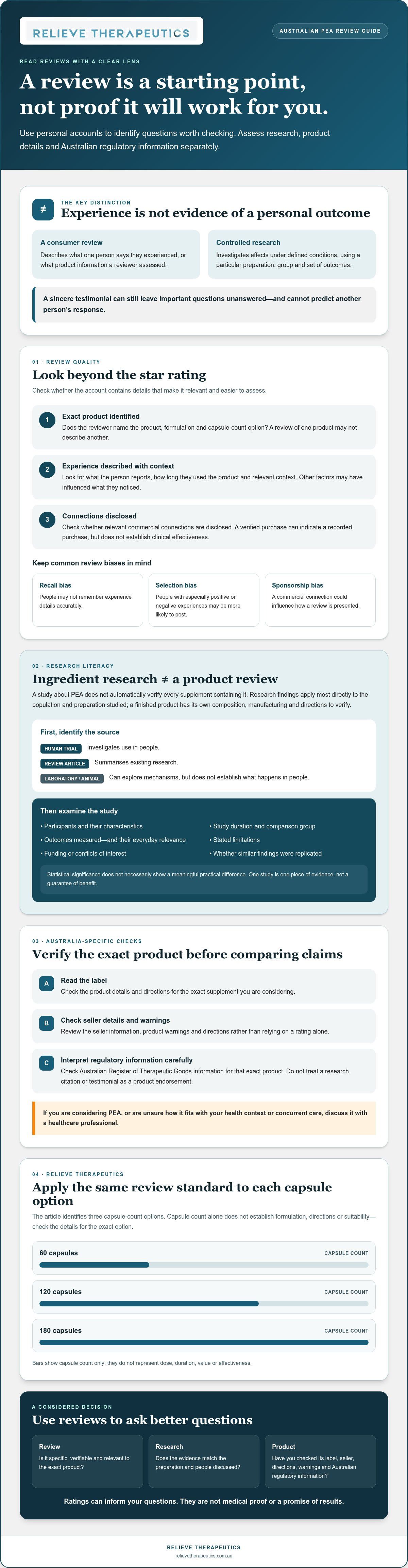
Consumer reviews report experiences; controlled research investigates effects under defined conditions. A testimonial may be sincere and still leave important questions unanswered: what else was happening, how long the person used the product, and whether changes were due to PEA or another factor. Reviews can inform questions to ask, but they can’t predict another person’s response.
What counts as a PEA supplement review?
Sources vary. A verified-purchase review may indicate that a purchase was recorded by the platform, but it doesn’t establish clinical effectiveness. An editorial assessment may compare disclosed product information, while a forum post usually reflects a personal account with less standardised detail. A scientific publication investigates a research question using its stated methods. It isn’t automatically a review of a retail product. For general background, see this overview of Palmitoylethanolamide (PEA), then look to research studies when assessing evidence about effects.
Check whether the reviewer used the exact product being discussed, including its formulation and capsule-count option. A review of one PEA product may not describe another. If the product isn’t clearly identified, the review offers limited help with comparison.
Why PEA reviews can differ
People bring different health contexts, expectations and concurrent care to their experience. They may also use a product for different lengths of time. These differences can shape what they notice and report, without making their account untrue.
Keep three common sources of bias in mind:
- Recall bias: people may not remember details of their experience accurately.
- Selection bias: people with especially positive or negative experiences may be more likely to post.
- Sponsorship bias: a commercial connection could influence how a review is presented.
These limitations don’t mean personal accounts are worthless. They mean each account needs context. Treat positive and negative anecdotes as one person’s report, not a reliable forecast for you. Then assess the product details and research separately.
How to read PEA research without mistaking it for a product review
A review may cite a study to support a claim, but research about PEA as an ingredient isn’t automatically evidence for every supplement containing it. A study examines a particular preparation, dose, group of participants and set of outcomes. A finished product has its own composition, manufacturing and directions, which need separate verification.
Study results apply most directly to the population and preparation studied. If a trial involved a specific PEA formulation and a defined group, its findings can’t simply be transferred to a different product or to everyone considering PEA. This distinction helps readers interpret PEA supplement reviews Australia without treating a research citation as an endorsement.
What to check in a study cited by a review
First, identify the type of source. A human trial investigates use in people; a review article summarises existing research; a laboratory or animal study can explore mechanisms but doesn’t establish what happens in people. For health context, NPS MedicineWise offers information on understanding nerve pain, which can help clarify the condition being discussed.
Then look at the number and characteristics of participants, study duration, comparison group and measured outcomes. Ask whether the outcome matters in everyday life, not just whether a result was statistically significant. A statistically significant finding doesn’t necessarily show a meaningful practical difference. Check the authors’ stated limitations, funding or conflicts of interest, and whether similar findings have been replicated. A single study is one piece of evidence, not a guarantee of benefit.
Why ingredient research doesn’t verify a specific brand
Research can provide background on PEA, but it doesn’t confirm the contents, quality or directions of a retail supplement. Those details require product-specific information, such as a current label and clear documentation. A study-tested dose or preparation shouldn’t be assumed to match any product, including Relieve Therapeutics’ PEA capsules.
For a primer on the ingredient, read the science behind Palmitoylethanolamide. Treat that background as a starting point, then compare the study methods with the exact product information available. If you’re reviewing the retailer’s 60, 120 or 180 capsule supplies, check the relevant listing for current details rather than assuming one option’s information applies to another.
To assess the product separately from the ingredient research, you can review the PEA capsule options and check what product-specific information is disclosed.
PEA Supplement Reviews Australia: a practical comparison checklist
Use this checklist to assess whether a review gives you useful, product-specific information. A high star rating can catch your eye, but detail and transparency matter more than the score alone.
- 1. Identify the exact product. Check the product name, formulation and capsule-count option. If a review discusses PEA generally or leaves the product unclear, you can’t confidently apply it to the supplement you’re considering.
- 2. Inspect the review’s detail. Look for a review date and a clear account of what the person used and what they noticed. Relevant context can help, but reviewers shouldn’t need to disclose private health information. Vague praise or criticism is harder to interpret than a specific, measured description.
- 3. Check for disclosures. See whether the reviewer mentions receiving a free product, payment, an affiliate relationship or another incentive. Repeated wording across multiple reviews may warrant closer scrutiny, though it doesn’t by itself prove a review is inauthentic.
- 4. Verify the claims. Compare statements in the review with the product’s disclosed information and credible evidence. Treat guaranteed health outcomes, claims that a supplement replaces medical care, or advice to stop prescribed treatment as serious warning signs.
Signs that a review is useful and transparent
A helpful review makes it possible to understand what product is being discussed and when the experience was reported. It separates personal impressions from claims about what others should expect. Balanced comments that mention uncertainty or limitations are often more informative than sweeping promises. Use reviews to develop questions, not to make assumptions about how you’ll respond.
Warning signs in PEA supplement testimonials
Check whether a testimonial refers to PEA as an ingredient or the exact product you’re assessing. A large number of reviews doesn’t establish efficacy or product quality, particularly if the reviews lack detail or their source is unclear. Be cautious of pressure-based language, guaranteed results and advice that conflicts with care from your health professional.
For PEA supplement reviews Australia shoppers can assess consistently, compare the reviewer’s claims with product-specific information rather than relying on a star average. The Australian guide to high-quality PEA capsules offers broader product-quality considerations to keep in mind as you compare.
What to verify before choosing a PEA supplement in Australia
Reviews can help you decide what to investigate, but the product label and seller information are where practical checks begin. Before purchase, confirm the exact product name and inspect its ingredients, amount per capsule, directions, warnings and any advice about who should seek professional guidance. If a detail is missing or unclear, ask the seller rather than relying on a reviewer’s assumptions.
Also check who is selling the product and whether the listing provides clear contact and product information. Compare claims in reviews with the wording on the product label and seller’s website. A testimonial doesn’t confirm that a claim is permitted or that it applies to a particular product.
Checking Australian regulatory and label information
Regulatory status is product-specific. General information about PEA or complementary medicines doesn’t confirm the status of an individual supplement. Where applicable, search the exact product in current Therapeutic Goods Administration (TGA) and Australian Register of Therapeutic Goods (ARTG) information, and compare the details carefully. Don’t infer inclusion from a seller’s general statement or a reviewer’s comment.
Keep a product’s marketing claims separate from verified regulatory information. If you’re unsure what a listing or claim means, contact the seller or ask a pharmacist. Any regulatory details published in an article should be checked against current official information for that exact product.
Questions to ask a health professional
A pharmacist or doctor can help you consider whether a supplement is appropriate alongside your health conditions, medicines and existing care. This is particularly relevant if you take other medicines, are pregnant or have complex health needs. Bring the product label or listing so they can review the specific ingredients and directions rather than discuss PEA in general terms.
You might ask: “Is this suitable with my current medicines?”, “Are there reasons I should avoid it?” and “What should I do if my symptoms change?” Don’t delay diagnosis or stop or alter prescribed treatment because of a testimonial or product claim. For further background, see this PEA safety and side-effects guide, and discuss personal health decisions with a qualified professional.
As you assess PEA supplement reviews Australia, apply the same checks to every product listing. You can view the PEA capsule options and review the product-specific information available before deciding what questions to ask.
How to assess Relieve Therapeutics PEA capsules using the same review standard
Apply the same checks to a retailer’s product information as you would to any review. Relieve Therapeutics is an Australian online retailer offering PEA capsules in 60, 120 and 180 capsule supplies. Those capsule counts are confirmed details, but they don’t tell you the serving size, how long a supply may last, or whether an option suits your needs.
Compare the available capsule-count options transparently
Use the table as a starting point, not a product recommendation. Confirm details against the current listing before relying on them. Information may vary by product option, so check the relevant page rather than assuming one listing covers all three.
| Option | Confirmed detail | Check on the current product page |
|---|---|---|
| PEA 60 Capsules | 60 capsules | Ingredients, amount per capsule, directions, warnings, price and applicable regulatory information |
| PEA 120 Capsules | 120 capsules | Ingredients, amount per capsule, directions, warnings, price and applicable regulatory information |
| PEA 180 Capsules | 180 capsules | Ingredients, amount per capsule, directions, warnings, price and applicable regulatory information |
Capsule count alone doesn’t establish quality, suitability or value. To compare options, you’d need current product-specific details, including the serving directions and price, and should consider these alongside your own circumstances. Don’t infer a dose or duration of supply from the number of capsules.
What a responsible brand review should disclose
Make the commercial relationship clear: a retailer’s description is product information from the seller, not independent clinical evidence. A balanced assessment should keep those sources distinct and avoid presenting marketing claims as proven outcomes. Include customer feedback only when its source, relevance to the exact product and permission to use it have been confirmed. Don’t assume ratings or testimonials where they haven’t been verified.
Before making a decision, review the current listing for the capsule-count option you’re considering and note any questions the information doesn’t answer. Ask the retailer about product details that remain unclear, and seek professional advice about personal suitability where appropriate. For a direct look at the available options, explore Relieve Therapeutics PEA capsules and assess the current product information for yourself.
Make your next step an informed one
Useful PEA supplement reviews Australia readers find can help identify questions, but personal testimonials aren’t clinical evidence and research on PEA doesn’t automatically verify every finished product. Look for reviews that name the exact supplement and disclose relevant connections, then check the product’s current label, directions, warnings and Australian regulatory information.
Relieve Therapeutics is an Australian direct-to-consumer PEA supplement retailer listing 60, 120 and 180 capsule supplies. Capsule count alone doesn’t show which option is suitable, so review the specific product information and seek advice from a pharmacist or doctor if you have questions about your health, medicines or care.
Take your time and focus on what can be verified, rather than promises or ratings alone. To examine the available product details, review the current PEA capsule options. A careful, well-informed decision is a constructive next step.
Frequently Asked Questions
Is PEA supplement evidence the same as customer reviews?
No. Research and customer reviews answer different questions. Studies investigate an ingredient or preparation under defined conditions, while reviews describe an individual’s experience with a product. Neither automatically proves that a particular brand will produce a specific outcome. Check what was studied and whether it matches the product being considered, including its formulation and directions. Look for review disclosures, too, and discuss personal health decisions with a qualified health professional.
Can online PEA supplement reviews be trusted?
Some reviews offer useful detail, but online feedback can be incomplete, incentivised or difficult to verify. Look for the exact product name, a relevant date, a specific account of the person’s experience and disclosure of any free product, payment or other incentive. Be cautious of guaranteed results or claims that a supplement can replace medical care. Treat PEA supplement reviews Australia shoppers find online as context, not proof of safety or effectiveness.
How do I compare PEA supplements in Australia?
Start with the exact product label and seller information. Check the ingredients, directions, warnings and relevant Australian regulatory information for that product. Compare like with like: capsule count alone doesn’t tell you the serving size, quality or value. Assess reviews for product-specific detail and incentive disclosures, rather than relying only on star ratings. If you have a health condition or take medicines, ask a doctor or pharmacist whether the product is suitable for you.
Are PEA supplements approved by the TGA?
Don’t assume every PEA supplement has the same regulatory status. Check the exact product using current official Therapeutic Goods Administration (TGA) and Australian Register of Therapeutic Goods (ARTG) information, where applicable. A general statement about PEA, a retailer or an ingredient doesn’t confirm a particular product’s status. Verify the details before relying on a regulatory claim. If you’re unsure how to interpret a listing, ask a pharmacist or another qualified health professional.
What should I look for in a PEA supplement review?
Look for the exact product, a relevant review date, a specific description of the person’s experience and disclosure of incentives. Useful reviews avoid promising the same outcome for everyone and don’t recommend stopping prescribed care. Cross-check product details against its current label, including directions and warnings. A collection of positive ratings can’t establish clinical effectiveness or replace professional advice, even if the reviews appear consistent.
Should I ask a doctor or pharmacist before taking PEA?
Consider asking a doctor or pharmacist if you take medicines, have an ongoing health condition, are pregnant or breastfeeding, or aren’t sure whether PEA is suitable for you. They can consider your circumstances and discuss questions about the specific product. Don’t rely on testimonials to diagnose a condition or delay assessment. And don’t stop or change prescribed treatment based on a review without first speaking with the clinician responsible for your care.
To check the available PEA capsule options, review Relieve Therapeutics’ current product information, and speak with a pharmacist or doctor if you have questions about personal suitability.