

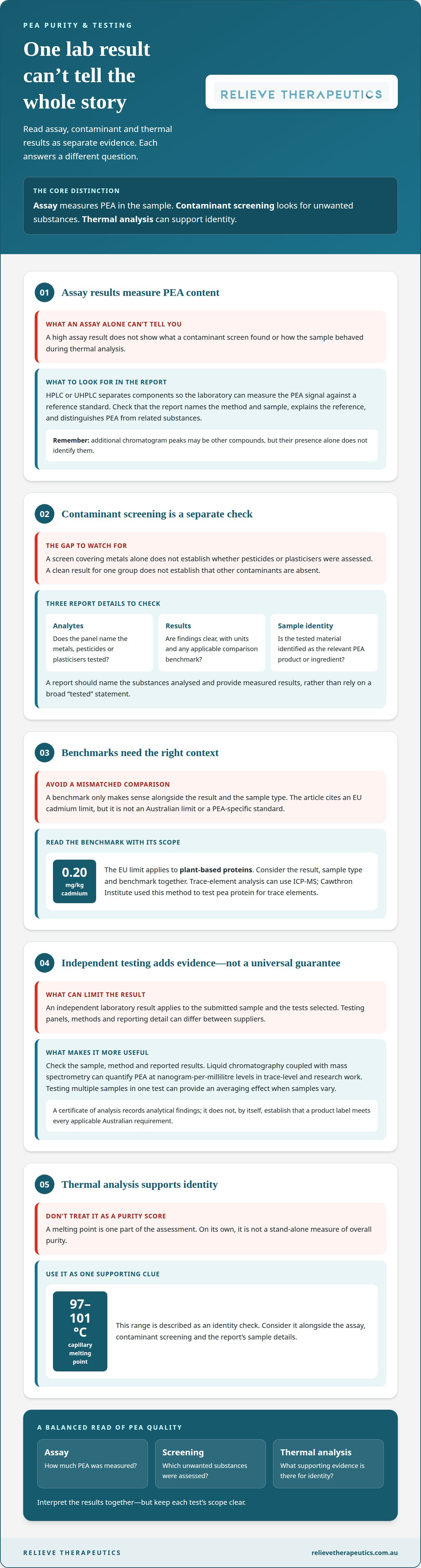
One lab result cannot tell you everything about PEA quality. A sound understanding of PEA purity and testing means separating identity and assay results from contaminant screening, because each answers a different question. A capillary melting point of roughly 97-101 °C is described as an identity check, but it’s only one part of the assessment.
It’s reasonable to want evidence that a supplement contains the ingredient stated on its label and has been assessed for unwanted contaminants. A high assay result shows how much PEA was measured in the sample. On its own, it doesn’t show what a contaminant screen found or how the sample behaved during thermal analysis.
This article explains how chemical assays identify and measure PEA, what contaminant screens can reveal, and how independent laboratory testing adds evidence. It also covers thermal analysis and how to interpret these results together for a clearer, more balanced view of purity.
Key Takeaways
- Read assay results as a measure of PEA content, then consider related substances separately to understand what the assay alone can’t show.
- Look at contaminant screening as its own part of quality assessment, covering heavy metals, pesticides and plasticisers.
- Independent laboratory results can add a separate layer of evidence; the method used should match the substance being tested.
- Use thermal analysis as supporting evidence of identity, not as a stand-alone measure of overall purity.
Heavy metals, pesticides and plasticisers
Contaminated PEA may expose someone to unwanted substances, while inaccurate labelling can mean the product contains something different from what they expect. That mismatch can affect decisions about use and make assay results harder to interpret. Screening should therefore assess contaminants separately from PEA identity and content.
Heavy metals, including cadmium, may enter ingredients through environmental contamination or processing. An EU limit of 0.20 mg/kg applies to cadmium in plant-based proteins; it is not an Australian limit or a PEA-specific standard. This distinction matters when interpreting a certificate: the result, sample type and benchmark must be considered together. Trace-element analysis can use ICP-MS, a method Cawthron Institute used to test pea protein for trace elements.
Pesticide screening looks for residues associated with agricultural production, while plasticiser testing targets compounds that may migrate from materials used in processing or packaging. A report should name the substances analysed and provide measured results, rather than rely on a broad “tested” statement. For example, a screen covering metals alone doesn’t establish whether pesticides or plasticisers were assessed.
Clean Label Project-certified products undergo extensive testing for contaminants such as heavy metals, pesticides and plasticisers. Certification can indicate a broader testing programme, but the specific report still matters. It should link the tested sample to the product and identify the analytical tests performed, helping distinguish documented results from general quality claims.
For a practical assessment, review three details in the lab report:
- Analytes: Does the panel name the metals, pesticides or plasticisers tested?
- Results: Are findings reported clearly, with units and any applicable comparison benchmark?
- Sample identity: Does the report identify the tested material as the relevant PEA product or ingredient?
These checks make contaminant results more useful. A clean result for one group of substances doesn’t establish that other contaminants are absent.
HPLC/UHPLC assay and related substances
HPLC and UHPLC assays separate components in a mixture so a laboratory can measure the PEA peak. The result describes the measured content, while related-substance analysis looks for other compounds detected in the sample.
HPLC and UHPLC Assays
High-performance liquid chromatography (HPLC) and ultra-high-performance liquid chromatography (UHPLC) separate compounds in a sample before detection. For a PEA assay, the laboratory compares the PEA signal with a reference standard to calculate the measured amount. This provides a more specific result than a general purity claim, provided the report identifies the method and sample.
Reported PEA Purity Levels
A reported purity level is an assay result for the sample tested, not a universal percentage for every PEA supplement. Results depend on the sample and analytical method, so a percentage only makes sense alongside the report’s stated basis and formula. This distinction helps prevent one result from being mistaken for a guarantee about every batch or product.
A chromatogram may show a principal PEA peak alongside additional peaks. These signals could represent related substances or other sample components, but their presence alone doesn’t identify them. A report is more informative when it states which compounds were identified, how they were measured, and whether the assay quantified them individually or together.
When reviewing assay findings, keep three details in view:
- Method: Does the report identify HPLC or UHPLC and the tested material?
- Reference: Does it explain how the PEA signal was compared with a reference standard?
- Related substances: Does it distinguish the PEA result from other detected compounds?
Together, these details help make a laboratory result easier to interpret. For context on the finished supplement format, see PEA capsule options.
Independent laboratory testing
An independent laboratory can provide evidence separate from a supplier’s own testing. The value of that evidence depends on the sample, method and reported results.
Supplier Testing and Purity Claims
Supplier claims can vary because testing panels, methods and reporting detail differ. One supplier may report a PEA assay, while another may include contaminant screens or related-substance analysis. These tests answer different questions, so a purity percentage alone can’t show which assessments were performed. Independent testing provides a separate analytical result, but it applies to the submitted sample and the tests selected.
For example, liquid chromatography coupled with mass spectrometry can quantify PEA at nanogram-per-millilitre levels in trace-level and research work. Testing multiple samples in one test can also provide an averaging effect when samples vary. The method and sample scope shape what the result can tell you.
Australian Quality Testing and Labelling Rules
For Australian products, quality testing and labelling are related but distinct. A laboratory report records analytical findings, while a product label communicates product information. Applicable requirements depend on the product’s regulatory classification and the claims made. A certificate of analysis does not, by itself, establish that a label meets every applicable Australian requirement.
Read the label and report as complementary records. Compare the stated ingredient identity with the material named in the report, then consider whether the tests support the particular quality claim. No single assay or contaminant panel answers every question about product composition, testing scope and label information.
Verifying Certificates and Batch Numbers
To verify a certificate of analysis, match its product description and batch identifier to the label, then review the test methods, results and report date. A matching batch number connects the document to a particular production batch, but doesn’t mean every batch has identical results. This check helps establish whether the document relates to the product being assessed.
Independent testing costs in Australia depend on the method, number of samples, analytes tested and reporting scope. A targeted assay and a broader panel require different laboratory work, so these factors shape the cost rather than one universal fee. Check that the requested analysis matches the question the certificate is intended to answer.
Melting point and differential scanning calorimetry
Thermal analysis examines how PEA responds to controlled heating. Capillary melting point testing and differential scanning calorimetry provide different evidence about a sample’s identity and thermal behaviour.
Melting Point Testing
Capillary melting-point testing records the temperature range where a small sample changes from solid to liquid. For PEA, a range of roughly 97-101 °C is described as an identity check. A result near that range can support identification, but it doesn’t quantify PEA content or screen for contaminants. Read it alongside chemical assay results.
A melting range is more informative than a single temperature because it shows how the sample behaves during the transition. For example, a reported range outside the stated PEA identity-check range may prompt closer examination of the sample and method. Heating conditions and sample preparation affect interpretation, so consider the result in the context of the test.
Differential Scanning Calorimetry
Differential scanning calorimetry (DSC) measures heat flow into or out of a sample as its temperature changes. Its thermal profile can show transitions, including melting behaviour, and offers a different view from a capillary test. For PEA, this can help assess the material’s thermal characteristics, but it doesn’t directly measure assay content or contaminant levels.
Interpretation depends on the recorded profile and the conditions used to produce it. A thermal event can help characterise a sample, but it doesn’t identify every compound contributing to the signal. Pairing DSC with a chemical assay provides complementary evidence: one describes thermal behaviour, while the other measures PEA using a specified analytical method.
Use thermal findings as one part of a broader quality assessment. Explore PEA capsule options as you consider which supplement format suits your needs.
Relieve Therapeutics
Relieve Therapeutics offers PEA capsules for readers considering a supplement after learning how purity results are assessed. The range includes PEA 60 Capsules, PEA 120 Capsules and PEA 180 Capsules, giving you a choice of bottle size.
Use the distinctions in this guide to interpret assay, contaminant and thermal-analysis findings as separate forms of evidence. Each can help you understand what a particular test addresses, rather than treating one result as a complete assessment of every quality question. If you’re considering PEA capsules, choose an option that suits your needs.
For questions about PEA options, contact Relieve Therapeutics.
Make an informed next move
Understanding PEA purity and testing can help you assess quality claims with greater confidence. The next step is to connect that information with your own needs: consider what evidence matters to you, how clearly the product communicates its testing, and whether its format suits your routine. A considered choice is more useful than relying on a single headline claim.
Take time to weigh the information without feeling pressured to decide immediately. If you’re still considering whether PEA is right for you, a health professional can help you discuss your circumstances and supplement use. Clear questions can make that conversation more productive and help you decide what feels appropriate.
For a conversation about your next steps, speak with Relieve Therapeutics. Take your time, stay informed and move forward with confidence.
Frequently Asked Questions
What is PEA and what does purity mean?
PEA, or palmitoylethanolamide, is a naturally occurring fatty acid amide in the endocannabinoid family. Purity describes the proportion of a tested material that is PEA, rather than other detected substances. It differs from the amount stated per capsule: one figure describes sample composition, while the other states the product’s quantity. Both matter, but neither alone describes every aspect of quality.
How is PEA purity tested in a laboratory?
A laboratory tests a prepared sample using a method suited to the question being asked. For example, an assay can measure PEA content, while a separate analysis can assess trace elements. Understanding PEA purity and testing means reading the method alongside the result: a number is meaningful only in relation to what the laboratory measured and which sample it received.
Which analytical methods are used to test PEA, such as HPLC or GC-MS?
HPLC and UHPLC separate sample components so the PEA content can be measured. Liquid chromatography coupled with mass spectrometry can also quantify PEA in trace-level work. GC-MS is another analytical technique, but its name alone doesn’t show whether it was suitable for a particular PEA assay. The report should identify the method and purpose of the test.
What contaminants and impurities should PEA testing screen for?
Relevant screens may include heavy metals such as cadmium, pesticide residues and plasticisers, alongside related substances detected during chemical analysis. The panel depends on which substances are being assessed. For instance, a trace-element result doesn’t answer whether pesticide residues were tested. Treat each reported panel as evidence about its named analytes, not every possible impurity.
What third-party testing standards apply to PEA supplements?
Third-party testing means an independent laboratory assesses a sample; it isn’t, by itself, a certification covering every quality claim. For a useful report, look for the sample identity, analytical method, tested substances and results. In Australia, laboratory findings and product labelling are separate considerations: a test report provides analytical evidence but doesn’t replace accurate product information.