

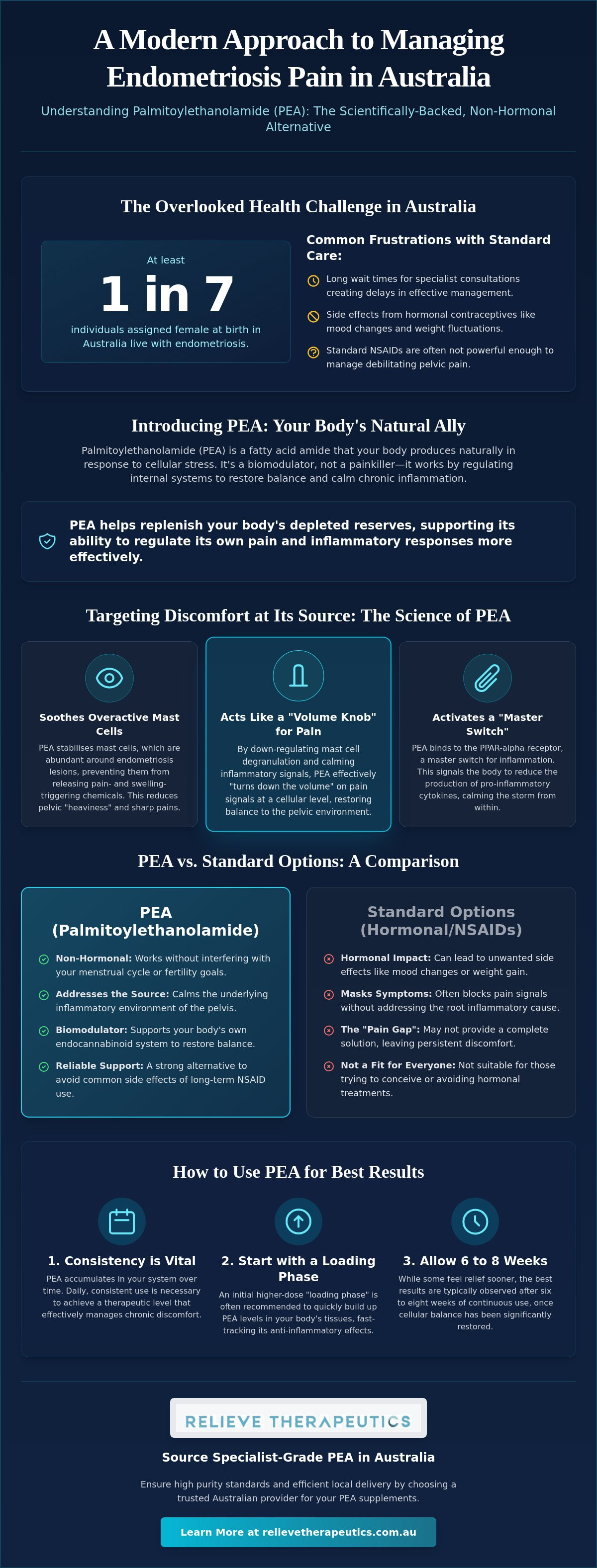
Did you know that at least 1 in 7 individuals assigned female at birth in Australia are currently living with endometriosis? This staggering statistic highlights a reality where debilitating pelvic pain and dysmenorrhoea are frequently met with long wait times for specialist consultations. If you've felt frustrated by the side effects of hormonal contraceptives or found that standard NSAIDs simply aren't enough, your experience is valid and shared by many. It's for this reason that more people are now exploring PEA for endometriosis Australia as a scientifically-backed, non-hormonal alternative for managing chronic discomfort.
We believe that effective care should be both evidence-based and accessible. In this guide, you'll discover how Palmitoylethanolamide (PEA) provides a natural approach to soothing overactive mast cells and supporting your body's endocannabinoid system. We'll break down the latest clinical research, explain how PEA helps reduce the intensity of pelvic pain, and provide clear steps for incorporating this support into your routine to help restore your quality of life during your menstrual cycles.
Key Takeaways
- Learn about Palmitoylethanolamide (PEA), a naturally occurring fatty acid amide that supports your body's biological response to chronic pelvic discomfort.
- Discover how PEA for endometriosis Australia acts as a "volume knob" for pain by down-regulating overactive mast cells at the cellular level.
- Explore why PEA is a reliable, non-hormonal alternative for those looking to avoid the common side effects associated with long-term NSAID use.
- Consistency is vital. Understand the importance of the initial loading phase and why use over six to eight weeks is necessary for the best results.
- Identify the benefits of sourcing specialist-grade PEA from a local provider to ensure high purity standards and efficient delivery across Australia.
Understanding Endometriosis Pain and the Role of PEA in Australia
Living with endometriosis in Australia often feels like a constant battle against your own biology. At least 1 in 7 individuals assigned female at birth in this country are now diagnosed with the condition, a figure that highlights the sheer scale of this health challenge. For many, the journey involves years of waiting for specialist consultations or struggling with the limitations of conventional treatments. This has sparked a growing shift in the Australian wellness landscape. More people are now looking beyond traditional scripts to find non-hormonal, natural support options that align with their body's needs. Using PEA for endometriosis Australia has emerged as a key strategy in this movement, offering a way to manage discomfort without the heavy side effects often associated with standard care.
This shift towards holistic wellness is supported by companies like Nutrahara, which focus on providing specialised women's health supplements to help manage complex conditions naturally.
It's helpful to view PEA not as a traditional "painkiller" that simply blocks signals, but as a sophisticated biomodulator. It works by regulating the body's internal systems to restore balance where chronic inflammation has taken hold. This approach validates the patient's experience by addressing the underlying cellular distress that causes debilitating pelvic pain.
What is Palmitoylethanolamide (PEA)?
To understand how this molecule supports your health, we must first look at its biological origins. What is Palmitoylethanolamide (PEA)? Essentially, it is a fatty acid amide that your body produces naturally in response to cellular stress and tissue damage. It's a lipid-like molecule found in every cell, acting as a primary defender that maintains cellular homeostasis. When inflammation becomes chronic, your natural reserves of PEA can become depleted. Integrating a PEA endocannabinoid supplement functions as a natural ally to your system. It helps "cool" the inflammatory fire from within, supporting the body's ability to regulate its own pain responses more effectively.
Why Traditional Endometriosis Management Often Falls Short
Standard medical approaches for endometriosis typically rely on hormonal contraceptives or surgical intervention. While these are vital tools, they don't always provide a complete solution. Many Australians find that hormonal treatments lead to undesirable mood changes, weight fluctuations, or concerns regarding bone density. There is also the common "pain gap" to consider. This is the persistent discomfort that remains even after surgery or while on medication. PEA for endometriosis Australia helps fill this gap by providing a supportive, non-hormonal layer of care. It doesn't interfere with your menstrual cycle or fertility goals. Instead, it offers a reliable way to soothe the inflammatory environment of the pelvis, improving your daily function and overall quality of life.
The Science: How PEA Targets Endometriosis at the Cellular Level
To understand why many choose PEA for endometriosis Australia, we must look at the microscopic environment of the pelvis. Endometriosis lesions are not static; they exist within what researchers call an "inflammatory soup." This environment is driven by overactive immune cells and dysfunctional signalling pathways that keep the body in a state of high alert. PEA addresses this by interacting with specific receptors, most notably the PPAR-alpha (Peroxisome Proliferator-Activated Receptor Alpha). This receptor acts as a master switch for inflammation. When PEA binds to it, it signals the body to reduce the production of pro-inflammatory cytokines, effectively calming the storm from the inside out. The Science of PEA for Pain and Inflammation confirms that this mechanism is central to how PEA manages chronic discomfort and tissue distress.
Soothing Overactive Mast Cells
Endometriosis lesions are often surrounded by high concentrations of mast cells, which release chemicals that trigger pain and swelling. PEA acts as a biological stabiliser for these cells to prevent the release of inflammatory chemicals. By down-regulating mast cell degranulation, it functions like a "volume knob" for your pain. This reduction in chemical release directly correlates to a decrease in the pelvic "heaviness" and sharp, stabbing sensations often felt during a flare. It's a precise way to manage the physical symptoms of the condition at their source.
The Endocannabinoid Connection
Chronic pelvic pain sufferers often experience what experts call "endocannabinoid deficiency." PEA supports the system through the "entourage effect," where it prevents the breakdown of anandamide, the body’s natural "bliss molecule." By keeping anandamide levels higher for longer, PEA enhances the body's own ability to soothe pain. You can read more about how does PEA work for pain to understand these biological pathways in greater detail. This synergistic relationship is why many Australians find PEA more effective over time as their internal balance is restored.
This cellular approach is why PEA offers a different experience compared to traditional blockers. It works with your biology, not against it, providing a steady foundation for long-term comfort. If you are ready to explore this support, you might consider starting with a high-purity PEA supplement tailored for Australian standards. By addressing the "inflammatory soup" at a cellular level, you can begin to regain control over your daily comfort and vitality.
PEA vs. Standard Options: A Comparison for Australian Patients
When you're managing chronic pelvic pain, the immediate instinct is often to reach for a fast-acting analgesic. In Australia, the standard of care typically involves non-steroidal anti-inflammatory drugs (NSAIDs) like ibuprofen or naproxen. While these provide an "instant hit" of relief, they often act as a temporary bandage rather than a long-term solution. PEA for endometriosis Australia offers a different trajectory. It's a "slow-build" approach that focuses on cumulative restoration. Unlike prescription medications that override your body's systems, PEA is a dietary supplement that supports your existing biological pathways. It doesn't offer the ten-minute relief of a pill, but it aims for a steady reduction in baseline pain over several weeks.
It's also important to recognise the regulatory context. In Australia, the Therapeutic Goods Administration (TGA) classifies PEA as a listed medicine or dietary supplement. This means it's accessible over-the-counter and online without the need for a prescription, providing a reliable alternative for those currently navigating long wait times for specialist pain clinics.
Safety and Side Effect Profile
A primary concern for many Australian patients is the gastric toll of long-term NSAID use. Heavy reliance on traditional anti-inflammatories frequently leads to stomach upset, acid reflux, or even more serious digestive issues. PEA stands out due to its remarkable safety profile; it's a fatty acid amide your body already recognises, which significantly reduces the risk of adverse reactions. There's a notable absence of gastric distress, making it a sustainable choice for daily management. While PEA has no known drug-drug interactions, we always recommend consulting your GP before starting a new regimen. For those looking to move away from habit-forming options, our non-opioid pain relief supplement guide provides broader context on these natural alternatives.
The Advantage of Non-Hormonal Support
Many individuals choose to avoid hormonal contraceptives or IUDs due to side effects like mood changes or weight gain. Others are actively trying to conceive and cannot use standard hormonal treatments to manage their symptoms. PEA for endometriosis Australia is entirely non-hormonal, meaning it won't interfere with your cycle or your fertility goals. It's particularly effective for managing "flares" that occur between surgical interventions or as a supportive adjunct to existing care. A Clinical Study on PEA for Endometriosis Pain demonstrated that patients using PEA saw significant improvements in their quality of life. By supporting your body's natural chemistry rather than overriding it, you can achieve a more balanced and dignified approach to pain management.
How to Use PEA for Endometriosis: Dosage and Best Practices
Achieving consistent results with PEA for endometriosis Australia requires a shift in mindset from acute relief to chronic support. Many patients make the mistake of stopping the supplement too early, often because they expect an immediate change similar to a standard analgesic. However, for a condition as complex as endometriosis, your body needs time to replenish its natural fatty acid reserves. This is why a loading phase is critical. By maintaining a higher intake during the first few weeks, you allow the molecule to build up in your tissues. This process eventually reaches a steady state where it can effectively down-regulate overactive mast cells and soothe the inflammatory environment of the pelvis.
Consistency over a six to eight-week period is the benchmark for success. During this window, the biological "volume knob" for pain begins to turn down, leading to a noticeable reduction in the intensity of monthly flares. While the TGA recommends consulting a healthcare provider if using PEA for more than 21 consecutive days, many clinical protocols for endometriosis involve longer-term support to maintain cellular balance. Your journey is a marathon, and the cumulative effects of PEA are what lead to lasting improvements in your quality of life.
Finding Your Optimal Intake
Clinical observations in Australia suggest that a common starting point for those with chronic pelvic discomfort is 1200mg daily, typically split into two 600mg doses. This level provides sufficient saturation to address deep-seated inflammation. As your symptoms begin to stabilise, some individuals find they can transition to a lower maintenance dose. For a detailed breakdown on how to adjust your intake based on your specific needs, we encourage you to explore our PEA dosage for pain guide. Individual results will vary; factors such as the severity of your condition and your overall metabolic health will influence your personal timeline.
Maximising Bioavailability
PEA is a lipophilic, or fat-loving, molecule. This means its absorption in the gut is significantly enhanced when taken alongside dietary fats. To get the most out of your supplement, try taking your capsules with a meal containing healthy fats like avocado, eggs, or a drizzle of olive oil. Additionally, the physical structure of the supplement matters. Standard PEA can be difficult for the body to process due to its large particle size. Choosing high quality PEA capsules that utilise micronised or ultra-micronised powder ensures the particles are small enough to pass through the intestinal wall efficiently.
High-purity formulations are essential for consistent results. If you are looking to start a structured programme, you can order specialist-grade PEA capsules directly from our Australian store to ensure you receive a product that meets rigorous quality standards.
Sourcing Quality PEA in Australia: The Relieve Therapeutics Difference
Finding a reliable source for PEA for endometriosis Australia is just as important as understanding the science behind the molecule. When you're managing a chronic condition, the quality of your supplements shouldn't be a variable. Relieve Therapeutics was established to bridge this gap, providing Australians with a specialised source of pure Palmitoylethanolamide. We focus on transparency, reliability, and clinical-grade purity. Our formulations are free from unnecessary fillers and additives, ensuring your body receives only what it needs to support its natural inflammatory response. By prioritising substance over marketing hype, we act as a disciplined partner in your long-term health journey.
We provide three distinct quantity options to suit your specific management stage: PEA 60 Capsules, PEA 120 Capsules, and PEA 180 Capsules. This structured approach allows you to select the volume that best aligns with your current clinical needs. Whether you are navigating a high-intake loading phase or transitioning into a steady maintenance period, having a consistent supply is vital for maintaining cellular balance. Our commitment to quality ensures that every capsule meets rigorous Australian standards, providing you with the peace of mind required for chronic care.
Why Local Australian Supply Matters
Choosing a local provider offers distinct advantages for your management routine. You avoid the uncertainty of international shipping delays, which can be particularly disruptive when you're trying to maintain the 6–8 week consistency required for results. Our Australian-based team provides empathetic, knowledgeable support, ensuring you have a partner who understands the local health landscape. For those committed to long-term PEA for endometriosis Australia support, our PEA 180 Capsules bulk option serves as a cost-effective and practical choice. It reduces the frequency of reordering and ensures you never miss a day of your biological support programme.
Starting Your Journey with Confidence
If you're new to this natural approach, our PEA 60 capsules serve as the ideal starter pack for your first month. This allows you to observe how your body responds during the initial phase of supplementation. Taking this step represents a proactive commitment to your wellbeing. It's an opportunity to move away from reactive, short-term fixes and towards a structured, evidence-based strategy. You deserve a support option that is as resilient and focused as you are. View our range of high-quality PEA capsules and start your support journey today.
Taking Control of Your Pelvic Health Journey
Managing endometriosis requires a strategy that addresses the condition at its cellular source. By regulating overactive mast cells and supporting your body's endocannabinoid system, you can move beyond temporary symptom masking. Integrating PEA for endometriosis Australia into your daily routine provides a reliable, non-hormonal path toward sustained comfort. This approach respects your body's natural chemistry while offering a scientifically validated method to reduce the intensity of chronic pelvic discomfort without the side effects of traditional blockers.
We're committed to providing you with the high-purity tools needed for this restorative journey. Our specialist focus ensures you receive pure Palmitoylethanolamide without hidden fillers; we also provide fast shipping across Australia to prevent any gaps in your management plan. Consistency is your greatest ally as you work toward a more balanced and vital life. Browse our clinical-grade PEA capsules for natural endometriosis support and take a definitive step toward better quality of life. You don't have to navigate this journey alone; we're here to provide the reliable support you deserve.
Frequently Asked Questions
Is PEA safe to take with my current endometriosis medications?
Yes, PEA is generally considered safe to use alongside most standard endometriosis treatments, including hormonal contraceptives and analgesics. Because it is a molecule your body already produces, it typically does not interfere with the mechanism of other pharmaceutical drugs. However, we always recommend discussing any new supplement with your GP or specialist to ensure your management plan is fully coordinated and safe for your specific needs.
How long does it take for PEA to start working for pelvic pain?
Most individuals begin to notice a subtle shift in their baseline discomfort within two to four weeks of consistent use. While some experience relief sooner, the cumulative nature of the molecule means the most significant benefits are typically felt after six to eight weeks. This timeline allows your cellular reserves to replenish and provides sufficient time for the regulation of overactive mast cells in the pelvic region.
Can I take PEA if I am trying to fall pregnant?
Yes, PEA is a non-hormonal support option that does not interfere with ovulation or the menstrual cycle. This makes it a preferred choice for many Australians who are trying to conceive but still require a reliable way to manage chronic pelvic pain. It works by supporting your body's natural chemistry rather than overriding it, providing a dignified approach to pain management during your fertility journey.
Does PEA have any side effects like weight gain or mood swings?
No, PEA is not associated with the weight fluctuations or mood changes often linked to hormonal endometriosis treatments. Because it is a lipid-like molecule found naturally in your cells, it is remarkably well-tolerated by the system. Most users find it provides a "clean" support experience without the cognitive fog or digestive upset common with heavy anti-inflammatory medications.
What is the difference between micronised and standard PEA for endo?
Micronised PEA has been processed into much smaller particles, which significantly enhances its ability to be absorbed by the gut. Standard PEA often features larger particles that the body struggles to process efficiently, meaning much of the supplement may pass through your system unused. For chronic conditions like endometriosis, choosing a micronised formulation is essential for ensuring the molecule reaches the tissues where it is needed most.
Do I need a prescription from my GP to buy PEA in Australia?
No, you do not require a prescription to purchase PEA for endometriosis Australia. The Therapeutic Goods Administration (TGA) classifies PEA as a listed medicine or dietary supplement, making it accessible over-the-counter and through specialised online providers. This accessibility is particularly helpful for those currently navigating the long wait times often associated with Australian public health pain clinics.
Can PEA help with the bloating (endo-belly) associated with endometriosis?
PEA may assist in reducing the severity of "endo-belly" by soothing the underlying inflammatory environment of the abdomen. Bloating in endometriosis is often triggered by the release of inflammatory chemicals from overactive mast cells near the lesions. By stabilising these cells and "cooling" the local inflammation, PEA can help settle the abdominal area and improve daily comfort during your cycle.
Is PEA a vegan-friendly supplement for endometriosis sufferers?
Yes, our PEA capsules are formulated to be entirely vegan-friendly and free from animal-derived ingredients. We utilise high-purity Palmitoylethanolamide housed in vegetable-based capsules to ensure our products are accessible to everyone, regardless of dietary preferences. This commitment to clean, ethical sourcing ensures you can focus on your recovery with complete peace of mind regarding the origins of your supplement.