

A private health insurance rebate isn’t a payment towards PEA. In Australia, whether PEA is covered by private health insurance depends on the benefits included in a policy, but the Government rebate applies to eligible hospital, extras and ambulance policies. It reduces the premium or is claimed as a refundable tax offset, rather than reimbursing a PEA purchase.
It’s understandable to consider Medicare and private cover when weighing health-related costs. The key distinction is between cover for eligible healthcare and reimbursement for an individual supplement purchase. Having insurance doesn’t automatically mean every health-related product is covered.
This guide explains which policy types may qualify for the rebate, how Medicare and the Pharmaceutical Benefits Scheme fit into the picture, and what those rules mean when considering PEA. You’ll get a clearer view of what insurance can contribute and what it doesn’t cover.
Key Takeaways
- Hospital, extras and ambulance policies may qualify for the Australian Government rebate; overseas cover does not.
- Income tier and age affect the rebate rate, so assess eligibility against the relevant income year and circumstances.
- Hospital cover tiers help describe the level of hospital insurance, but the policy’s benefits determine what it covers.
- Understand how Medicare, the PBS and private insurance each apply before weighing healthcare costs alongside a PEA supplement purchase.
Eligible policy types
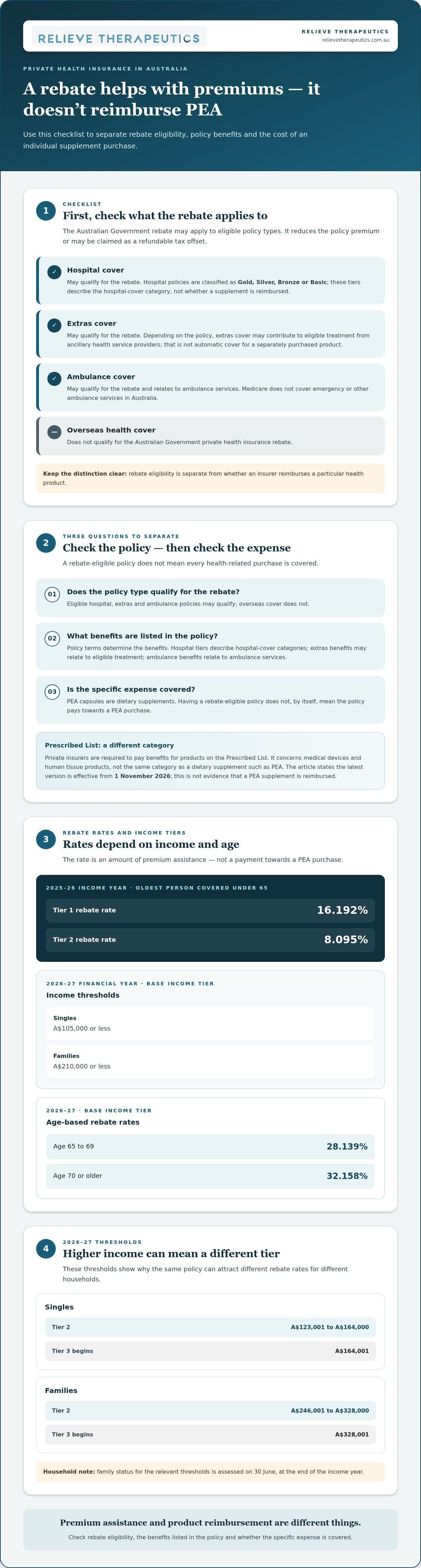
In Australia, the private health insurance rebate may apply to eligible hospital, extras and ambulance policies, but not overseas health cover. The rebate reduces an eligible policy’s premium or may be claimed as a refundable tax offset. Rebate eligibility is separate from whether an insurer reimburses a particular health product.
So, is PEA covered by private health insurance? Having a policy that qualifies for the rebate doesn’t, by itself, mean it pays towards a PEA supplement. PEA capsules are dietary supplements, while hospital and extras cover relates to the benefits listed in a policy. The policy’s benefits matter, and the rebate is not a general refund for health-related purchases.
Hospital cover is classified under Australia’s four tiers: Gold, Silver, Bronze and Basic. The tiers began rolling out on 1 April 2019, and became mandatory classifications for hospital insurance policies from 1 April 2020. They indicate the policy’s hospital-cover category, not whether it reimburses a supplement. For example, having a Gold hospital policy doesn’t establish that a PEA purchase is claimable.
Hospital cover concerns treatment as a hospital patient. In Australia, a facility must be declared a hospital by the Minister for Health and Ageing under section 121-5(6) of the Private Health Insurance Act 2007. That legal definition matters when considering hospital benefits. It doesn’t turn a supplement bought for personal use into a hospital treatment or guarantee cover for its purchase.
Extras cover, also called general treatment cover, may reimburse some or all of the cost of treatment from ancillary health service providers, depending on the policy. This is cover for treatment, not automatic cover for products used alongside care. For example, an extras benefit for an eligible treatment doesn’t mean a separately purchased supplement is reimbursed. The distinction is between a covered service and a product purchase.
Ambulance cover is another policy type to distinguish. Medicare doesn’t cover emergency or other ambulance services in Australia, so private ambulance cover may help with those costs. That gap in Medicare cover doesn’t make ambulance insurance a way to claim for PEA. Each policy type addresses different costs, and ambulance benefits relate to ambulance services.
- Hospital: covers eligible hospital-related benefits under the policy’s terms and tier.
- Extras: may contribute to eligible ancillary-provider treatment, depending on the policy.
- Ambulance: relates to ambulance services, which Medicare doesn’t cover.
The Prescribed List is a separate consideration. Australia’s private health insurers are required to pay benefits for products listed on it. The list concerns medical devices and human tissue products, not the same category as a dietary supplement such as PEA. The latest version is effective from 1 November 2026. Its rules shouldn’t be treated as evidence that a PEA supplement is reimbursed.
When comparing policies, separate three questions: does the policy type qualify for the rebate, what treatment benefits does it include, and does it cover the specific expense? You may have a rebate-eligible policy without every health-related purchase being covered. Medicare, private insurance and the rebate each have distinct roles; identifying the right category helps avoid confusing premium assistance with reimbursement for PEA.
Hospital cover provides eligible hospital-related benefits and treatments under the policy’s terms; ambulance cover concerns ambulance services. These distinctions matter when comparing a policy’s rebate status with what it pays for.
The rebate rate can vary depending on income and the age of the oldest person covered by the policy. For the 2025-26 income year, Australia’s Tier 1 private health insurance rebate rate is 16.192% when the oldest person covered by the policy is under 65 years old. For the 2025-26 income year, Australia’s Tier 2 private health insurance rebate rate is 8.095% when the oldest person covered by the policy is under 65 years old. These rebate rates describe the rebate, not a promise that a policy will pay a claim for a supplement. Eligible people on subclass 482 working visas and their accompanying family members must maintain adequate health insurance arrangements while they are in Australia. That requirement concerns maintaining insurance arrangements; it does not establish that every product is an insured benefit. A PEA claim still depends on the policy’s terms and listed benefits.
Insurance rebate
Australia’s private health insurance rebate is income-tested. Your income tier and the age of the oldest person covered help determine the applicable rate. The rebate reduces the premium or may be claimed as a refundable tax offset. It applies to eligible hospital, extras and ambulance policies, but not overseas cover.
For the 2026-27 financial year, the base-tier income threshold is A$105,000 or less for singles and A$210,000 or less for families. The Australian Taxation Office sets the rebate rates by income tier and the age of the oldest person covered. In the base income tier, people aged 65 to 69 receive a 28.139% rebate, according to the Australian Taxation Office. People aged 70 or older in that tier receive 32.158%, according to the Australian Taxation Office.
Those percentages describe a rebate rate, not a payment towards any health purchase. For example, an eligible policyholder may receive the rebate as a reduction in premiums or claim it as a refundable tax offset. Neither method directly reimburses a PEA supplement purchase.
Higher income can place a policyholder in a different tier, reducing or removing the rebate. For 2026-27, the Tier 2 threshold for singles is A$123,001 to A$164,000. Tier 3 begins at A$164,001 for singles. For families, Tier 2 runs from A$246,001 to A$328,000, while Tier 3 begins at A$328,001. These thresholds explain why the same policy can attract different rebate rates for different households.
Family status affects which thresholds apply. The relevant status is assessed on 30 June, at the end of the income year. A single person with dependent children on that date is tested against family thresholds. For families, the income thresholds increase by A$1,500 for each child after the first, effective from 1 July 2026. A couple’s circumstances can therefore affect the tier used to assess their policy.
Age is another factor, alongside income. The oldest person covered determines which age-related rate applies to the policy. For example, a household with one member aged 70 or older uses the applicable older-age rate, rather than the under-65 rate. The rate still depends on the household’s income tier. Check the relevant financial year, since thresholds and rates can change over time.
To understand a rebate estimate, separate the three inputs:
- Policy type: hospital, extras and ambulance cover can qualify; overseas cover doesn’t.
- Income: singles and families use different thresholds, with tiers affecting the rate.
- Age: the oldest person covered determines the age band for the rate.
These criteria clarify what the rebate changes: the effective cost of eligible insurance premiums. They don’t establish whether a particular supplement purchase is reimbursed. Medicare and the rebate are also separate systems. Medicare concerns eligible healthcare, while the rebate relates to qualifying private insurance premiums.
If you’re weighing insurance costs separately from a supplement purchase, explore PEA capsule options as a distinct consideration. Keeping those decisions separate makes it easier to see what the rebate contributes and what it doesn’t.
For the 2025-26 income year, the base-tier single income threshold is $101,000 or less, while the base-tier family income threshold is $202,000 or less. The single Tier 1 threshold is $101,001 - $118,000, and the single Tier 2 threshold is $118,001 - $158,000. These figures provide a separate year’s reference point when checking which income tier may apply; they should not be substituted for the 2026-27 thresholds described above. In Australia, the private health insurance rebate is income tested, so people whose income is above the relevant threshold may not be eligible for a rebate.
The rebate rate also depends on the oldest person covered. For the 2025-26 income year, the base-tier rebate rate is 24.288% when the oldest person covered by the policy is under 65 years old. Consider the income year, household category, income tier and age together when interpreting an estimate. A threshold tells you where income sits for the relevant tier, while the rate describes the applicable rebate percentage; neither figure, by itself, gives the amount of any premium reduction. Checking the correct income year is important when comparing the thresholds and rates, because the figures for one year may differ from those for another.
Relieve Therapeutics: PEA 60 Capsules
Relieve Therapeutics offers PEA 60 Capsules for people considering PEA as a dietary supplement, rather than as an insurance benefit. The range also includes PEA 120 Capsules and PEA 180 Capsules, giving you different capsule-count options to consider. These products are separate from hospital, extras and ambulance cover, and the Australian Government rebate does not itself reimburse a supplement purchase. If you’re weighing PEA alongside your existing healthcare arrangements, keep the insurance decision distinct from choosing a supplement. For information about the available PEA capsule options, visit relievetherapeutics.com.au.
Make your next decision with clarity
Understanding whether PEA is covered by private health insurance helps keep two decisions distinct: what your policy contributes towards and whether a supplement suits your circumstances. That separation makes it easier to consider your insurance without assuming it determines your approach to PEA. If you’re considering PEA, Relieve Therapeutics offers PEA capsules in three pack sizes. Review the product information and consult a healthcare professional if you have questions about whether it suits you.
Relieve Therapeutics offers PEA capsules for people exploring this supplement. Visit Relieve Therapeutics to learn more about the available options. A considered decision starts with clear information, and you can take the next step at your own pace.
Frequently Asked Questions
What policies are eligible for the rebate?
Hospital, extras and ambulance policies may qualify for Australia’s private health insurance rebate; overseas cover doesn’t. The rebate applies to eligible insurance premiums, not to a specific treatment or supplement you buy. For example, an eligible extras policy may qualify for the rebate, but that doesn’t mean you can claim a separate PEA purchase through it.