

The safest alternative to an NSAID may not be another tablet. If you’re searching for pain relief when you can't take NSAIDs, it’s understandable to want something that helps when pain is disrupting sleep, movement or everyday tasks. But the right option depends on why NSAIDs aren’t suitable, what’s causing the pain and your other health needs.
There are other approaches to discuss, including paracetamol, topical products, physical strategies and complementary medicines such as palmitoylethanolamide (PEA). Each has limits, and none is automatically suitable for everyone. Even over-the-counter medicines can carry risks, so check active ingredients and discuss your health conditions and other medicines with a GP or pharmacist.
This guide compares non-NSAID options to consider in Australia, what they may and may not offer, and practical questions to take to a health professional. It also explains how PEA capsules fit into the conversation as a supplement option, not a replacement for prescribed care. The aim is to help you prepare for a safer plan tailored to your circumstances.
Key Takeaways
- Needing pain relief when you can't take NSAIDs doesn’t mean you’re out of options.
- Compare medicines, topical approaches, physical strategies and supplements, and remember paracetamol may not suit everyone.
- Consider PEA as a dietary supplement while keeping its evidence and limitations in perspective.
- Prepare for a more useful conversation with a GP or pharmacist by noting your medicines, supplements, allergies and relevant health history.
- PEA capsules are available in 60, 120 and 180-count supplies. Consider them as part of a discussion about your options, not as a substitute for prescribed care.
Why might you need pain relief without NSAIDs?
Avoiding non-steroidal anti-inflammatory drugs (NSAIDs) doesn’t mean you have to manage pain without support. It means understanding why an NSAID may not be suitable and considering alternatives in light of your health, medicines and the cause of your pain. A medicine that works for one person may carry different risks for another.
In brief: NSAIDs are medicines that help relieve pain and inflammation. Non-NSAID approaches don’t contain an NSAID and may include paracetamol, physical strategies or some supplements.
What medicines count as NSAIDs?
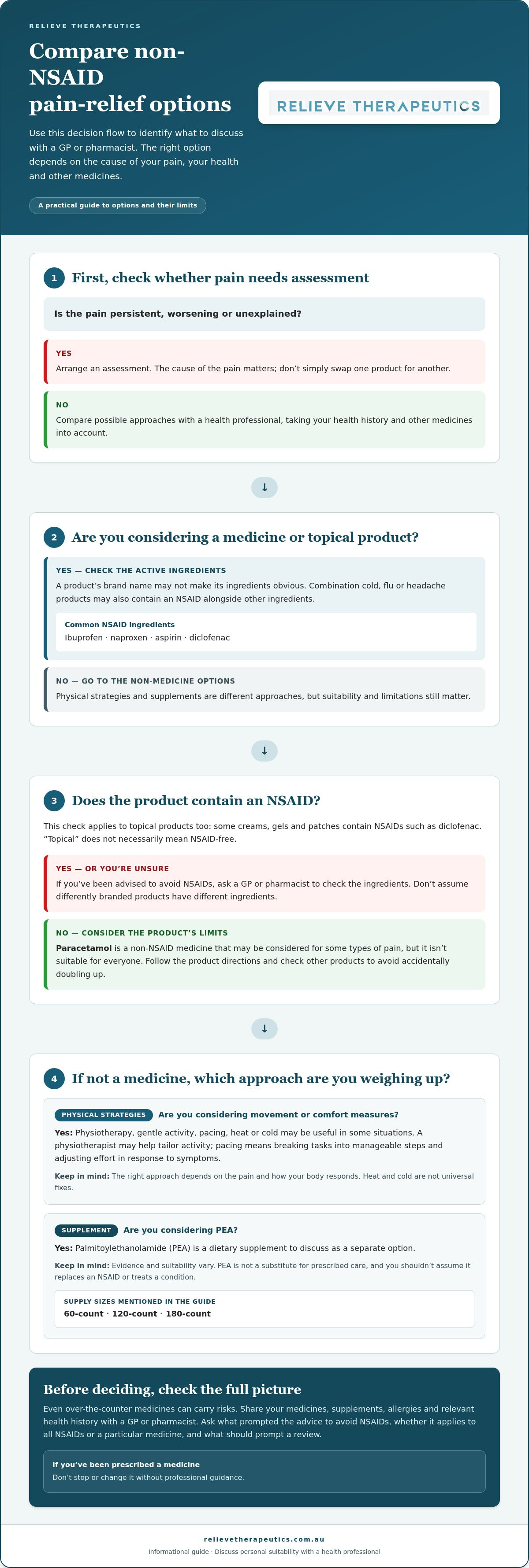
Common NSAID active ingredients include ibuprofen, naproxen, aspirin and diclofenac. They’re sold under different brand names, so the name on the front of a packet may not make the active ingredient obvious. Some combination products, including certain cold and flu or headache medicines, may also contain an NSAIDs alongside other ingredients.
Check the active ingredients on the pack or ask a pharmacist to help identify them if you’re unsure. This is especially useful when comparing products or if you already take medicine for another condition. Don’t assume differently branded products have different ingredients.
Why might a clinician recommend avoiding them?
NSAIDs can cause unwanted effects, and the balance of benefit and risk varies from person to person. Possible concerns include stomach irritation, ulcers or bleeding, effects on kidney function, and cardiovascular risks. Some people can also have an allergic reaction or asthma symptoms associated with these medicines. These possibilities don’t mean everyone will experience harm, but they can affect a clinician’s recommendation.
Risk can depend on the particular NSAID, the dose and how long it’s used, as well as your medical history. Existing stomach, kidney or heart problems, a previous reaction to an NSAID, and other medicines may all be relevant. Some medicines can interact with NSAIDs, so tell your GP or pharmacist what you take, including non-prescription products and supplements.
A recommendation to avoid NSAIDs may be temporary or part of a longer-term plan. If you’ve been prescribed an NSAID or another medicine, don’t stop or change it without professional guidance. Ask what prompted the advice, whether it applies to all NSAIDs or a particular medicine, and what symptoms or changes should prompt a review. This helps clarify the restriction rather than leaving you to guess.
For background on palmitoylethanolamide, often shortened to PEA, see this overview of Palmitoylethanolamide (PEA). PEA is a dietary supplement, not an NSAID. Whether it’s worth discussing depends on your circumstances. The cause of your pain matters too, so persistent, worsening or unexplained pain deserves assessment rather than simply swapping one product for another.
Which non-NSAID pain relief options can you compare?
There isn’t a universal substitute for an NSAID. The right option depends on what’s causing your pain, your health history and other medicines you take. Compare possible approaches with a GP or pharmacist, including what each may help with and its limits.
| Approach | What to consider | Important limitation |
|---|---|---|
| Paracetamol | A non-NSAID medicine that may be considered for some types of pain. | It isn’t suitable for everyone. Check directions and ingredients, especially if using other products. |
| Topical products | Creams, gels or patches may be applied to a particular area. | Some contain an NSAID. “Topical” doesn’t mean NSAID-free. |
| Physical strategies | Physiotherapy, gentle activity, pacing, heat or cold may be useful in some situations. | The right approach depends on the pain and how your body responds. |
| Supplements | Dietary supplements, including PEA, can be discussed as a separate option. | Evidence and suitability vary; supplements aren’t a substitute for prescribed care. |
Medicines and topical options to discuss
Paracetamol isn’t an NSAID, but that doesn’t make it appropriate for every person or type of pain. Follow the product directions and check with a health professional if you have health concerns or take other medicines. Combination products may contain paracetamol or an NSAID alongside other ingredients, so check the active ingredients to avoid accidentally doubling up. Healthdirect’s guide to pain relief medicines in Australia provides further information.
Some topical gels and creams contain NSAIDs such as diclofenac. If you’ve been advised to avoid NSAIDs, ask a pharmacist or GP to check the ingredients before using a topical product. Depending on the cause and severity of your pain, a clinician may also assess whether a prescription alternative is appropriate.
Non-medicine approaches and supplements
Movement doesn’t need to mean pushing through pain. A physiotherapist may help tailor gentle activity. Pacing means breaking tasks into manageable steps and adjusting your effort in response to symptoms. Heat or cold may provide comfort for some people, but neither is a universal fix. Follow professional advice if you’re unsure what’s appropriate for your situation.
Supplements are distinct from medicines, and evidence and suitability can differ between products and individuals. PEA is one dietary supplement to discuss with a health professional. Don’t assume it replaces an NSAID or treats a condition. For a broader overview, see this guide to non-opioid pain relief supplements. You can also explore PEA capsules as one option to consider.
Could PEA be one option when NSAIDs are unsuitable?
Palmitoylethanolamide (PEA) is a fatty acid amide that occurs naturally in the body and is also available as a dietary supplement. It isn’t an NSAID or a prescription medicine. If you’re considering pain relief when you can't take NSAIDs, PEA may be a topic to discuss with a GP or pharmacist. Don’t assume it will have the same effects as an NSAID or replace recommended care.
What to understand about PEA evidence
Research has examined PEA, including human studies, but the evidence is still developing. Findings from individual studies don’t establish that a supplement will be effective for a particular person, type of pain or health condition. Evidence for a supplement also isn’t the same as established treatment guidance. Be wary of claims promising a particular level or speed of relief. A guide to how PEA works for pain can provide background on the proposed science, but it doesn’t replace clinical advice.
This distinction matters if NSAIDs have been ruled out for a specific medical reason. PEA isn’t a proven one-for-one substitute, and a supplement shouldn’t delay assessment of new, persistent or worsening pain. Its place, if any, depends on the broader plan for managing the underlying cause and supporting everyday function.
Questions to consider before trying a supplement
Before adding PEA or another supplement, discuss it with a GP or pharmacist, particularly if you take regular medicines, have a health condition, are pregnant or breastfeeding, or have had a reaction to a supplement before. Share the product label and ask whether it’s appropriate for your circumstances. Don’t stop prescribed treatment or combine several products without reviewing them with a health professional.
Check the full ingredient list and directions on the label. This helps identify other active ingredients and avoid unintentionally doubling up across products. “Natural” doesn’t mean suitable for everyone, and a supplement may not be right for you even if it’s available without a prescription.
In Australia, complementary medicines are subject to regulation, but that alone doesn’t mean a product is right for an individual or established as a treatment for their pain. Consider transparent labelling and other quality factors as part of your discussion. The Australian PEA supplement quality guide covers considerations for assessing PEA capsules.
Use the conversation to agree on what you’re considering, how it fits alongside your existing care and what to do if your symptoms change. This keeps PEA in perspective: a dietary supplement to assess carefully, not a guaranteed solution or a replacement for professional guidance.
How can you make a safer pain-relief plan?
A clear plan starts with the pain and the reason NSAIDs aren’t suitable, not with choosing a substitute at random. A safe plan matches the option to the reason NSAIDs are unsuitable, the cause of pain and your health circumstances. A GP or pharmacist can help you weigh these factors and decide what to try, avoid or review.
Use this sequence to prepare:
- Describe the pain. Note where it is, when it began, how it feels and whether it’s changing. Mention what makes it better or worse and how it affects sleep, movement or daily tasks.
- Clarify the NSAID restriction. Explain whether you’ve had a reaction, been advised to avoid a particular medicine, or have a health condition that affects its suitability. Ask whether the advice applies to all NSAIDs or only certain products.
- Review possible options together. Discuss medicines, topical products and non-medicine approaches in light of the cause of pain and your health history. Ask what to avoid, how to use any recommended option safely and when to arrange a review.
Prepare for a GP or pharmacist conversation
Bring a current list of prescription medicines, over-the-counter products and supplements. Include the doses shown on their labels, and note any allergies, previous medicine reactions and relevant health conditions. If it’s easier, take the packets or clear photos of their ingredient lists.
Useful questions include: “Which options fit the reason I need to avoid NSAIDs?” and “Could any of my medicines or supplements interact with them?” Be specific about your concerns, such as pain disrupting sleep or making it difficult to walk, work or manage usual activities.
Track what changes and when to seek help
A brief record can make follow-up more useful. Note pain intensity in your own words, what you could or couldn’t do, what you tried and any unwanted effects. Track changes in function as well as pain, such as whether you can return to a usual activity more comfortably. Share the pattern with your clinician rather than changing prescribed treatment on your own.
Arrange professional advice for pain that is worsening, persistent or unexplained. Don’t delay prescribed care while trying a supplement. Seek urgent help for sudden, severe or concerning symptoms, particularly chest pain, difficulty breathing, sudden weakness or a serious injury. If someone appears to need immediate emergency assistance in Australia, call Triple Zero (000).
If PEA is one of the options you’re discussing, you can explore PEA capsule options as part of that informed conversation. It’s a supplement, not a replacement for an assessment or prescribed care.
Where can PEA capsules fit into your next steps?
After discussing why NSAIDs aren’t suitable and reviewing possible approaches with a health professional, you may want to consider whether a supplement belongs in your plan. PEA is one option to ask about, not a default choice or a proven substitute for NSAIDs. Its suitability depends on your circumstances, and it shouldn’t take the place of assessment or prescribed care.
Consider the product format without assuming a treatment outcome
Relieve Therapeutics sells PEA capsules in 60, 120 and 180-count supplies. The difference is capsule quantity only. A larger bottle doesn’t mean greater effectiveness, a more appropriate option or a recommended treatment duration.
Before choosing a supplement, read the product information and label carefully. Check the ingredients and directions, and raise any questions with your GP or pharmacist, especially if you take regular medicines or have a health condition. Follow the label and professional advice. Don’t change the amount you take or your prescribed care based on bottle size.
It may help to take the product details to your appointment or show them to your pharmacist. This lets them consider the specific product alongside your current medicines and health history. If you’re unsure what a label means, ask before starting rather than making assumptions.
Explore PEA as part of an informed conversation
For people considering pain relief when you can't take NSAIDs, a supplement can be one part of a broader discussion, but it isn’t a replacement for an individual pain-management plan. Ask whether PEA is appropriate for you, how it fits with other options you’re considering, and what to do if your pain persists or changes. You don’t need to decide before having that conversation.
If you’ve discussed suitability with a health professional and want to review the capsule options, explore Relieve Therapeutics’ PEA capsules. Review the product information without delaying medical advice or altering treatment. Personalised guidance comes first, and your pain-relief approach should reflect your needs, health circumstances and the cause of your pain.
Make your next step a considered one
Choosing pain relief when you can't take NSAIDs doesn’t mean settling on the first alternative you find. Take the reason NSAIDs aren’t suitable to your next conversation with a GP or pharmacist, and use their advice to decide what fits your health needs and daily life. If you’re considering a supplement, treat it as a question to explore, not a substitute for diagnosis or prescribed care.
Once you’ve discussed whether PEA is appropriate for you, review the product information at your own pace. Explore Relieve Therapeutics’ PEA capsules as one possible part of that informed consideration.
A safe plan can evolve as your symptoms and needs change. Keep communicating with your health professional, note what affects your comfort and function, and seek further advice if the situation changes. With the right guidance, you can take a steady, informed next step towards managing pain more safely.
Frequently Asked Questions
Is paracetamol an NSAID?
No. Paracetamol is a different type of pain-relief medicine and doesn’t have the same anti-inflammatory action as NSAIDs. It may be considered for some types of pain, but check the label and avoid doubling up: some cold and flu products also contain paracetamol. If you have liver problems, take regular medicines or aren’t sure about the directions, ask a pharmacist or GP before using it.
Can I use a topical anti-inflammatory cream if I cannot take NSAIDs?
Not without checking what it contains and why you’ve been told to avoid NSAIDs. Some anti-inflammatory gels and creams contain an NSAID, such as diclofenac, even though they’re applied to the skin. If the restriction is due to an allergy or a previous reaction, get advice before applying one. A pharmacist can check the active ingredients and help identify whether a product is suitable for your situation.
What happens if I accidentally take an NSAID when I have been told to avoid it?
One accidental dose doesn’t automatically mean you’ll be harmed, but the risk depends on the medicine, amount and reason you were told to avoid it. Don’t take another dose. In Australia, call the Poisons Information Centre on 13 11 26 for advice, and have the packaging and details of when and how much you took ready. Don’t induce vomiting. Call Triple Zero (000) for severe symptoms or an emergency.
Can I take paracetamol with my other medicines?
It depends on the medicines and your health circumstances, so don’t assume a combination is suitable. Check every product’s active ingredients: taking a pain reliever alongside a cold and flu remedy, for example, could unintentionally duplicate paracetamol. A pharmacist can review your medication list and the labels with you. Mention regular prescriptions, non-prescription medicines and supplements, and follow the product directions unless a health professional advises otherwise.
Are natural supplements automatically safe if I cannot take NSAIDs?
No. “Natural” doesn’t guarantee that a supplement is suitable, free from side effects or compatible with your medicines. Ingredients can vary, and health conditions or allergies may affect whether a product is appropriate. Before starting one, show its full label to your GP or pharmacist and ask about possible interactions with your current medicines. Don’t use a supplement to delay an assessment or replace care that’s been prescribed for you.
When should I seek urgent help for pain?
Call Triple Zero (000) if pain comes with severe or sudden symptoms, such as chest pain, difficulty breathing, sudden weakness or a serious injury. Don’t drive yourself if you may need emergency care. For pain that is worsening, persistent or unexplained but not an immediate emergency, contact your GP or call healthdirect on 1800 022 222 for health advice in Australia. If you’re worried the situation is urgent, seek help promptly.