

What does “natural” tell you about a pain relief option? Less than you might think. If you’re searching for natural pain relief I can trust, look beyond reassuring labels. Natural ingredients can still cause unwanted effects, interact with medicines or be supported by evidence that varies in strength.
Conflicting claims can make it difficult to know what deserves consideration. You shouldn’t have to choose between exploring other options and continuing care that helps you. A practical approach is to assess the evidence, check the product and safety information, and discuss possible options with a healthcare professional.
This Australian guide offers a framework for doing that. Learn how to assess health claims, compare ingredients and amounts, review manufacturing information and prepare questions before trying a supplement. It also explains how PEA may fit into a broader pain management plan, without presenting it as a substitute for diagnosis, prescribed treatment or individual medical advice. The aim is to help you make an informed decision, not promise a simple answer.
Key Takeaways
- Assess natural pain relief I can trust by checking the exact claim, the quality of human evidence and how relevant it is to your situation.
- Compare movement-based care, mind-body practices and supplements by evidence, practical fit and safety considerations, rather than looking for one universal best option.
- Before considering a supplement, review its ingredients and amounts, manufacturing information, testing and warnings.
- Track symptoms and daily function before and during a change to support a clearer discussion with your healthcare professional.
- Relieve Therapeutics’ PEA capsules provide clear product information, including ingredient amounts and Australian manufacturing details.
Natural pain relief you can trust starts with realistic expectations
Persistent pain can affect everyday life, from sleep and concentration to work and time with family. Wanting another option is understandable, especially if progress has been slow. The goal isn’t to replace care that’s helping, but to understand what a complementary approach may offer and where its limits lie.
Trustworthy natural support is presented honestly, with evidence, limitations, potential risks and the role of professional care made clear. Natural describes an origin, not a guarantee of effectiveness, safety or suitability. A plant-based ingredient or supplement can still cause unwanted effects or be unsuitable alongside a person’s health conditions or medicines.
Pain support may help someone manage symptoms or daily function, but it is not a cure and cannot promise a particular result. Credible information avoids certainty where the evidence or individual outcomes don’t support it.
What does trustworthy natural pain relief mean?
Separate a plausible explanation from demonstrated benefit. A substance might affect a biological pathway associated with pain, but that alone doesn’t show that it improves a particular condition in people. Historical use can offer context, not proof. The overview of Medicinal Plants and Traditional Pain Relief is a starting point for understanding that distinction.
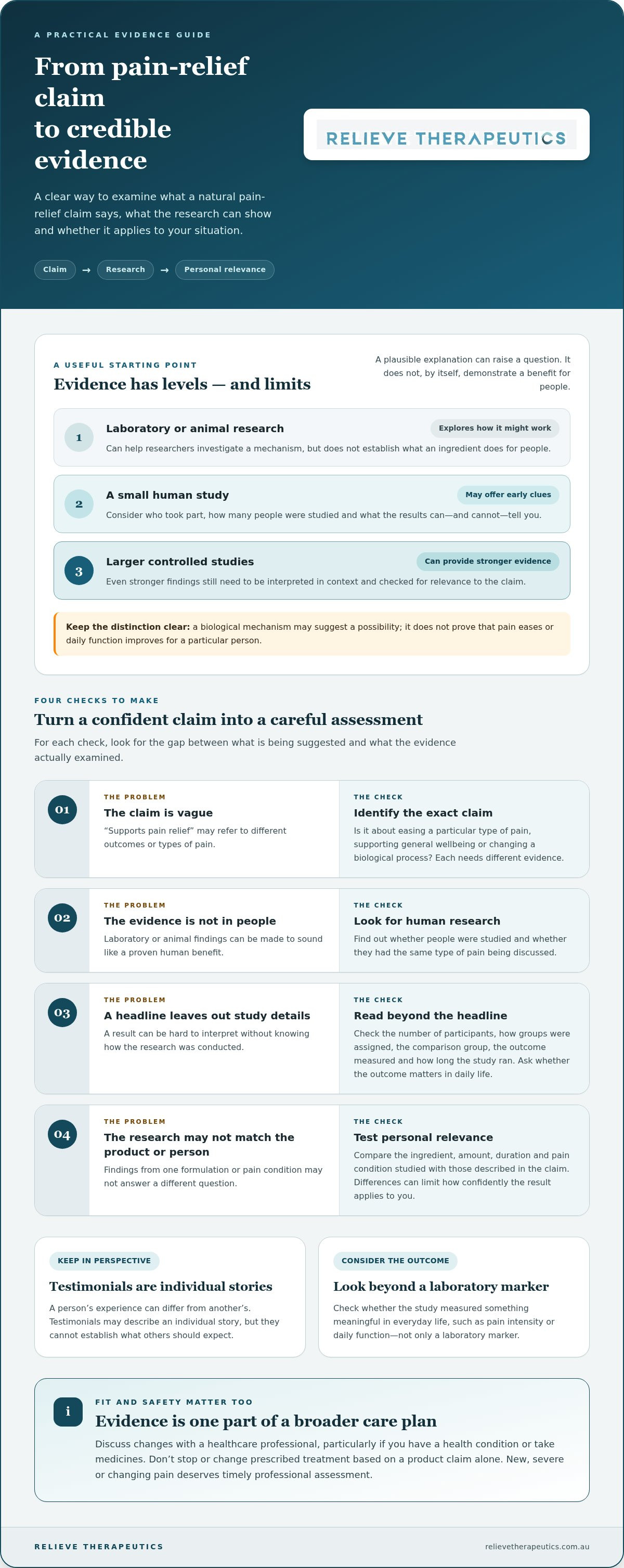
Confidence also depends on how a study is designed. Laboratory research can suggest questions to investigate, while a small human study may offer early clues. Larger controlled studies can provide stronger evidence, but their findings still need to be interpreted in context. Consider:
- Whether the research involved people with the same type of pain.
- How many participants took part and how they were assigned to groups.
- Whether the outcome measured matters in daily life, not only a laboratory marker.
One person’s experience can differ from another’s. Testimonials may describe an individual story, but they can’t establish what others should expect. Natural pain relief I can trust means weighing evidence without turning a possibility into a promise.
Why a whole-person approach can matter
Pain is experienced in the context of a person’s health, routines and circumstances. Some people discuss combining appropriate clinical care with supportive approaches such as gentle movement, sleep support or mindfulness. These may contribute to wellbeing for some, but they aren’t universal treatments. Suitability depends on the person, the cause of pain and their broader care plan.
Discuss changes with a healthcare professional, particularly if you have a health condition or take medicines. This can help you consider how an option fits alongside existing care, what to monitor and when to review your plan. Don’t stop or change prescribed treatment based on a product claim alone.
New, severe or changing pain deserves timely professional assessment. Don’t assume it’s something to manage with a natural product. Pain can have causes that need diagnosis and specific care. Thoughtful support starts with understanding what may be contributing to the pain, then choosing next steps with appropriate guidance.
How to assess the evidence behind natural pain relief
Assess a pain relief claim by examining the claim itself, reviewing the research and considering whether the findings apply to you. This helps prevent an interesting theory or confident headline from standing in for evidence of a meaningful benefit.
- Identify the exact claim. Is it about easing a particular type of pain, supporting general wellbeing or changing a biological process? These are different claims and need different evidence.
- Look for research in people. Laboratory or animal findings can help researchers explore how an ingredient might work, but they don’t establish what it does for people.
- Assess the study’s limits. Consider who took part, the number of participants, the comparison group, the outcome measured and how long the study ran.
- Check personal relevance. Ask whether the research examined the same ingredient, amount, duration and pain condition described in the claim. Differences can limit how confidently results apply to your situation.
A biological mechanism alone cannot establish a clinical outcome. Showing that a substance may interact with a pathway associated with pain doesn’t prove that it reduces pain or improves daily function for a particular person. Mechanistic research is a starting point for questions, not a substitute for human evidence.
What makes a pain-relief study more informative?
Read beyond the headline. Check whether participants had the pain condition being discussed, how many people were studied and whether researchers compared the intervention with a control group. Then look at what they measured, such as pain intensity or daily function, and the study duration. A result from one small study may be an early signal, but it isn’t the same as consistent findings from well-designed research.
Study details also show what the findings can’t tell you. Research on one ingredient or amount may not support a claim about a different formulation. A short study may not answer questions about longer-term use. If a claim leaves out those details, look for the underlying study or a balanced review before drawing conclusions.
How to read claims about PEA without overinterpreting them
Palmitoylethanolamide (PEA) is a naturally occurring fatty acid amide and a dietary supplement ingredient, not a prescription medication. It has been studied in relation to PPAR-α and pain pathways. These proposed biological actions help explain why researchers investigate PEA, but they don’t establish a reliable benefit for every person, pain condition or product.
To judge whether a study supports a product claim, compare the PEA formulation and amount, use period and participant group with the product information and claim. Differences matter. Individual responses can vary, so research findings shouldn’t be presented as a guaranteed result. You can read more about the science of how PEA works for pain while keeping proposed mechanisms distinct from demonstrated outcomes.
If you’re considering PEA, Relieve Therapeutics’ PEA supplements provide product information to review alongside the evidence and a discussion with a healthcare professional. Product details can clarify what a supplement contains, but can’t determine whether it’s suitable for you.
Compare natural pain relief options by evidence, safety and fit
Different approaches address different needs, and they aren’t interchangeable. A useful comparison considers the evidence, practical demands and safety questions associated with each option. This table is an orientation tool, not a diagnosis or substitute for personalised care.
Match the type of support to the question you need answered
Begin with your specific concern. Evidence about one pain condition can’t automatically be applied to another, and a study of one form of support may not tell you whether a different approach is relevant. Look for research involving people with symptoms and circumstances like yours, then consider whether the measured outcome reflects what you want to improve. For supplement options, this guide to non-opioid pain relief supplements offers further context for comparing claims.
Treat safety and suitability as part of the comparison
A natural label doesn’t rule out side effects or interactions with medicines. Before starting a supplement, discuss it with a healthcare professional, particularly if you’re pregnant or breastfeeding, have a health condition, or take prescribed or over-the-counter medicines. Share the ingredient list and directions so the discussion is specific. Don’t stop, delay or change prescribed treatment without guidance from your prescriber.
There’s no universal winner. The best fit depends on the evidence for your situation, an approach’s practical demands and your individual safety considerations. If you’re weighing up PEA, Relieve Therapeutics’ PEA supplement information can help you review product details as part of an informed comparison.
A practical Australian checklist for choosing natural pain support
Once an approach seems relevant, pause to check the details before trying it. A checklist can help you compare product claims with what’s disclosed and prepare a useful conversation with a qualified healthcare professional. It won’t determine whether an option is right for you, but it can support a more informed decision.
Questions to ask before trying a supplement
Check the label and product information for specifics, not just broad claims. A clear label should identify ingredients, amounts and relevant cautions. Look for evidence that relates to the same ingredient and claim, then review manufacturing controls and whether independent batch testing is described. These details help you understand the product, but don’t prove it will suit you or deliver a particular result.
- Ingredients and amounts: Are all active ingredients named, with the amount per serving stated clearly? Can you tell how much of each ingredient you’d take by following the directions?
- Evidence: Does the research relate to the ingredient, amount and type of pain described, or is the claim broader than the available findings?
- Quality information: Is there accessible information about manufacturing controls and independent batch testing? Are the purpose and scope of testing explained?
- Warnings and interactions: Are possible side effects and relevant cautions provided? Discuss potential interactions with a healthcare professional, especially if you take medicines or have other health considerations.
In Australia, a GP or pharmacist can help you review a supplement alongside your medicines and health history. Mention pregnancy or breastfeeding, allergies, existing conditions and any other products you use. Bring the packaging or ingredient information if that makes the discussion easier. Don’t change prescribed treatment without guidance from the prescriber responsible for your care.
How to assess whether an approach is helping
Before making a change, choose a simple record you can keep consistently. Note your symptoms and a few everyday activities that matter to you, such as sleeping comfortably, walking or completing a usual task. With professional guidance, set a realistic period for reviewing the approach. A record can help you describe patterns, but it can’t by itself prove that the approach caused a change.
- Record your starting point before introducing the change.
- Use the same measures and routine notes during the observation period.
- Write down changes to other care or routines, and any unwanted effects.
Review your notes with a healthcare professional rather than relying on a single better or worse day. Reassess the plan if symptoms worsen or you have concerns, and seek timely advice for new, severe or changing pain. This process supports a grounded discussion about what feels manageable, what may be helping and what to do next.
If you’re considering PEA as a dietary supplement, explore Relieve Therapeutics’ PEA supplement information and review the product details as part of your decision.
PEA capsules from Relieve Therapeutics: transparent information for an informed choice
Relieve Therapeutics is an Australian retailer of PEA dietary supplements. Its PEA capsules are a supplement option to consider as part of a broader plan, not a replacement for diagnosis, prescribed treatment or individual medical advice. No supplement can promise the same outcome for everyone.
For someone looking for natural pain relief I can trust, clear product details make it easier to assess what a supplement contains and how it is made. Each serving contains 600 mg ultra-micronised PEA, 150 mg Quercetin and 30 mg Luteolin. The PEA products are made in a GMP-certified facility in Australia and third-party batch tested for purity, potency and heavy metals. These details help you assess composition and reported quality checks alongside evidence, safety and personal suitability. They don’t establish that a product will work for a particular person or condition.
What the PEA product information tells you
The product is called PEA Capsules 600 mg with Luteolin, Palmitoylethanolamide Ultra-Micronised, and is available in 60, 120 and 180 capsule supplies. The recommended use is 2 capsules daily, providing 600 mg PEA total. The capsules can be taken with or without food. Follow the stated directions and discuss the product with a healthcare professional if you’re unsure whether it fits your health circumstances or current medicines.
The listed serving amounts show that Quercetin and Luteolin are included alongside PEA, rather than relying on a broad description such as “natural blend”. Manufacturing and batch-testing information adds another part of the picture, helping you understand the quality checks reported for the product.
The three capsule supplies are listed at $54.90 for 60 capsules, $79.90 for 120 capsules and $99.00 for 180 capsules. Each is shown with a different discount from its regular price: 21% off, 43% off and 53% off, respectively. Free shipping is automatically applied to orders of $75 or more in Australia.
Consider PEA within your wider pain-support plan
People can respond differently to the same supplement. PEA is a dietary supplement, not a cure or a guaranteed route to pain relief. A healthcare professional can help you weigh the available evidence, consider possible interactions and decide whether it is suitable alongside your existing care. Don’t stop or change prescribed treatment without guidance from your prescriber.
For more detail on what to assess in a product, the Australian guide to high quality PEA capsules explores further product-assessment criteria. Once you’ve considered evidence, suitability and professional advice, you can explore Relieve Therapeutics PEA capsules and review their product information at your own pace.
Take your next step with confidence
Choosing support for ongoing pain doesn’t need to be a once-and-for-all decision. Treat it as a thoughtful conversation: identify what matters most to your daily life, share your questions or concerns, and agree with your healthcare professional how you’ll review your options. That keeps the focus on care that fits your circumstances, rather than pressure to try every new claim.
If you’re considering PEA, read the product information and decide whether it’s worth discussing as part of your wider care plan. Seeking natural pain relief I can trust means staying curious while being realistic about evidence, personal suitability and what a supplement can promise.
Explore Relieve Therapeutics PEA capsules and review the product details at your own pace.
Frequently Asked Questions
How can I tell whether natural pain relief is trustworthy?
Look for a clear claim supported by human research relevant to the pain or use being discussed. A plausible explanation of how an ingredient might work isn’t proof of a benefit, and testimonials can’t predict your response. To assess natural pain relief I can trust, check whether the information explains limitations as well as potential benefits. If your symptoms persist or the claim relates to a diagnosed condition, discuss its relevance with a healthcare professional.
Is natural pain relief always safe?
No. A product or practice described as natural can still cause side effects or be unsuitable for you. Risks may depend on your health, other treatments and circumstances such as pregnancy or breastfeeding. Before adding a supplement, read its warnings and give a GP or pharmacist the ingredient list and details of medicines you take. Seek individual advice rather than assuming a natural origin makes an option risk-free.
Can natural pain relief replace prescribed medication?
No. Don’t stop, reduce or replace prescribed treatment without first speaking with the prescriber responsible for your care. If you’re interested in adding a complementary option, ask how it may fit with your current plan and whether there are interaction concerns. This is especially useful if you’re managing several treatments or considering a change because of side effects. Your prescriber can help you make any adjustments safely.
What should I look for in a natural pain relief supplement?
Check that the label names each ingredient and gives its amount per serving, with directions and cautions that are easy to understand. Look for product information about manufacturing and quality testing, then compare any health claim with research on the same ingredient and intended use. Be cautious of cure language or guaranteed outcomes. A photo of the label can help your pharmacist or GP review the exact product with you.
Is PEA a prescription medication?
No. PEA, or palmitoylethanolamide, is a dietary supplement ingredient, not a prescription medication. That doesn’t mean it is right for every person or that research on it guarantees a benefit for your particular pain. If you’re considering PEA, discuss your health circumstances and other medicines with a healthcare professional. They can help you consider whether it belongs in your wider plan and what to monitor.
How long does it take to notice a difference with PEA?
There’s no single time frame. Some people report noticing changes within days, while others may take several weeks or notice no difference. These experiences aren’t a promise of what you’ll experience. Follow the product’s recommended use rather than increasing it in response to slow progress. If you try PEA, note changes in symptoms and everyday activities, and seek professional advice if pain persists or worsens.
Can I take PEA with other medicines?
PEA is generally described as having minimal interactions, but that doesn’t rule out individual risks. Before adding it, ask a GP or pharmacist to review your medicines, including non-prescription products, and your health circumstances. This is particularly important if you take several medicines, have an ongoing condition, or are pregnant or breastfeeding. Mild gastrointestinal discomfort, headache or dizziness are possible. If you develop a new symptom after starting a supplement, seek professional advice and share the product details.