

If you’re asking what happens when you stop taking PEA, the key question may not be whether you’ll experience withdrawal, but whether the discomfort you hoped to manage could return. It’s understandable to want a clear answer, particularly when symptoms can change for several reasons.
Current evidence doesn’t suggest that PEA causes dependence or a recognised withdrawal syndrome, but it can’t predict how every person will feel after stopping. If discomfort returns, that doesn’t necessarily mean withdrawal. It may reflect the underlying condition, changes in symptoms over time or the loss of support you felt while taking the supplement.
This article explains what is and isn’t established about stopping PEA, what changes you might notice and how to think through your next steps. You’ll also learn when to seek individual medical advice and why it’s important not to change prescribed medicines without guidance. The aim is a measured plan, not a one-size-fits-all stopping schedule.
Key Takeaways
- PEA is also produced naturally in the body, but evidence about what happens after stopping a supplement is limited.
- Learn how to distinguish possible withdrawal concerns from a return of the symptoms you were managing or unrelated changes.
- Use a simple plan to clarify your reasons for stopping, note your baseline and track changes over time.
- If you’re wondering what happens when you stop taking PEA, symptoms alone can’t confirm withdrawal or prove that stopping caused them.
- Consider your individual health circumstances and seek advice from a GP, pharmacist or treating health professional when needed. Don’t change prescribed medicines without guidance.
What happens when you stop taking PEA? Start with what is known
There isn’t a reliable, universal answer to what happens when you stop taking PEA. People’s experiences may differ, and evidence specifically examining what happens after people discontinue PEA supplements is limited. PEA, short for palmitoylethanolamide, is a fatty acid amide that the body also produces naturally. You can read a general overview of Palmitoylethanolamide (PEA), including how it occurs in the body.
Stopping a supplement is not the same as stopping a prescribed medicine. Some prescribed medicines need to be reduced or stopped with a clinician’s guidance. Don’t alter prescribed treatment because you’re changing your PEA use. Speak with your GP, pharmacist or treating health professional if you’re unsure.
What’s known is that stopping PEA does not, by itself, establish withdrawal. What remains uncertain is how an individual’s symptoms may change afterwards. If symptoms shift, that alone can’t prove dependence or show that stopping PEA caused the change.
Does stopping PEA cause withdrawal?
Withdrawal describes symptoms that arise as the body adjusts after a substance is reduced or stopped. Dependence means the body has adapted in a way that can make stopping difficult. It is different from simply noticing symptoms again. Current evidence does not establish a recognised withdrawal pattern or dependence caused by PEA, but limited research on discontinuation means this should not be read as proof that no one could experience changes.
A return of the original discomfort is another possibility, not automatically withdrawal. For example, if someone took PEA while managing ongoing discomfort and that discomfort later increases, the change could relate to the underlying issue or other factors. It doesn’t confirm a cause on its own.
Why might people notice a change after stopping?
Symptoms can fluctuate, and stopping a supplement may happen around the same time as other changes. The underlying condition may vary naturally; sleep, activity or daily routine may shift; and other treatments may have changed too. These factors can overlap, making it difficult to identify what influenced how someone feels.
Keep the distinction clear: noticing a change is valid, but it doesn’t identify its cause. Available evidence can’t reliably predict whether a person will notice a difference, when it might occur or how long it could last. Tracking symptoms alongside routine and treatment changes can help you give a health professional a clearer account.
How PEA, symptoms, and individual responses fit together
People may respond differently to the same supplement, and the condition they’re managing can also change over time. Someone might feel more comfortable while taking PEA, notice no clear difference or experience ups and downs that are hard to interpret. A perceived benefit matters to that person, but it doesn’t establish exactly how PEA contributed or what will happen after stopping.
A symptom change after stopping PEA is something to observe, not proof that PEA caused it. Timing can offer a clue, but it can’t separate the effects of supplementation from natural symptom variation, changes in sleep or activity, or adjustments to other treatments.
What can symptom changes tell you?
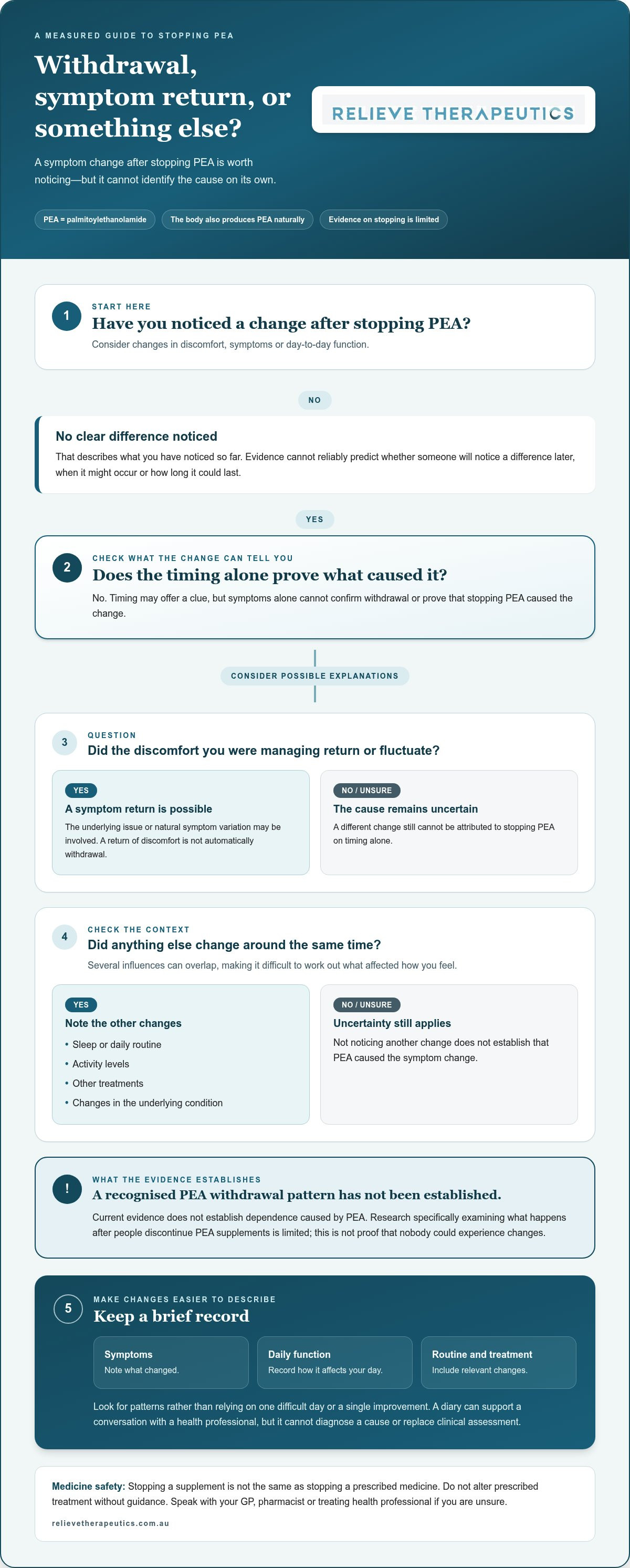
A brief record can make changes easier to describe. Note symptoms, daily function and relevant changes to your routine or treatment, such as disrupted sleep or a change in activity. Look for patterns rather than relying on one difficult day or a single improvement. A diary can support a conversation with a health professional, but it can’t diagnose a cause or replace clinical assessment.
What does the evidence say about stopping PEA?
Research on PEA generally examines its use for particular conditions rather than what happens when participants discontinue it. The Alzheimer's Drug Discovery Foundation’s review summarises clinical safety findings, including that trials have not reported serious adverse events. This is useful context about PEA use, but it does not directly establish whether withdrawal occurs or predict symptom changes after stopping.
Study results also need to be read in context: participants, health conditions, formulations and study methods can differ. Findings in one group don’t necessarily predict an individual’s experience, and evidence about taking PEA can’t automatically answer a question about stopping it. For an accessible explanation of the proposed pathways behind PEA, see this guide to how PEA works for pain.
If you’re reviewing your supplement choices, the PEA capsule range provides product information to consider alongside your own circumstances. This is not a recommendation to continue. If symptoms change or you’re weighing PEA against other treatments, discuss your situation with your GP, pharmacist or treating health professional.
Withdrawal, symptom return, or something else? How to tell the difference
If symptoms change after you stop a supplement, it’s natural to look for an explanation. But the timing alone can’t tell you what caused the change. A symptom returning does not automatically mean dependence, and it isn’t enough to identify withdrawal.
| Possible explanation | What it means | What to keep in mind |
|---|---|---|
| Withdrawal | A response to stopping a substance that the body has adapted to. | Calling a change withdrawal requires evidence that stopping the substance can cause that pattern. Current evidence doesn’t establish a recognised withdrawal syndrome for PEA. |
| Return or fluctuation of symptoms | The original discomfort or health issue reappears or varies. | This may happen whether or not a supplement was involved. It doesn’t, by itself, show dependence or prove that stopping PEA caused the change. |
| Another change | A symptom shift related to a different health issue or change in circumstances. | Illness, sleep, activity, routine or other treatments may be relevant context, but only an appropriate assessment can help interpret the cause. |
How is withdrawal different from symptoms returning?
Withdrawal is a specific explanation, not a catch-all term for feeling worse after stopping something. It describes symptoms linked to stopping a substance and should only be used when evidence supports that link. A recurrence is different: it means the issue someone was trying to manage has returned or changed. For PEA, evidence about discontinuation is limited, so neither label should be assumed from symptoms alone.
A return of discomfort may deserve attention, but it does not automatically mean your body has become dependent on PEA. If you’re trying to work out what happens when you stop taking PEA, note what changed and when, while keeping other possible influences in view.
When could another cause need attention?
Consider whether you’ve had a new illness, a shift in daily routine or a change to another treatment around the same time. These details can help a GP, pharmacist or treating health professional assess the situation. A brief record can be useful, but it can’t diagnose the cause.
Seek prompt professional assessment if symptoms are severe, sudden, unusual or rapidly worsening, whatever you think may have triggered them. For related information, read the PEA safety and side effects guide. Don’t stop or alter prescribed medicines without guidance from the clinician responsible for your care.
A measured plan for stopping PEA and monitoring what changes
If you’re considering stopping PEA, a simple plan can make any changes easier to understand. There’s no evidence-based tapering schedule or fixed observation period established here, so don’t assume a particular reduction plan or timeline is necessary for everyone. Focus instead on your reason for stopping, other treatments and a clear record of how you’re feeling.
- Clarify your reason. Note what’s prompting the decision, such as a lack of perceived benefit, a concern or a change in your circumstances.
- Review the bigger picture. Consider other medicines and supplements, and speak with a health professional if you have complex health needs or questions about interactions.
- Record a baseline. Before making a change, briefly note relevant symptoms and how they affect daily activities.
- Monitor without assumptions. Keep observations consistent and include changes to your routine or other treatments, rather than expecting a particular result.
This approach won’t establish what caused a symptom change, but it can provide useful context for a conversation with a professional. Don’t stop or alter prescribed medicines based on guidance about supplements. Discuss changes to prescribed treatment with the clinician responsible for your care.
What should you note before and after stopping?
Keep the record brief enough to maintain. You might note your main symptoms, their effect on activities such as walking or sleep, and any relevant changes in routine. Include other medicines and supplements so a GP or pharmacist can consider the full picture. Use the same simple descriptions over time, and record what you notice without labelling it as withdrawal or assuming PEA caused it.
When should you speak with an Australian health professional?
A GP or pharmacist can help with questions about interactions, ongoing symptoms or whether your circumstances call for individual advice. If symptoms are severe, sudden, unusual or rapidly worsening, seek timely medical attention rather than relying on online troubleshooting.
If you’re reviewing information about PEA use, this PEA dosage guide provides general context, not personalised dosing advice or a stopping plan. If you’re considering continued use, you can also view the PEA capsule range for product information. This isn’t a recommendation to continue taking it.
Your next step: make an informed decision about PEA
Evidence about what happens when you stop taking PEA is limited, so make decisions based on your own circumstances rather than assuming a particular outcome. A symptom change alone doesn’t prove withdrawal, dependence or that stopping PEA caused it. Continuing, stopping or seeking advice are all choices to consider in light of your goals, experience and other health needs.
If you use prescribed medicines, keep them separate from decisions about supplements. Don’t stop or alter prescribed treatment without guidance from the clinician responsible for your care.
If you are considering continuing PEA
Reflect on what you hoped PEA would support and what you’ve actually noticed, including any effect on daily activities. Discuss those observations and your health circumstances with a qualified health professional, particularly if you take other medicines or have ongoing health concerns. This guide to taking PEA for nerve pain offers general information, not personalised treatment or dosing advice.
Relieve Therapeutics offers PEA capsules in 60-, 120- and 180-capsule supplies. These are product options only; capsule quantity does not determine which choice is clinically appropriate for you.
If you have already stopped taking PEA
A change in symptoms after stopping doesn’t, by itself, prove withdrawal or mean you’ve caused harm. Note what has changed, when you noticed it and whether other parts of your routine or treatment changed as well. If symptoms persist, concern you or affect your daily life, discuss them with your GP, pharmacist or treating health professional. Your notes can help explain what you’ve experienced, but they can’t identify the cause on their own.
For severe or rapidly worsening symptoms, seek urgent medical help rather than relying on online advice. If you’re weighing up continued use, Explore Relieve Therapeutics PEA capsules for product information. This is not a recommendation to start or continue supplementation; the decision should fit your individual circumstances.
Choose your next step with confidence
The clearest answer to what happens when you stop taking PEA is that individual experiences vary and reliable evidence about discontinuation is limited. A symptom returning doesn’t automatically mean withdrawal or dependence, and timing alone can’t confirm that stopping caused a change.
Whether you’re considering continuing, stopping or seeking advice, let your health circumstances and observed experience guide the decision. Keep track of symptoms and relevant changes, and speak with a GP, pharmacist or treating health professional if you’re unsure, especially before changing prescribed medicines.
If you’re considering continued use, Relieve Therapeutics’ PEA capsules are available in 60-, 120- and 180-capsule supplies as product options, not treatment recommendations. Explore Relieve Therapeutics PEA capsules for product information.
A thoughtful next step doesn’t require certainty about every symptom. It starts with noticing what’s changed and getting appropriate support when you need it.
Frequently Asked Questions
Can you stop taking PEA suddenly?
There’s no established universal method for stopping PEA or evidence that everyone needs to taper. That doesn’t prove stopping is risk-free for every person; your health circumstances and other treatments matter. If you have complex health needs, persistent symptoms or questions about other treatments, discuss your situation with a GP or pharmacist. Don’t stop or change prescribed medicines based on guidance about supplements.
Does stopping PEA cause withdrawal symptoms?
Current evidence does not establish a recognised withdrawal pattern after stopping PEA, but claims about withdrawal need relevant evidence and shouldn’t be inferred from symptoms alone. Withdrawal means a response to stopping a substance; a return or fluctuation of the symptoms you were managing is different. If symptoms concern you or worsen, speak with a health professional rather than assuming the cause.
Will my pain come back if I stop taking PEA?
Pain may change after you stop taking PEA, but individual outcomes can’t be predicted. If discomfort returns, that doesn’t prove PEA caused withdrawal or that you’ve become dependent. Consider recording when pain changes, how it affects daily activities and whether anything else changed, such as your routine or other treatments. Seek tailored advice if pain persists, worsens or interferes with daily life.
How long does PEA stay in your system after you stop taking it?
There isn’t a reliable timeline established here for how long supplemental PEA remains in the body, so a specific number of hours or days shouldn’t be assumed. How long a substance is present and how symptoms change are separate questions. If you’re concerned about your own situation, discuss it with a GP or pharmacist rather than using an unsupported timeline to guide decisions.
Should I taper off PEA or stop taking it all at once?
No universal tapering schedule for PEA is established by the evidence discussed here, so a specific reduction plan shouldn’t be invented. The right approach may depend on your health circumstances and other treatments. Ask a GP or pharmacist for advice if you’re unsure, particularly if symptoms are ongoing or you take other medicines. Don’t stop or adjust prescribed medicines without appropriate clinical guidance.
What should I do if my symptoms get worse after stopping PEA?
Note when symptoms changed, how severe they are and whether your routine or other treatments changed too. Contact a GP or pharmacist if symptoms persist or affect daily life, and share your notes to support the discussion. Severe, sudden, unusual or rapidly worsening symptoms need prompt medical attention. Don’t rely on online information to assess urgent symptoms or change prescribed treatment.