

A clear product listing is only the starting point. The most useful questions to ask before buying PEA online are whether the product is clearly identified as Palmitoylethanolamide (PEA), what the pack contains, and what information the seller provides about its quality and intended use. Straightforward answers make it easier to compare offers without relying on broad claims or assumptions.
It’s reasonable to want more than a polished description when choosing a supplement online. Product details, information about the seller and clear purchase terms help you judge whether an offer is transparent and suits your needs.
This guide covers practical questions for comparing PEA products, understanding product information and checking key details before you buy. It also explains when to pause and seek advice from a health professional, helping you make a considered choice.
Key Takeaways
- Compare recent sales of similar properties to assess whether an asking price is aligned with the local market.
- Look beyond the offer price: compare home loan types and lenders by considering the terms, fees and features that affect your budget.
- Put agreed sale inclusions in writing and have them recorded in the contract, rather than relying on a verbal understanding.
- Ask about zoning, easements, the roof, the foundation and hazards such as flooding or bushfire, then arrange inspections where needed.
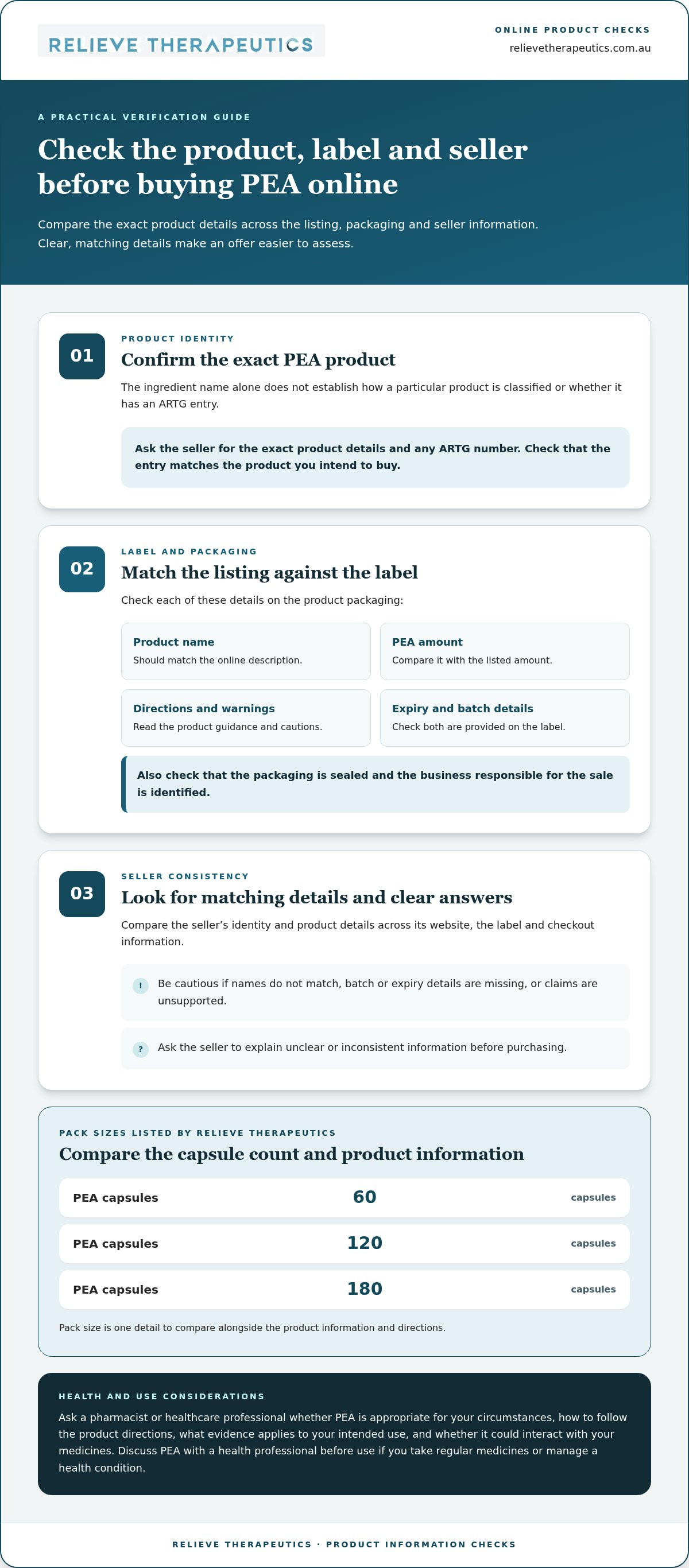
- For an online PEA purchase, compare the listed pack size and product information; Relieve Therapeutics offers PEA capsules in 60-, 120- and 180-count supplies.
1. Asking about offers and comparable sales
For a property purchase, compare recent sales of similar homes in the same area before deciding what to offer. In a steady or good Australian property market, a home listed for six to eight weeks or more may have an asking price that is too high. Ask the estate agent how the asking price compares with similar sales, then weigh the evidence against your budget.
Compare home loans by looking at the full terms, not just the advertised rate. Consider whether a fixed or variable rate suits your financial plans, then compare fees, repayment conditions and features that affect how you manage repayments. Work out the total cost over the loan term and check that repayments would remain affordable if your circumstances changed.
Before making an offer, clarify which items are included in the sale. Record agreed inclusions in writing and have them added to the contract rather than relying on a verbal promise. For an investment property, compare median house prices and rents in the area when estimating potential rental yield. Ask the council about planned local developments, as transport, housing or shopping projects may influence your decision.
Is PEA classified as a medicine or complementary medicine in Australia? A product’s status depends on how it is presented and its intended use. The ingredient name alone doesn’t establish how a particular product is classified.
What are Australia's rules for importing PEA supplements for personal use? Requirements can depend on the product’s classification, formulation and intended use, so check the relevant Australian import requirements for the exact product before ordering.
What are the usual PEA doses and forms, and is there evidence for them? There isn’t one dose that applies to every product or purpose. Ask a pharmacist or healthcare professional to assess the exact form, amount per serve and evidence for the use you’re considering.
What are the possible side effects, interactions and safety risks of PEA? Ask a pharmacist to review the product information alongside your medicines and health conditions, and explain which symptoms should prompt you to stop taking it.
Who should avoid PEA or consult a doctor before using it? If you take regular medicines or manage a health condition, discuss PEA with a healthcare professional before use.
What should I ask a pharmacist or healthcare professional before taking PEA? Ask whether it’s appropriate for your circumstances, how to follow the product directions, what evidence applies to your intended use, and whether it could interact with your medicines. These are useful questions to ask before buying PEA online, especially when comparing product information.
2. Vendor disclosure of material facts
For an Australian property, ask the real estate agent about facts that could affect your decision, and request clear written answers. In Western Australia, selling agents must tell prospective buyers information that could influence their decision, including structural issues, asbestos hazards, past use as a drug laboratory, or major fire or flood incidents.
Victoria has its own timing requirement: vendors and estate agents must disclose material facts before an auction or, for a private sale, before the buyer signs the contract. The sale contract is also known as a Section 32 statement. Read it carefully, and ask about anything unclear before signing.
Use a focused checklist for the property and surrounding suburb. Ask about the roof’s age and condition, the foundation, zoning restrictions, easements, and known hazards such as flooding, landslides or bushfires. Verify zoning with the local council and ask whether planned developments could affect the property. A building and pest inspection can help identify concerns such as structural defects or termite activity.
Are PEA supplements listed on the Australian Register of Therapeutic Goods (ARTG)? The ingredient name alone doesn’t show whether a specific product has an ARTG entry. Ask the seller for the exact product details and any ARTG number, then check that the entry matches the product you intend to buy.
What should I check on the label before buying PEA online in Australia? Match the product name and PEA amount to the online description, then read the directions, warnings, expiry date and batch details. Check that the packaging is sealed and that the seller identifies the business responsible for the sale.
How can I verify an online PEA seller and avoid counterfeit or poor-quality products? Compare the seller’s identity and product details across its website, label and checkout information. Be cautious of listings with mismatched names, missing batch or expiry details, or unsupported claims. Ask the seller for an explanation before purchasing.
Relieve Therapeutics: PEA 60 Capsules
Relieve Therapeutics offers PEA 60 Capsules for people comparing clearly identified PEA options online. The range also includes PEA 120 Capsules and PEA 180 Capsules, allowing you to compare pack sizes while reviewing product information and directions.
If you’re considering PEA, discuss its suitability and use with a pharmacist or healthcare professional, particularly if you take medicines or manage a health condition. For information about the available PEA capsules, visit Relieve Therapeutics online.
Choose your next step with care
Use these questions to ask before buying PEA online as a final decision tool, not as a substitute for considering whether the supplement suits your circumstances. Take time to review the product information and discuss PEA with a pharmacist or healthcare professional if you need guidance. That conversation can help you weigh your intended use alongside your medicines and health needs.
If you’re ready to compare pack sizes, Relieve Therapeutics offers PEA 60 Capsules, PEA 120 Capsules and PEA 180 Capsules. Choose the option that best matches your preferences, and read its product information before placing an order. If you’d like to explore the available PEA capsules, visit Relieve Therapeutics.
A measured, informed approach can make an online purchase more straightforward. Keep your questions close, seek professional guidance when relevant, and choose with confidence.
Frequently Asked Questions
Are PEA supplements listed on the Australian Register of Therapeutic Goods (ARTG)?
Ask the seller for the exact product details and any ARTG number, then check that the entry matches the product you intend to buy.
What are the possible side effects, interactions, and safety risks of PEA?
Ask a pharmacist to review the product information alongside your medicines and health conditions, and explain which symptoms should prompt you to stop taking it.