

Choosing between nature's most researched compounds isn't about finding a winner; it's about matching a biological key to your specific cellular lock. You've likely spent hours comparing supplement labels, feeling frustrated by the slow progress of natural remedies or worrying about the gastric side effects often associated with traditional options. It's exhausting to seek relief only to be met with conflicting marketing and vague promises.
This guide clarifies the scientific nuances of PEA vs curcumin for inflammation to help you determine which pathway best supports your unique health journey. We'll explore how these two substances target different systems, from the endocannabinoid system to traditional inflammatory markers. You'll gain a clear understanding of the latest 2026 Australian clinical insights and practical steps to select the right protocol for your mobility. By the end, you'll have the confidence to choose a supplement strategy that prioritises both efficacy and your long-term wellbeing.
Key Takeaways
- Understand the distinct biological pathways of each compound, comparing curcumin’s enzyme inhibition with PEA’s sophisticated modulation of the endocannabinoid system.
- Learn to categorise your discomfort as mechanical or neurological to determine whether PEA vs curcumin for inflammation is the more appropriate clinical choice for your needs.
- Navigate the "absorption gap" by identifying why delivery technologies like micronisation are vital for ensuring these compounds actually reach your cells.
- Recognise the specific advantages of PEA for nerve-related conditions, providing a targeted and evidence-based alternative for neurological comfort.
- Develop a sustainable management plan by selecting the right capsule count to support your long-term mobility and restoration goals.
The Inflammation Dilemma: Why Australians are Comparing PEA and Curcumin
Australian wellness circles are witnessing a significant shift in how we approach physical discomfort. While traditional non-steroidal anti-inflammatory drugs (NSAIDs) have long been the standard, their limitations are becoming harder to ignore. Many Australians now seek naturalised alternatives to avoid gastric irritation, cardiovascular risks, and long-term pharmaceutical reliance. This search for safer, sustainable relief has led to the rise of the 'Big Two': Palmitoylethanolamide (PEA) and Curcumin.
Deciding between PEA vs curcumin for inflammation requires moving beyond marketing buzzwords. It involves understanding the specific biological pathways these compounds activate. While both are celebrated for their anti-inflammatory properties, they function in fundamentally different ways. One targets systemic pathways, while the other works closer to the cellular source of discomfort. Choosing the right one depends on your unique health journey, the nature of your symptoms, and your desired level of activity.
The dominance of these two supplements isn't accidental. They represent the pinnacle of evidence-based natural medicine for 2026. Australians are increasingly savvy; they don't want a generic "cure-all" anymore. They want targeted support that respects the body's complex chemistry. By comparing these two, you're looking for a specialist tool rather than a blunt instrument. A targeted response. A natural evolution.
What is Palmitoylethanolamide (PEA)?
PEA is a naturally occurring fatty acid amide that our own cells produce in response to tissue stress or injury. It acts as a sophisticated biological fire extinguisher, working within the endocannabinoid system to regulate mast cells and glial cells. Its primary role is to maintain cellular balance, reduce neuroinflammation, and prevent the over-activation of inflammatory signals. However, during chronic inflammatory states, the body's demand for PEA often exceeds its ability to produce it. This depletion leaves the system vulnerable, making high-quality supplementation a logical step for restoration.
What is Curcumin (Turmeric Extract)?
Curcumin is the primary bioactive compound found within the Curcuma longa (turmeric) root. While turmeric has been a staple of traditional medicine for centuries, modern clinical interest focuses on high-potency standardised extracts. These concentrates provide the therapeutic dosages necessary to impact systemic inflammation effectively. Curcumin is widely recognised as a broad-spectrum anti-inflammatory, meaning it inhibits multiple pro-inflammatory enzymes like COX-2 and LOX across the body. It remains a cornerstone of natural health for those seeking to manage general systemic swelling, joint stiffness, and joint-related discomfort.
Mechanism of Action: How They Target Inflammation Differently
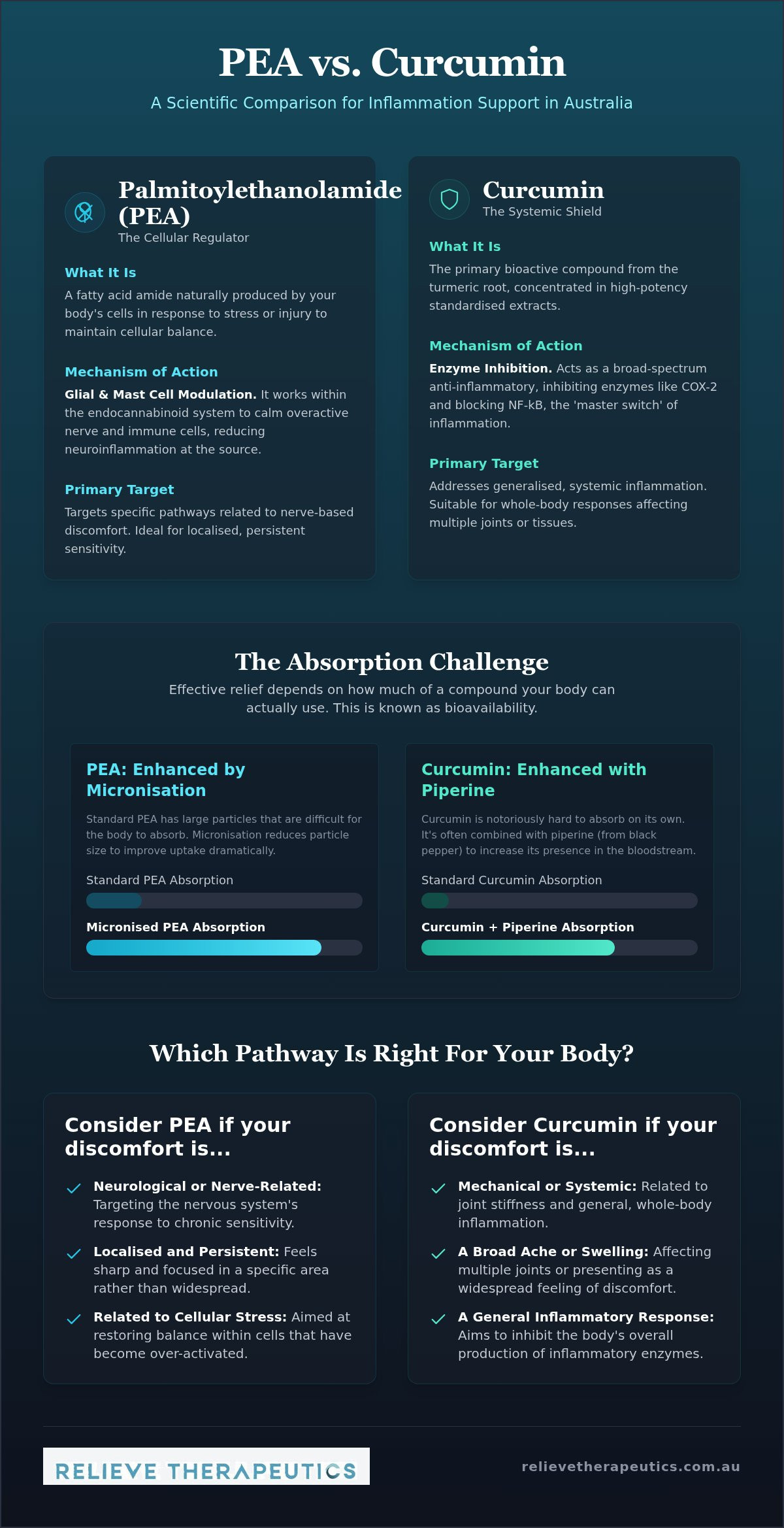
Understanding the biological mechanics of PEA vs curcumin for inflammation reveals why one might succeed where the other falls short. Curcumin acts as a potent external force, entering the body to intercept inflammatory processes. PEA, conversely, provides endogenous support by mimicking the fatty acids your body naturally produces to resolve tissue stress. Both are effective, but they speak different biological languages to achieve restoration.
Curcumin is often viewed as a systemic shield. It travels through the bloodstream to address generalised swelling. PEA is more of a cellular regulator, working directly at the site of overactive nerves and immune cells. This distinction is vital when you're trying to match a supplement to your specific symptoms. If your discomfort feels like a broad ache, curcumin's systemic approach is relevant. If it feels like a sharp, localised, or persistent sensitivity, PEA's cellular focus is often more appropriate.
Curcumin and the Enzyme Inhibition Pathway
Curcumin's primary strength lies in its ability to inhibit pro-inflammatory enzymes like COX-2 and LOX. By blocking NF-kB, which researchers often call the 'master switch' of inflammation, it prevents the cascade of chemicals that cause systemic swelling and joint stiffness. This makes it particularly effective for whole-body responses where multiple joints or tissues are affected simultaneously. Curcumin functions as a broad-spectrum enzyme inhibitor that shields the entire body from excessive inflammatory responses.
PEA and the Glial Cell Modulation Pathway
While curcumin focuses on enzymes, PEA targets the nervous system's security guards: mast cells and glial cells. When these cells become overactive, they create a cycle of chronic sensitivity that feels like a constant "alarm" in the body. PEA works through the PPAR-alpha receptor to quieten this alarm, effectively retraining the nervous system to lower its sensitivity to discomfort. For a deeper technical exploration of these pathways, you can read our guide on how does PEA work for pain.
Can you combine them? Yes. Because they target distinct pathways, they often work in synergy. Curcumin handles the systemic chemical "storm" while PEA addresses the cellular "wiring" and nerve sensitivity. This multi-pathway approach provides a more comprehensive strategy for those dealing with complex, long-term discomfort. If you're looking to start this journey, choosing a specialist-grade PEA supplement ensures you're supporting your body's internal resolution mechanisms with the highest purity available in the Australian market.
Bioavailability and Absorption: The Micronisation vs. Piperine Debate
Many people feel frustrated when natural remedies don't produce the expected results. Often, the issue isn't the compound itself, but how much of it actually reaches the bloodstream. This "Absorption Gap" is a critical factor when comparing PEA vs curcumin for inflammation. Both molecules are lipophilic, meaning they dissolve in fats rather than water. Since our digestive environment is primarily water-based, standard forms of these supplements often pass through the system without being utilised. Without specific delivery technologies, your body might only absorb a tiny fraction of the dose you ingest.
The metabolic half-life also differs significantly between the two. PEA is an endogenous fatty acid, meaning your body already possesses the machinery to process and transport it to stressed tissues. Curcumin is a foreign botanical compound that the liver seeks to clear as quickly as possible. This difference in biological familiarity dictates how long each substance stays in your system and how frequently you need to dose to maintain therapeutic levels.
The Crucial Role of Micronisation in PEA
Standard PEA particles are naturally large and tend to clump together, which severely limits their intestinal uptake. To solve this, specialist manufacturers use ultra-micronisation to break these particles down. This process reduces the particle size to between 2 and 10 micrometres, vastly increasing the surface area available for absorption. It's the difference between trying to dissolve a large rock versus fine sand in a glass of water. Selecting high quality PEA capsules ensures you're receiving a form that is physically optimised for your digestive tract. Micronised PEA is the gold standard in 2026 because it overcomes the inherent solubility issues that render unprocessed PEA ineffective.
Curcumin's Bioavailability Hurdles
Curcumin faces a different challenge known as rapid metabolism. Even if curcumin enters the system, the liver identifies it as a substance to be excreted and neutralises it almost immediately. To counter this, many formulations include piperine, a compound found in black pepper. Research has shown that piperine can increase curcumin absorption by up to 2000% by slowing down the liver's metabolic breakdown. While effective for absorption, this method has drawbacks. High doses of piperine can cause gastric irritation or reflux, which is a significant concern for Australians with sensitive stomachs or those already frustrated by the side effects of traditional anti-inflammatories.
Suitability Guide: When to Choose PEA Over Curcumin
Selecting the right support requires a clear understanding of your inflammatory profile. Not all discomfort is created equal. We can generally categorise these issues into mechanical, chemical, or neurological drivers. When weighing PEA vs curcumin for inflammation, the decision often rests on which of these categories dominates your daily experience. Curcumin is highly effective for systemic chemical inflammation, while PEA excels in addressing the neurological "alarm" system.
Safety profiles also play a significant role in this choice. PEA is a substance your body recognises and produces itself, which contributes to its exceptional safety record and lack of known drug interactions. Curcumin, while natural, possesses mild blood-thinning properties. This makes it a consideration for those on anti-coagulant medications. If you have a sensitive stomach, PEA is often the gentler choice, as it doesn't require the piperine (black pepper) often used to make curcumin effective.
The Case for PEA in Chronic Nerve Support
PEA is the superior tool for addressing "hidden" inflammation within the central nervous system. Conditions like sciatica, carpal tunnel, or persistent back sensitivity often involve overactive glial cells rather than simple joint swelling. PEA targets these cells directly to lower the volume of discomfort signals. It's a cumulative process. While some feel a difference quickly, most clinical data suggests a 4 to 12-week window is necessary to achieve full restoration. It's about retraining your system, not just masking a symptom. For those seeking this targeted neurological support, you can buy high-purity PEA capsules to begin your restoration journey.
The Case for Curcumin in General Wellness
Managing the "aches and pains" of an active Australian lifestyle often involves broad-spectrum support like curcumin. It's a powerful tool for post-exercise recovery or managing acute flare-ups of joint stiffness. Beyond its anti-inflammatory role, it supports digestive health and provides significant antioxidant status. Use curcumin as a systemic support for general wellness or as a short-term "burst" when you've pushed your body a little too hard on the weekend. It addresses the chemical cascade that follows physical exertion, helping you return to your routine with greater comfort and mobility.
Optimising Your Natural Support Strategy with Relieve Therapeutics
Understanding the distinction between PEA vs curcumin for inflammation allows you to move away from trial-and-error supplementation. By identifying whether your discomfort is driven by systemic enzymes or overactive glial cells, you can select the specific tool that aligns with your biology. Integrating high-purity PEA into a modern Australian lifestyle is a commitment to long-term restoration rather than a temporary mask. It requires a methodical approach, starting with the right dosage and maintaining the consistency your nervous system needs to recalibrate.
Selecting the appropriate supply is a practical step in this strategy. We offer three distinct sizes to support different stages of your health journey. The 60-capsule bottle serves as a focused entry point for those trialling the compound for the first time. The 180-capsule pack provides the most sustainable value for long-term maintenance and inflammatory management. However, for most Australians beginning their journey, the middle ground is often the most effective choice for establishing a baseline of comfort and function.
Starting Your Journey with PEA
Clinical observation often supports a 'loading dose' strategy to saturate the system and initiate the modulation of glial cells. This typically involves a higher daily intake for the first few weeks before transitioning to a lower maintenance level. Because this initial phase requires more capsules, the PEA 120 capsules pack is the preferred starting point for most users. It provides enough supply to complete a full loading cycle and accurately assess the cumulative benefits. Consistency is the primary driver of success here. Skipping doses can disrupt the steady-state levels required to quieten persistent inflammatory alarms.
The Relieve Therapeutics Difference
We believe that purity is the foundation of efficacy. Relieve Therapeutics focuses exclusively on high-purity, micronised PEA to ensure every capsule delivers targeted results without unnecessary fillers. As an Australian-owned and operated specialist, we understand the importance of reliable access to your support regime. Our direct-to-consumer model ensures transparency in our manufacturing standards and clinical-grade quality. We provide fast local shipping across Australia, ensuring there are no gaps in your support when you need it most. Explore our range of PEA capsules and start your natural support journey today to experience the benefits of a science-led approach to wellbeing.
Empowering Your Recovery with Targeted Science
Deciding on the right path between PEA vs curcumin for inflammation shouldn't be a matter of guesswork. It's a choice between systemic enzyme inhibition and sophisticated cellular modulation. While curcumin offers broad support for general joint stiffness, PEA provides a targeted solution for the overactive nervous system and persistent sensitivity. By prioritising micronised delivery and understanding the role of glial cells, you're choosing a strategy built on biological reality rather than marketing trends.
As a specialist Australian PEA provider, Relieve Therapeutics is dedicated to offering a clinically-informed product range that supports your long-term mobility. Whether you're starting with a trial or committing to restoration with our bulk 180-count value packs for chronic support, we're here as your partner in health. You deserve a life defined by comfort and vitality rather than the limitations of discomfort.
Secure your supply of high-purity PEA capsules from Relieve Therapeutics today. Your journey toward lasting comfort starts with a single, scientifically-backed choice.
Frequently Asked Questions
Can I take PEA and Curcumin together for better results?
Yes, you can combine these two supplements safely because they function through distinct biological pathways. While curcumin focuses on systemic enzyme inhibition, PEA modulates the endocannabinoid system to quieten overactive nerve signals. This dual approach often provides more comprehensive support for complex inflammatory profiles. Many Australians find that using them in tandem addresses both the chemical and neurological aspects of their discomfort without interference.
Which is better for arthritis, PEA or Curcumin?
The choice depends on the specific nature of your arthritis symptoms. Curcumin is frequently preferred for managing systemic joint swelling and acute stiffness due to its broad-spectrum enzyme inhibition. However, if your arthritis involves persistent sensitivity or a neurological component, PEA is often the superior choice for retraining your system's response. Understanding the nuances of PEA vs curcumin for inflammation helps you select the tool that matches your specific mobility challenges.
Does PEA have the same blood-thinning risks as Turmeric?
No, PEA doesn't carry the same blood-thinning risks often associated with high-dose turmeric or curcumin extracts. Curcumin has mild anti-coagulant properties that require caution for those on blood-thinning medication. In contrast, PEA is a fatty acid produced naturally by your own cells and doesn't impact blood clotting mechanisms. This makes it a reliable alternative for individuals who need to avoid botanical supplements with potential cardiovascular interactions.
How long does it take for PEA to start working compared to Curcumin?
Curcumin typically offers a faster response for acute flare-ups, with some users noticing changes within days of starting a high-potency dose. PEA functions differently by gradually modulating cellular activity, which requires more patience. While some people experience early relief, the full clinical benefits of PEA generally manifest over a 4 to 12-week period. Consistency is vital to ensure your system reaches the steady state required for sustained restoration.
Is PEA more effective than Curcumin for nerve pain like sciatica?
Yes, PEA is generally considered more effective for nerve-related discomfort like sciatica or carpal tunnel. These conditions are driven by neuroinflammation and overactive glial cells, which are the primary targets of PEA. Curcumin addresses systemic chemical markers but lacks the specific mechanism required to quieten the nervous system's internal alarm. For those dealing with sharp or radiating nerve sensitivity, PEA provides a more specialised and evidence-based pathway to comfort.
Are there any side effects when switching from Curcumin to PEA?
Switching from curcumin to PEA is usually a seamless process with a very low risk of side effects. PEA is exceptionally well-tolerated because it's a substance your body already produces to resolve tissue stress. Unlike some curcumin formulations that use piperine to aid absorption, PEA doesn't cause gastric irritation or reflux. This transition is often a relief for those who've struggled with the digestive sensitivities common to botanical extracts.
Do I need to take PEA with food like I do with Turmeric?
While curcumin must be taken with a meal containing fats to be absorbed, PEA is more flexible. Taking PEA with food can support the absorption of its lipophilic particles, but it's not as strictly dependent on dietary fat as curcumin. If you use a micronised form, the particle size is already optimised for uptake. This convenience makes it easier to maintain a consistent dosing schedule, regardless of your meal times throughout the day.
Is PEA safe for long-term use in Australia?
Yes, PEA has a robust safety profile for long-term use within the Australian wellness landscape. Since it's an endogenous compound, your body possesses the natural pathways to metabolise and clear it without habituation or toxicity. Clinical studies have monitored its use for extended periods without identifying significant adverse effects. It remains a sustainable choice for those seeking a naturalised approach to managing chronic inflammatory states and maintaining daily vitality over many years.