

What if the solution to your persistent burning and tingling wasn't about blocking the pain, but rather modulating how your body perceives it? For the one in five Australians currently living with chronic discomfort, the search for relief often leads to a cycle of heavy prescriptions and frustrating side effects. You likely feel that your recovery has stalled, your mobility is limited, and your quality of life is under constant strain. Many people are now turning to pea for nerve pain as a scientifically backed, natural alternative that works in harmony with the body's internal repair systems.
This 2026 guide provides the clinical clarity you need to manage your nerve health with confidence. You'll discover how Palmitoylethanolamide (PEA) supports cellular restoration, reduces sensitivity, and offers a cleaner path toward daily function without the fog of traditional medications. We will examine the latest TGA guidelines, explain why micronised formulations are essential for absorption, and help you identify high-purity Australian sources to ensure your health journey is grounded in transparency and scientific rigour.
Key Takeaways
- Learn how PEA acts as a biological modulator to calm overactive glial cells and lower the "volume" of chronic signals.
- Discover why micronised pea for nerve pain is the critical factor in overcoming the absorption gap and ensuring bioavailability.
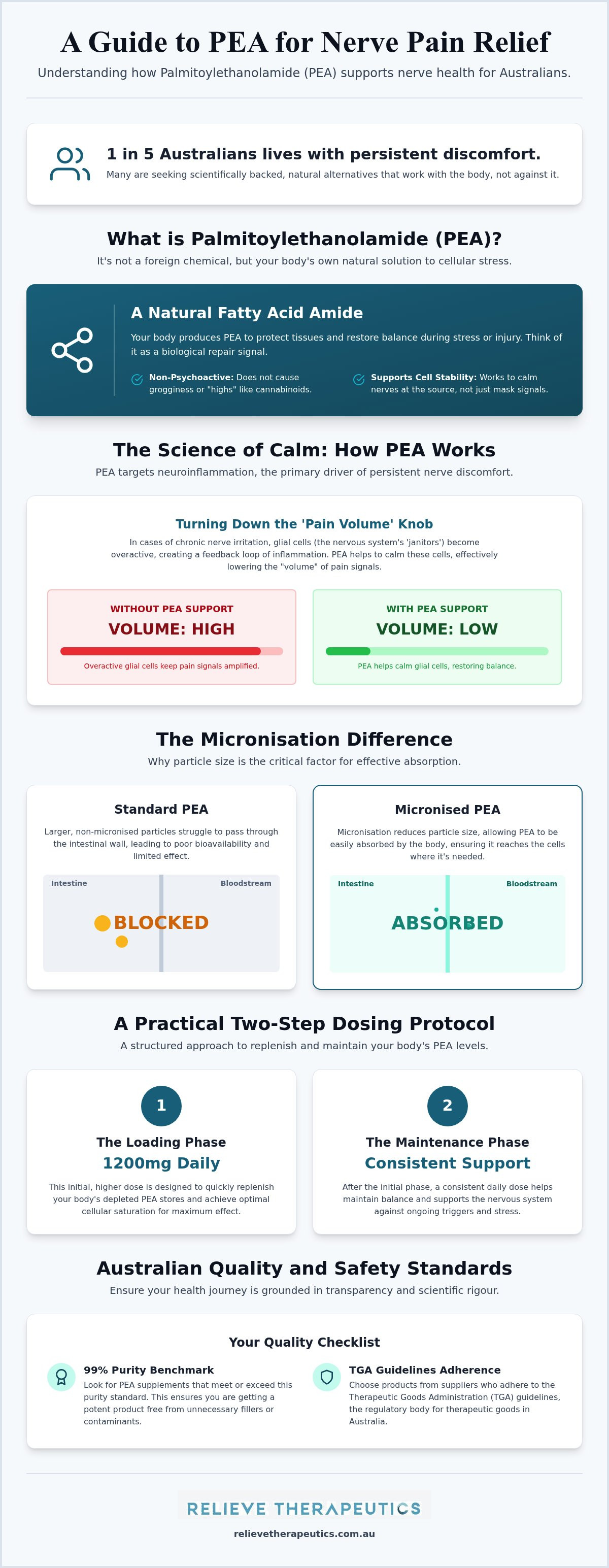
- Understand the practical two-step dosing protocol, beginning with a 1200mg loading phase for optimal saturation.
- Explore how PEA supports comfort, vitality, and daily function without the cognitive grogginess of traditional medications.
- Gain clarity on 2026 TGA standards to ensure your supplement meets the 99% purity benchmark for safety.
What is Palmitoylethanolamide (PEA) for Nerve Pain?
To understand the efficacy of pea for nerve pain, we must first recognise that this compound isn't a foreign substance. It's a fatty acid amide that your body synthesises naturally as a protective response to tissue stress or injury. Think of it as a biological repair man. When cells are under fire, the body produces PEA to dampen inflammation and restore balance. While small amounts exist in common foods like egg yolks, soy lecithin, and peanuts, these dietary levels are far too low to provide a therapeutic effect for those managing persistent discomfort.
A common point of confusion involves the relationship between PEA and cannabinoids. While they share similar pathways in the body's endocannabinoid system, they are functionally distinct. What is Palmitoylethanolamide (PEA) exactly? It is a non-psychoactive lipid that works by binding to specific receptors in the cell nucleus. Unlike CBD or THC, it doesn't cross the blood-brain barrier in a way that causes grogginess or "highs." It remains focused on cellular stability and nerve health, making it a reliable choice for those who need to remain sharp and active throughout the day.
The Role of PEA in Neuropathic Health
During periods of chronic nerve irritation, your body's internal demand for PEA often outpaces its ability to produce it. This leads to a state of depletion. When these natural reserves run dry, the "volume" of pain signals can become stuck at a high level. Supplementing with pea for nerve pain helps replenish these stores, effectively rebooting your body's innate calming mechanism. While acute injuries might resolve on their own, chronic management requires this consistent support to prevent the nervous system from becoming oversensitised.
Why 'Natural' Doesn't Mean 'Weak'
There is a growing shift in the Australian wellness landscape toward evidence-based natural support. PEA is not a "new" discovery; it has been the subject of clinical research for several decades, with hundreds of peer-reviewed studies documenting its safety and efficacy. It doesn't override your biology with synthetic chemicals. Instead, it works alongside your natural processes to encourage restoration. This clinical rigour ensures that choosing a natural path doesn't mean compromising on results. It's about using sophisticated science to support the body's own healing intelligence.
The Science of Calm: How PEA Targets Nerve Inflammation
Neuroinflammation is the primary driver of persistent nerve discomfort. To effectively manage this, we must look at the cells responsible for maintaining the delicate environment around our nerves. Glial cells are essentially the janitors of the nervous system, tasked with cleaning up cellular debris and ensuring neurons function correctly. When these cells become overactive due to chronic stress or injury, they stop cleaning and start contributing to a state of heightened sensitivity. This shift creates a feedback loop of inflammation that is difficult to break without targeted support.
Glial Cells and the 'Pain Volume' Knob
Imagine your nervous system has a volume knob for pain signals. In a healthy state, this knob is set to a low, background level. When glial cells become hyper-responsive, it's as if that knob gets stuck on 'high'. This mechanical failure leads to the physical sensations of burning, tingling, or electric shocks that many Australians describe. By utilising pea for nerve pain, you aren't just masking the sensation; you are addressing the underlying glial activation. There is significant scientific evidence for PEA showing its ability to turn that knob back down to a manageable level. Additionally, PEA promotes mast cell stabilisation. Mast cells are the body's first responders that release histamines and other pro-inflammatory chemicals. By keeping these cells calm, PEA reduces the chemical triggers that keep nerves in a state of high alert.
PEA and the Endocannabinoid System (ECS)
While it isn't a cannabinoid itself, PEA is an 'endocannabinoid-like' molecule. It works through what researchers call the 'entourage effect', where it helps maintain the body's own levels of anandamide, our natural 'bliss' molecule. This synergy supports the body's internal balance and reinforces the calming mechanisms of the endocannabinoid system. By supporting these pathways, pea for nerve pain helps restore the biological rhythm that chronic discomfort often disrupts. For a deeper dive into the molecular pathways involved, you can read our detailed breakdown on How Does PEA Work for Pain? The Science of Natural Relief in 2026.
This methodical approach to calming the nervous system is why many Australians find long-term success with high-purity supplements. If you're ready to support your body's recovery, you might explore our range of specialised PEA capsules designed for consistent daily management.
Why Australians are Choosing PEA Over Traditional Options
For many Australians, the decision to trial pea for nerve pain often stems from a desire to reclaim their mental clarity. While traditional neuropathic prescriptions can be effective at dampening signals, they frequently come with a significant cognitive trade-off. Users often report feeling 'spaced out', groggy, or trapped in a persistent brain fog that interferes with their ability to work, drive, or engage fully with their families. PEA offers a distinct advantage here because it works through cellular modulation rather than by depressing the central nervous system.
This shift is also driven by a growing awareness of the risks associated with long-term dependency. As a non-opioid pain relief supplement, PEA provides a safe, non-habit-forming alternative for those wary of the complications linked to stronger scripts. It is a cleaner approach to wellness that prioritises safety, transparency, and restoration. Because it is a naturally occurring fatty acid, it can often be integrated into an existing health plan alongside other therapies. We always recommend consulting with your GP to organise a comprehensive approach to your recovery.
Managing Side Effects and Mental Clarity
The struggle with standard neuropathic medications usually centres on the physical side effects. Dizziness, fatigue, and a lack of coordination can make daily tasks feel insurmountable. In contrast, PEA does not impact your cognitive function or your ability to drive safely. It allows you to manage discomfort while remaining present and focused. This ability to feel 'like yourself' again is often the most significant milestone for our clients. It represents a move away from simply surviving the day toward actually living it.
Long-Term Sustainability
Chronic nerve issues require a strategy that is sustainable for years, not just weeks. Many traditional options lead to 'tolerance' issues, where the body requires increasingly higher doses to achieve the same effect. PEA works differently. It supports the body's natural calming mechanisms without triggering this desensitisation. This makes it an ideal candidate for long-term management. To support this journey, many Australians prefer the convenience and cost-effectiveness of bulk options. Choosing a 180-capsule supply ensures you have a consistent, uninterrupted source of support, making your health journey more predictable and manageable. It is a practical solution for those committed to a steady, evidence-based path to vitality.
How to Take PEA for Nerve Pain: A Step-by-Step Approach
Adopting a new supplement routine requires a methodical strategy to ensure the best possible outcomes. This is particularly true when using pea for nerve pain, as the compound works by gradually modulating cellular responses rather than providing an instant, temporary mask. To help you navigate this process, we have developed a structured protocol based on current clinical observations and user feedback. For a more detailed breakdown, you can read our How to Take PEA for Nerve Pain: A Practical Australian Guide for 2026.
- Step 1: The Loading Phase. Start with a loading dose of 1200mg daily. This initial period is designed to saturate your system and "reboot" the body's natural calming mechanisms.
- Step 2: Prioritise Consistency. Take your capsules at the same time every day. Maintaining steady levels in your bloodstream is essential for long-term glial cell regulation.
- Step 3: Document Your Journey. Keep a simple daily diary for at least 8 weeks. Track your comfort levels, mobility, and sleep quality to identify subtle improvements.
- Step 4: Transition to Maintenance. Once you have established a baseline of relief, you may choose to adjust to a maintenance dose that sustains your results.
Finding Your Optimal PEA Dosage
While the loading phase typically requires 1200mg, the ideal daily intake for maintenance often falls between 600mg and 1200mg. Many Australians find that splitting the dose—taking 600mg in the morning and 600mg in the evening—provides more consistent support throughout a 24-hour cycle. This approach helps manage the "peaks and troughs" of discomfort. You can find specific guidance on tailoring your intake in our report on PEA Dosage for Pain: A Comprehensive Australian Guide to Optimal Intake. Always remember that the TGA recommends consulting a healthcare professional if you intend to use PEA for more than 21 consecutive days.
The Importance of Patience: The 8-Week Rule
Managing nerve health is a marathon, not a sprint. Because PEA works with your biology to calm neuroinflammation, the benefits accumulate over time. Many people make the mistake of stopping after only two or three weeks, missing the window where the most significant restoration occurs. We encourage a commitment of at least 8 weeks to truly gauge how the compound interacts with your unique physiology. Patience is the key to moving beyond temporary fixes and toward sustainable vitality. If you are ready to begin your 8-week protocol, you can order high-purity PEA capsules directly from our Australian warehouse to ensure a consistent supply.
Quality Matters: Choosing High-Purity PEA in Australia
The efficacy of pea for nerve pain depends heavily on the quality and purity of the supplement you choose. Many generic options available online contain unnecessary fillers, artificial colours, or synthetic binders that offer no therapeutic value. When managing chronic discomfort, your body requires a clean, concentrated source of Palmitoylethanolamide to support its internal repair systems. Partnering with an Australian specialist like Relieve Therapeutics ensures you receive a product designed for stability and professional-grade performance.
Micronisation and Bioavailability
Micronisation is the specialised process of reducing particle size to improve the solubility and absorption of a compound. Smaller particles reach the bloodstream more efficiently because they bypass the "absorption gap" typically found in standard lipid supplements. This is a critical distinction. If the particles are too large, they simply pass through the digestive tract without being utilised. Choosing a micronised formulation means you get more active support from every capsule, providing better results and superior value for your health investment.
Selecting the Right Quantity for Your Journey
Finding the right supply is about matching your dosage needs with your long-term goals. We offer flexible options to support you at every stage of your recovery:
- PEA 60 Capsules: This quantity is ideal for a 2-week intensive trial to observe your initial response.
- PEA 120 Capsules: A balanced and popular choice for completing your first month of consistent daily use.
- PEA 180 Capsules: Our best value option for those dedicated to the full 8-week protocol and ongoing nerve health maintenance.
Investing in high-purity supplements is a commitment to your future mobility and comfort. You can browse our range of high-purity PEA capsules today to find the right fit for your personal wellness journey.
Your Path Toward Restored Nerve Health
Managing chronic discomfort is a journey that requires patience, clinical clarity, and high-quality support. We have explored how pea for nerve pain acts as a biological repair man, calming overactive glial cells and stabilising mast cells to lower the "volume" of pain signals. Success lies in the details: choosing micronised formulations for superior absorption and committing to a consistent 8-week protocol. By focusing on purity and following a structured loading phase, you can move away from the fog of traditional scripts and toward a life defined by mobility and function.
As an Australian-owned and operated specialist, we are committed to providing pure Palmitoylethanolamide without heavy fillers or artificial additives. You can support your nerve health with our high-purity PEA capsules; order now from Relieve Therapeutics for fast local shipping across Australia. You don't have to navigate this journey alone. With the right evidence-based tools, a future of greater comfort and daily vitality is well within your reach.
Frequently Asked Questions
Is PEA safe to take with my other nerve pain medications?
PEA is generally considered safe to use alongside other nerve pain medications because it has no known drug-drug interactions. It works through different biological pathways than standard prescriptions, which often allows it to be integrated into a broader health plan. We always recommend consulting with your GP to organise your specific regimen safely and effectively.
How long does it take for PEA to start working for nerve pain?
Most users begin to notice the benefits of pea for nerve pain within four to eight weeks of consistent daily use. While some individuals report subtle changes earlier, the compound needs time to accumulate and modulate glial cell activity. Patience is vital for achieving the sustainable, long-term results discussed in our dosing guide.
Are there any side effects when taking Palmitoylethanolamide?
Palmitoylethanolamide has an excellent safety profile with very few reported side effects in clinical literature. In rare instances, some individuals may experience mild gastrointestinal discomfort or a heavy feeling in the stomach. These effects are typically transient and often resolve as the body adjusts to the supplement over the first few days.
Can I take PEA if I have sciatica or diabetic neuropathy?
Yes, PEA is frequently used to manage discomfort associated with both sciatica and diabetic neuropathy. Its role in stabilising mast cells and calming neuroinflammation makes it a versatile option for various types of nerve sensitivity. It addresses the underlying biological irritation regardless of the specific cause of the discomfort.
What is the difference between micronised and standard PEA?
The primary difference lies in the particle size, which directly impacts how well the body can utilise the supplement. Micronised PEA has been processed into much smaller particles to overcome the absorption gap in the gut. This ensures higher bioavailability and more efficient delivery to the bloodstream compared to standard, larger-particle formulations.
Is PEA legal and available over-the-counter in Australia?
PEA is entirely legal and available over-the-counter in Australia as a complementary medicine. It is regulated by the Therapeutic Goods Administration (TGA), meaning you don't need a prescription to purchase high-quality capsules. However, the TGA advises consulting a healthcare professional if you intend to use the supplement for more than 21 consecutive days.
Should I take PEA with food or on an empty stomach?
It is best to take pea for nerve pain with a meal, particularly one containing healthy fats. Since PEA is a fatty acid amide, consuming it with food enhances its solubility and absorption into your system. This simple habit ensures you receive the maximum therapeutic benefit from each dose you take.
Is PEA addictive or habit-forming?
PEA is not addictive and does not carry any risk of habituation or physical dependency. It is a naturally occurring lipid that your body already produces in response to tissue stress. Unlike some traditional pharmacological options, you won't experience withdrawal symptoms or a need for ever-increasing doses to maintain the same level of support.