

Finding the right palmitoylethanolamide dosage shouldn't feel like a guessing game, yet for many Australians, the persistent sting of nerve discomfort is matched only by the confusion of capsule counts. You've likely felt those frustrating nerve 'zaps' or the stinging sensation that refuses to settle, even after trying various remedies that promised quick results. It's exhausting to wait weeks for a change while wondering if you're taking enough to actually make a difference. We understand that when you're managing long-term inflammation, you need more than just hope; you need a precise, evidence-based plan.
This guide provides clinical clarity, offering protocols that focus on comfort, vitality, and daily function. You'll discover how to effectively manage your intake to support your body's natural endocannabinoid function and restore your sense of wellbeing. We will walk you through the essential loading phase, the transition to a maintenance routine, and the practical steps to ensure your daily routine is simple, effective, and grounded in science. By following these structured protocols, you can move toward a life defined by restoration rather than persistent discomfort.
Key Takeaways
- Learn how to replenish your body's natural reserves of PEA, which are often depleted by persistent inflammation and long-term physical stress.
- Understand the necessity of a 4–8 week loading phase to saturate tissues and effectively calm overactive glial cells.
- Discover how to personalise your palmitoylethanolamide dosage based on specific factors like body mass and the intensity of your discomfort.
- Master the titration method to identify your minimum effective dose for a sustainable and structured maintenance routine.
- Determine the correct capsule count for your specific needs, ensuring you have an uninterrupted supply to complete the critical three-month introductory period.
Understanding Palmitoylethanolamide Dosage: Why One Size Doesn't Fit All
Your body is an efficient bio-factory that produces Palmitoylethanolamide (PEA) as a natural response to physical stress, injury, or inflammation. It's an "on-demand" molecule designed to protect your tissues and nerves from excessive damage. However, when discomfort transitions from an acute event to a chronic condition, your internal production often falls behind, leaving your system in a state of constant deficit. Determining your optimal palmitoylethanolamide dosage isn't about overriding your biology; it's about replenishing these depleted stores to restore your internal "rheostat" for pain. This replenishment allows your body to return to its natural state of equilibrium without the need for harsh, synthetic interventions.
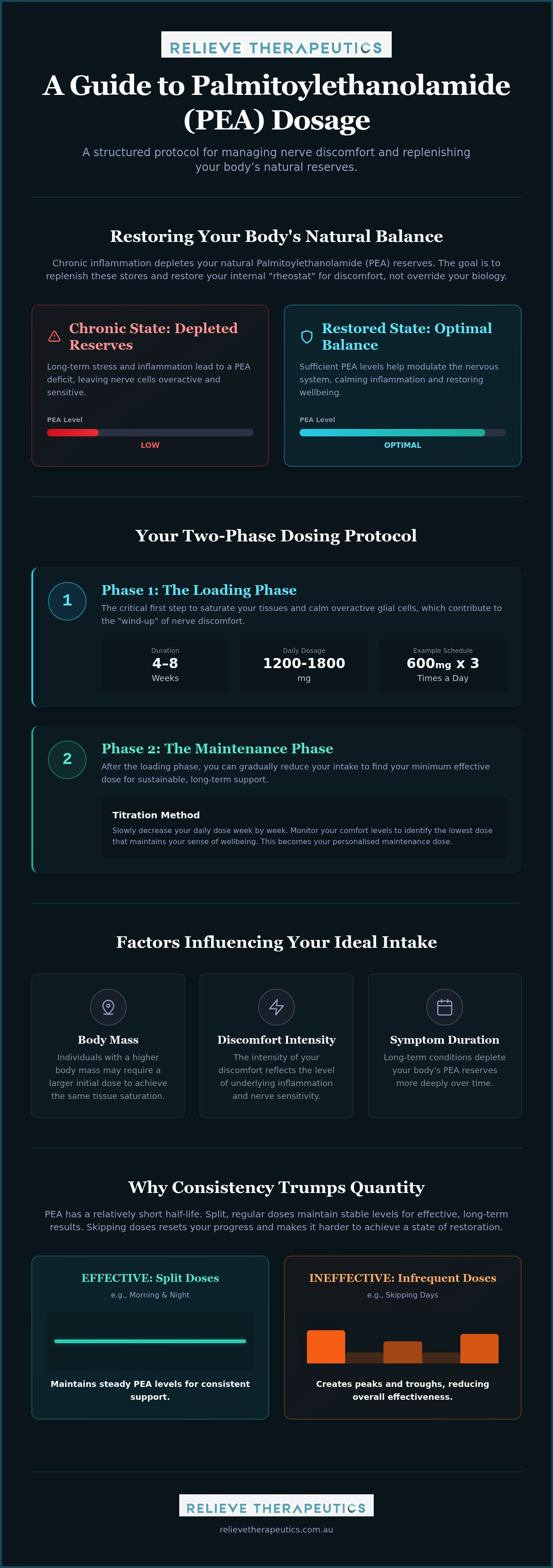
This biological "rheostat" acts like a dimmer switch for your nervous system. When PEA levels are sufficient, the switch stays low, keeping inflammation and nerve sensitivity in check. When levels drop, the "volume" of your discomfort increases. Because every person's baseline is different, your dosage must account for bio-individuality. A person managing mild joint stiffness will naturally require a different protocol than someone dealing with intense, persistent nerve zaps. Your weight, age, and the duration of your symptoms all dictate how much supplemental support your cells need to reach a state of calm. For instance, individuals with a higher body mass may require a larger initial "top-up" to achieve the same tissue saturation as those with a smaller frame.
The Role of the Endocannabinoid System
PEA functions as a vital modulator within your endocannabinoid system (ECS). Unlike THC, it's completely non-psychoactive and won't leave you feeling altered or "cloudy." It works through the "entourage effect," where it enhances your body's own calming molecules to prolong their soothing influence. You can learn more about the biochemical history of What is Palmitoylethanolamide through foundational research. The PPAR-alpha receptor serves as the primary biological target for your palmitoylethanolamide dosage, acting as a gateway to regulate the genes involved in the inflammatory response.
Why Consistency Trumps Quantity
Taking a large amount of PEA once a week won't provide the relief you're seeking. Because PEA has a relatively short half-life in the body, split doses in the morning and night are far more effective at maintaining steady blood levels. It works by influencing gene expression over time, which requires a constant, steady presence. Skipping days or being inconsistent resets your saturation progress, making it harder for your cells to maintain a state of restoration. Steady, daily intake is the key to achieving long-term functional improvements.
The Loading Phase: Establishing Your PEA Baseline
To break the cycle of chronic neuroinflammation, a structured approach is required rather than a haphazard one. This begins with the Loading Phase, a deliberate 4 to 8 week period where you maintain a higher intake to achieve full tissue saturation. This phase is critical because it addresses the overactive glial cells that contribute to the "wind-up" effect of nerve discomfort. When these cells remain in a state of high alert, they perpetuate a loop of inflammation and sensitivity. According to a PEA dosage meta-analysis, clinical trials frequently utilise a daily range of 1200mg to 1800mg to effectively calm these responses. By providing a consistent surplus of PEA, you allow your system to reset its baseline and begin the process of restoration.
Think of the loading phase as a biological "reboot." You aren't just managing a symptom; you're providing the raw materials your body needs to downregulate its own inflammatory pathways. Establishing this baseline is the most important step in your journey. Without this initial saturation, your palmitoylethanolamide dosage may not reach the threshold required to shift the body out of its chronic defensive state. It's about moving from a state of deficiency to a state of sufficiency, allowing your internal systems to function as they were intended.
Step-by-Step Loading Schedule
During the first four weeks, a high-frequency dosing schedule is often the most effective way to build your baseline. Many Australians find success with a 600mg dose taken three times daily. This rhythm ensures that your palmitoylethanolamide dosage remains stable throughout the day and night, preventing "troughs" where levels might dip. We advise against judging the efficacy of the supplement before the 30-day mark. Instead, monitor subtle shifts in your daily life. You might notice a slight improvement in your sleep quality or a gradual reduction in the intensity of "background noise" sensations. These small victories indicate that your cells are beginning to respond to the support.
Managing the 'Patience Gap'
It's natural to feel frustrated when results aren't immediate in the first fortnight. We understand that when you're in discomfort, every day feels significant. However, PEA is a systemic modulator rather than an "instant fix" like a traditional aspirin. It works by reorganising biological responses at a cellular level, a process that requires time and consistency. If you're looking for practical administration tips, you can read our guide on how to take PEA for nerve pain. For those starting this journey, choosing a 180-count bottle ensures you have an uninterrupted supply to complete the critical three-month introductory period.
Factors Influencing Your Ideal PEA Intake
While the loading phase provides a vital foundation, your long-term palmitoylethanolamide dosage is rarely a static number. Several biological levers influence how much supplemental support your system requires to maintain comfort. The severity of your condition is the first primary lever; those with deep-seated, multi-year nerve sensitivity often require a more robust intake than those managing recent, localized discomfort. If you experience an acute flare-up, a temporary increase in your daily amount can help manage the sudden spike in glial cell activity. Because PEA is an endogenous fatty acid amide already present in your cells, higher intakes are generally well-tolerated by the body without the common side effects associated with synthetic alternatives.
Bioavailability and body mass are the remaining levers that dictate efficiency. PEA is fat-soluble, meaning its absorption is significantly enhanced when consumed alongside healthy fats. Integrating your capsules into a meal containing avocado, olive oil, or fatty fish can improve the transit of the molecule into your bloodstream. Without these lipid carriers, a portion of your palmitoylethanolamide dosage may be wasted during digestion. Finally, individuals with a larger physical frame or a high metabolic rate typically require a higher mg-per-kilogram ratio to ensure the compound reaches therapeutic concentrations in the target tissues.
Micronisation and Dosage Efficiency
The physical structure of the PEA you consume determines how easily it can reach your nervous system. Standard PEA often consists of large particles that the body struggles to break down and absorb effectively. In contrast, micronised palmitoylethanolamide features significantly smaller particle sizes. These refined particles cross the blood-brain barrier with greater ease, allowing for potentially lower doses to achieve the same clinical outcome. When the particle size is reduced, the surface area increases, which directly translates to better solubility and more reliable results for the user.
Dosage Adjustments for Body Weight
Clinical observations suggest that a baseline of 15mg to 20mg of PEA per kilogram of body weight is a common starting point for therapeutic support. For a person weighing 80kg, this equates to a daily range of approximately 1200mg to 1600mg. A recent U.S. clinical trial on PEA utilised a standardised protocol of 600mg twice daily, illustrating a common middle-ground approach for average-weight adults. If you have a higher body mass or a particularly demanding physical lifestyle, you may find that you lean toward the upper end of the dosage spectrum. We always recommend discussing these adjustments with your GP, particularly if you are managing complex health needs or taking other medications, to ensure your routine is perfectly tailored to your biology.
A Practical Guide to Titrating Your PEA Dosage
Titration is the methodical process of identifying your "minimum effective dose," the lowest amount of supplemental support required to maintain your desired level of comfort. Once you have completed the initial 8-week loading phase and achieved tissue saturation, you don't simply remain on a high intake indefinitely. Instead, you begin to carefully scale back your daily palmitoylethanolamide dosage to find a sustainable long-term balance. This transition is a vital part of your journey, as it ensures your routine remains efficient, cost-effective, and perfectly aligned with your body's changing requirements. Finding this balance requires a high degree of self-awareness; you are essentially fine-tuning your internal environment to ensure the "volume" of your discomfort remains low.
Recognising the signs that you've reached your ideal dose is relatively straightforward. When your intake is "just right," you will experience sustained comfort and a noticeable reduction in the frequency of nerve-related zaps or stinging. Conversely, if you reduce your intake too quickly and your symptoms begin to resurface, it's a clear signal that your palmitoylethanolamide dosage has dropped below the therapeutic threshold. For those who experience intermittent flare-ups due to weather changes or physical exertion, a "pulse dosing" strategy can be highly effective. This involves temporarily returning to your loading phase amount for a few days to settle the system before tapering back down to your maintenance level.
The Maintenance Phase: Finding Your 'Sweet Spot'
To transition effectively, we recommend reducing your intake by one capsule every two to three weeks after the initial 8-week period. Most individuals find their long-term "sweet spot" settles between 400mg and 800mg per day. This range provides enough support to maintain glial cell calm without over-supplying the system. For a deeper analysis of how these levels vary based on specific conditions, you can explore our detailed guide on PEA dosage for pain. For those ready to transition to a long-term routine, our 120-count PEA capsules offer the ideal balance for a two-month maintenance supply.
Safety and Upper Limits
Clinical trials have utilized daily doses of up to 2400mg with no significant adverse effects reported, highlighting the compound's high safety profile. Because PEA is a lipid naturally found in common foods like eggs and soy, the risk of toxicity is extremely low. It's an endogenous substance that your body already knows how to process and utilise. If you happen to miss a dose, there's no need to double up the following day; simply resume your normal schedule at the next opportunity. While PEA is generally well-tolerated, TGA guidelines suggest consulting with your healthcare provider if you intend to use the supplement for more than 21 consecutive days to manage chronic conditions.
Aligning Your PEA Supply with Your Dosage Requirements
Planning your supply is just as important as the palmitoylethanolamide dosage itself. If you are following a standard loading protocol of 1200mg to 1800mg per day, you need to calculate your monthly requirements with precision to avoid any gaps in your routine. For most individuals, this equates to consuming between three and four capsules daily. While a 60-capsule pack serves as an excellent starter for testing your tolerance and ensuring the supplement agrees with your system, it's important to recognise that it will only last 15 to 20 days at a loading dose. To achieve the tissue saturation required to calm overactive glial cells, your supply must remain uninterrupted for the first two months.
Adopting a long-view approach to your supplement planning is the most effective way to ensure success. We generally recommend the 180-capsule bottle for the initial 90-day period. This bulk option is the most economical choice for those committed to the full loading and early maintenance phases. By securing a three-month supply, you eliminate the risk of running out of capsules just as your body begins to reorganise its inflammatory responses. Consistency is the cornerstone of restoration; a single week without your supplement can reset the progress you've worked hard to establish.
Why Quality and Purity Matter for Dosage
The efficiency of your palmitoylethanolamide dosage is directly linked to the purity of the product you choose. Many generic options are "filler-heavy," containing binders that can interfere with the breakdown and absorption of the active lipid. When a product is diluted with unnecessary additives, you may find yourself needing a higher daily count just to achieve a basic therapeutic effect. Choosing Australian-sourced supplements ensures you are receiving a product manufactured to rigorous quality standards. Investing in high quality PEA capsules provides the peace of mind that every milligram is working toward your recovery rather than being lost to poor manufacturing.
Next Steps: Starting Your Journey
Starting a new health protocol requires discipline and a structured plan. We encourage you to commit to an initial 8-week window to allow the PEA to fully integrate with your system and downregulate chronic sensitivity. Before you begin, use this final checklist to ensure you're prepared:
- Consult with your GP to discuss your plan, especially if you take other medications.
- Organise your daily schedule to include fat-soluble meals (like breakfast with eggs or avocado) for optimal timing.
- Use a journal or app to track your symptoms and notice subtle improvements in sleep and background comfort.
Restoring Your Quality of Life with Precision
Managing chronic discomfort is a journey that requires both patience and a structured biological plan. By establishing a solid baseline through a dedicated loading phase and refining your intake via titration, you're giving your body the support it needs to reset its inflammatory responses. We've explored how factors like body mass and micronisation influence your success, highlighting that a consistent, daily routine is far more effective than sporadic high doses. Finding your optimal palmitoylethanolamide dosage is about more than just numbers; it's about reclaiming your daily function and restoring your sense of vitality.
At Relieve Therapeutics, we provide pure, high-strength PEA with no nasty fillers, ensuring you receive only the active support your system requires. We're proud to be trusted by Australians for natural nerve support and offer free shipping on bulk orders across the country to keep your routine uninterrupted. Shop our PEA 180 Capsules for a full 3-month loading protocol and take the first step toward sustained comfort. You now have the evidence-based tools to manage your wellbeing with confidence and clarity.
Frequently Asked Questions
How many mg of PEA should I take daily for nerve pain?
A typical therapeutic palmitoylethanolamide dosage for nerve pain begins with a loading phase of 1200mg to 1800mg daily for the first four to eight weeks. This higher intake is designed to saturate your tissues and calm overactive glial cells that perpetuate discomfort. Once you achieve sustained comfort and your system has reset its baseline, you can often transition to a maintenance level of 400mg to 800mg per day for long-term support.
Can I take PEA on an empty stomach?
You can take PEA on an empty stomach, but it is significantly more effective when consumed with a meal containing healthy fats. Because PEA is a lipid, or a fatty acid amide, it requires dietary fats like olive oil, avocado, or eggs to improve its absorption into the bloodstream. Taking your capsules during breakfast or dinner ensures you get the most out of every dose and prevents the compound from being wasted during digestion.
Is it possible to take too much Palmitoylethanolamide?
PEA has an exceptional safety profile because it is a substance your body already produces naturally in response to stress. Clinical trials have safely utilised daily doses of up to 2400mg without significant adverse effects reported. Since it is an endogenous lipid found in common foods like soy and eggs, the risk of toxicity is extremely low; however, we always suggest consulting your GP if you plan to exceed the standard recommended amounts for your specific condition.
How long does it take for PEA dosage to start working?
Most individuals notice subtle improvements in sleep quality or background discomfort within the first two to four weeks of a consistent palmitoylethanolamide dosage. However, because PEA works by reorganising biological responses at a cellular level, it can take up to eight to twelve weeks to experience the full functional benefits. Patience is key during this initial period of tissue saturation, as the body needs time to downregulate chronic inflammatory pathways.
Should I split my PEA dosage throughout the day?
Yes, splitting your daily amount into morning and evening doses is highly recommended for maintaining steady blood levels. PEA has a relatively short half-life in the body, so taking it twice or three times daily prevents the "troughs" that occur when levels dip between doses. This consistent presence allows for more reliable gene expression and glial cell regulation throughout the day and night, leading to more stable results.
Does PEA interact with other pain medications?
PEA is generally well-tolerated and hasn't shown significant negative interactions with common medications. In many cases, it is used alongside existing treatments to provide additional support for the endocannabinoid system without the side effects often associated with synthetic options. Because it works through different biological pathways, it is a versatile choice for many Australians; though a conversation with your healthcare provider is always advisable when starting any new supplement routine.
Can I take PEA long-term for chronic management?
Yes, PEA is suitable for long-term use as part of a chronic management routine once the initial loading phase has settled your system. Its natural origin and high safety profile make it an ideal partner for those seeking sustained support for their daily function. However, TGA guidelines suggest consulting with your healthcare provider if you intend to use the supplement for more than 21 consecutive days to ensure your personal health journey is professionally monitored.
What should I do if I don't see results after a month?
If you don't see results after 30 days, ensure you are taking your capsules consistently with a fat-containing meal and that your palmitoylethanolamide dosage is high enough. Some individuals have a higher biological demand and may require the full eight to twelve weeks of the loading phase to notice a significant shift. We recommend continuing the protocol for at least three months before assessing its overall efficacy for your specific needs, as cellular restoration is a gradual process.