

When comparing non-prescription pain relief alternatives Australia offers, start by matching the option to the kind of pain and your health needs. The most familiar choice isn’t automatically the safest or most suitable one.
It can be hard to tell where pharmacy medicines end and supplements or drug-free approaches begin. This guide explains the main options, how they differ and what to consider before trying something new. It also covers when a pharmacist or doctor can help you decide on a sensible next step.
You’ll find an overview of common non-prescription medicines, complementary supplements such as palmitoylethanolamide (PEA), and practical non-medicine supports, including movement and heat. These categories aren’t interchangeable: a supplement isn’t an over-the-counter medicine, and neither should replace prescribed care without professional advice. Understanding the options can help you make an informed choice and recognise when to seek individual guidance.
Key Takeaways
- Compare pharmacy medicines, non-medicine strategies and dietary supplements by their intended use, evidence limits and safety considerations.
- Choosing among non-prescription pain relief alternatives Australia offers starts with the kind, duration and impact of your pain, as well as your health circumstances.
- Use a simple framework to describe your pain, review your health context, compare options and monitor your response.
- Non-prescription doesn’t mean risk-free or suitable for everyone. Consider label directions, possible interactions and when to seek professional advice.
- Learn what PEA is, how it differs from a pain medicine and what to consider before discussing this supplement with a health professional.
What non-prescription pain relief alternatives are available in Australia?
Non-prescription pain relief includes more than medicines. In Australia, options can include pharmacy medicines, non-medicine strategies such as movement or heat, and dietary supplements. They differ in purpose, evidence and safety considerations. The right option depends on the type and duration of pain, your health history, other medicines or supplements you use, and your personal circumstances.
A medicine may be one part of a short-term plan, while practical supports may help someone manage everyday activities. A supplement is a separate category, not simply a natural version of a medicine. The broad field of pain management strategies includes approaches that can be adapted or combined, rather than one universal substitute.
Which non-prescription pain relief categories should you know?
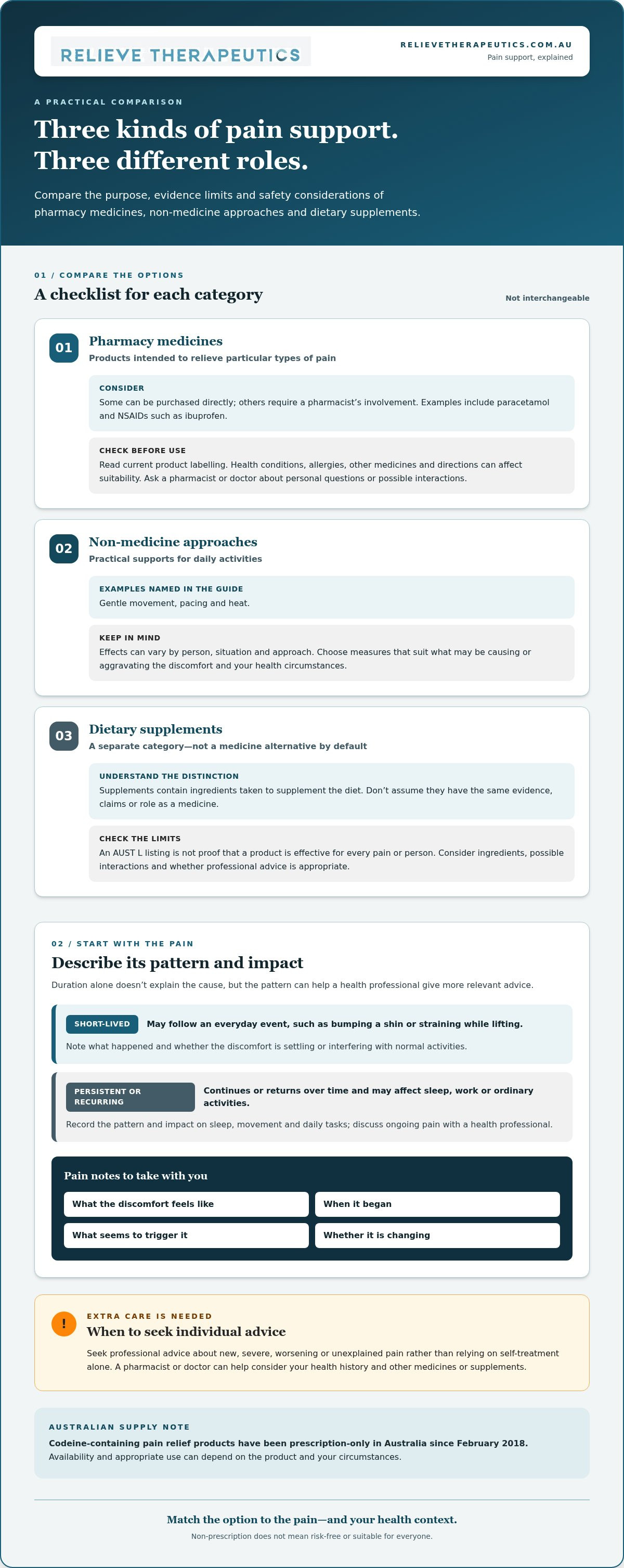
Pharmacy medicines are products intended to relieve particular types of pain, with directions and warnings on the label. Some are available directly from a pharmacy; others require a pharmacist’s involvement. In Australia, codeine-containing pain relief products have been prescription-only since February 2018. Availability and appropriate use depend on the product and your circumstances.
Non-medicine approaches include gentle movement and heat. Their suitability depends on what is causing or aggravating the discomfort, your health and how the approach affects you. Dietary supplements are different again: they contain ingredients taken to supplement the diet. Don’t assume they have the same evidence, claims or role as a medicine. For listed complementary medicines, an AUST L listing is not proof that a product is effective for every pain or person.
Why does the type and duration of pain matter?
Acute pain may appear after an everyday event, such as bumping a shin or straining yourself while lifting. Persistent pain continues or returns over time and may affect sleep, work or ordinary activities. These experiences can call for different assessment and support. Duration alone doesn’t explain the cause, and an approach that suits one person or situation may not suit another.
Before choosing an option, note what the discomfort feels like, when it began, what seems to trigger it and whether it is changing. This information can help a pharmacist or doctor give more relevant advice, particularly if you have an ongoing health condition or use other medicines.
- Short-lived pain: note what happened and whether the discomfort is settling or interfering with normal activities.
- Persistent or recurring pain: record its pattern and impact on sleep, movement and daily tasks, and discuss it with a health professional.
Seek professional advice about new, severe, worsening or unexplained pain rather than relying on self-treatment alone. The range of non-prescription pain relief alternatives Australia offers is broad, but a sensible next step starts with understanding the pain and your individual health context.
How do medicine, non-medicine and supplement options differ?
These options may all be considered as part of pain support, but they aren’t interchangeable. Medicines have specific ingredients and directions for use. Non-medicine approaches focus on activities or practical measures, while dietary supplements are a separate product category with different evidence and claims. Compare each option in context. “Natural” doesn’t automatically mean safer, and a pharmacy medicine won’t suit everyone.
| Category | Intended context | Evidence limits | Safety considerations |
|---|---|---|---|
| Pharmacy medicines | Short-term relief for certain types of pain, depending on the medicine. | Evidence and suitability relate to a particular ingredient and use, not every kind of pain. | Check the label, health conditions, other medicines and current advice from a pharmacist or doctor. |
| Non-medicine approaches | Support daily function through measures such as movement, pacing or heat. | Effects can vary with the person, situation and approach. | Choose an approach that is appropriate to your circumstances; seek advice if unsure. |
| Dietary supplements | A separate option for people researching complementary support. | A supplement should not be assumed effective for pain or suitable for everyone. | Consider ingredients, possible interactions and whether professional advice is appropriate. |
What should you know about pharmacy pain medicines?
Pharmacy options include medicines such as paracetamol and non-steroidal anti-inflammatory drugs (NSAIDs), including ibuprofen. Some products can be purchased directly, while others require a pharmacist’s involvement. Availability and conditions of supply can vary, so read current Australian product labelling and seek pharmacy advice. Healthdirect’s guide to pain relief medicines in Australia outlines common uses and safety considerations.
Whether a medicine is suitable depends on more than the type of pain. Existing health conditions, other medicines, allergies and label directions can all matter. Don’t combine products or change how you use a medicine based on guesswork. A pharmacist or doctor can help answer personal questions, including those about possible interactions.
Where do non-medicine approaches and supplements fit?
Movement and pacing may help some people maintain or gradually adapt daily activities, while heat may be a practical comfort measure in some situations. These approaches can complement care, but they aren’t substitutes for medicines where those are recommended, and they aren’t suitable for every cause of pain. Choose an approach that fits your symptoms. If it worsens discomfort, stop and seek advice.
Supplements are another distinct category, not an equivalent replacement for established care. Palmitoylethanolamide (PEA), for example, is a dietary supplement ingredient, not a pain medicine. Don’t assume it will work or suit your circumstances. If you’re researching PEA, the non-opioid pain relief guide offers further context. You can also explore PEA supplement options as part of your research, while keeping personal health advice at the centre of your decision.
Are non-prescription pain relief alternatives safe and effective?
Available without a prescription doesn’t mean risk-free, suitable for everyone or effective for every kind of pain. Safety and benefit depend on the particular product or approach, why you’re considering it and who is using it. Evidence that an option may help in one defined situation shouldn’t be stretched into a claim that it works for all pain.
Check medicine labels and seek tailored advice when personal risks or interactions may apply. This is especially important if you have a health condition, take other medicines or supplements, are pregnant or breastfeeding, or are considering an option for a child. These circumstances can change what is appropriate. A pharmacist or doctor can help you understand relevant risks.
What can change the safety of a pain relief option?
Different medicines have different precautions, so don’t generalise risks across every product. Read the Australian label for intended use, warnings and directions. Don’t exceed the stated directions or assume that combining products is safe because they’re available without a prescription. If a warning is unclear or you’re unsure whether a product fits your health circumstances, pause and seek advice from a pharmacist or doctor.
Keep a clear record of what you use, including medicines and supplements, and share it when asking about possible interactions. This is particularly helpful if you see more than one health professional or use several products for different reasons. Non-medicine approaches also need to suit the situation: if movement or heat worsens symptoms, stop and reassess rather than pushing through.
How should you judge evidence without expecting a cure?
Research findings apply to the people studied, the particular product or approach tested, and the outcomes measured. A study about one type of pain doesn’t establish effectiveness for another. Evidence of a possible biological mechanism also doesn’t prove that a supplement produces a meaningful benefit in everyday life. Promising findings can justify further research, but they aren’t the same as an established clinical recommendation or a guaranteed result.
For a useful evidence check, look beyond a headline or broad claim. Consider what was studied, whether the research assessed people or laboratory mechanisms, and whether the outcome matters to your circumstances. For supplements, don’t assume effectiveness or personal suitability from an ingredient name alone. PEA, or palmitoylethanolamide, is a dietary supplement ingredient, not a pain medicine or a replacement for prescribed care. Information about PEA’s proposed mechanisms and pain science can explain what researchers are exploring, but keep a proposed mechanism distinct from proven clinical benefit.
When weighing up non-prescription pain relief alternatives Australia offers, consider three questions: does the evidence relate to this use, could personal factors affect safety, and is the approach helping with a meaningful daily goal? If pain persists, changes or limits normal activities, seek professional advice rather than adding more products or continuing an approach that isn’t helping.
How can you choose a practical pain relief plan in Australia?
A clear plan helps you compare options without guessing or trying several things at once. Start with what the pain is like and how it affects your day, then consider your health circumstances and the support available. This framework can help you prepare for a conversation with a pharmacist or doctor. It doesn’t diagnose the cause or replace individual medical advice.
- Describe the pain. Note where it occurs, when it began, how it feels and whether it comes and goes or is present most of the time. Record possible triggers and anything that seems to ease or aggravate it.
- Review your context. Consider how the pain affects sleep, work, movement and other daily activities. Write down health conditions, medicines and supplements you already use, as these details may influence which options are suitable.
- Compare possible approaches. Look at the intended use, evidence and safety information for each option. A pharmacy medicine, a non-medicine strategy and a dietary supplement have different roles, so don’t treat them as interchangeable.
- Monitor safely. If you try an appropriate option, follow its directions and pay attention to changes in symptoms and daily function. If pain worsens, persists or you’re unsure what to do next, seek professional advice rather than adding products or exceeding label directions.
What details can help you choose your next step?
Useful notes don’t need to be complicated. Record the start date, location, pattern, triggers and effect on everyday activities, along with what you’ve already tried and how it seemed to affect you. Keep a current list of medicines and supplements, including products you use only occasionally. Taking these details to a health professional can make it easier to discuss your concerns and clarify questions about suitable options or possible interactions.
When should you seek professional or urgent advice?
Arrange advice from a doctor or pharmacist if pain is persistent, worsening, unexplained or limiting your usual activities. Seek guidance if you have a health condition, take other medicines, are pregnant or breastfeeding, or feel uncertain about a product’s directions or suitability. Don’t wait for a self-management approach to work if your symptoms are changing or causing concern.
If symptoms feel urgent or life-threatening, call 000 in Australia. For non-urgent concerns, a concise record of your pain and what you use can help you explain the situation clearly and discuss a sensible next step.
If you’re researching supplements as one part of your options, you can explore PEA supplement options and discuss any questions with a health professional. A considered plan is more useful than searching for one universal answer among the non-prescription pain relief alternatives Australia provides.
Could PEA be one non-prescription pain relief alternative to research?
Palmitoylethanolamide, usually shortened to PEA, is an ingredient used in dietary supplements. It’s not a pain medicine, whether prescription or over the counter, and shouldn’t be treated as a proven treatment, cure or replacement for prescribed care. People researching non-prescription pain relief alternatives Australia offers may come across PEA, but interest in an ingredient isn’t the same as evidence that it will help a particular person.
Research into PEA includes questions about how it interacts with biological processes. That scientific interest can provide a reason to learn more, but it doesn’t guarantee a meaningful outcome for an individual. Interpret evidence in context, including the type of research, the product studied and the outcomes measured. Be wary of claims that promise reliable relief or suggest one supplement is suitable for every kind of pain.
What should you understand before considering a PEA supplement?
A dietary supplement and a medicine have different roles and claims. Don’t use PEA to replace prescribed treatment or delay assessment of pain that persists, worsens or concerns you. If you take medicines or other supplements, have a health condition, or are pregnant or breastfeeding, discuss possible suitability and interactions with a health professional. Follow the product label and don’t infer a dose, timeline or expected result from general information about PEA.
It can help to make a short list of what you want to clarify: what the supplement contains, how its claims are supported and whether it fits your circumstances. A pharmacist or doctor can consider these questions alongside your health history and current care. This keeps curiosity about a supplement separate from decisions about diagnosis or treatment.
How can you research PEA quality and product options?
Look for clear product information and assess claims carefully rather than relying on persuasive language alone. Check whether the ingredient and product details are easy to understand, and whether statements about benefits are appropriately qualified. A guide to high-quality PEA capsules in Australia can help you think through quality considerations as you compare information.
- Check the product information: understand what is stated about the supplement and avoid assuming it has medicine-like effects.
- Assess claims critically: look for measured, qualified language rather than promises of a cure or guaranteed pain relief.
- Consider personal fit: discuss the ingredient with a health professional if your health circumstances or other products raise questions.
Relieve Therapeutics offers PEA capsules in 60, 120 and 180-capsule supplies. Explore the range as one step in your research, not as a substitute for individual health advice. Explore PEA capsules from Relieve Therapeutics, and speak with a health professional about whether a supplement is appropriate for you.
Make your next step an informed one
Finding a way forward doesn’t mean choosing a single solution or expecting an immediate answer. Use what you’ve learned to guide a considered conversation with a pharmacist or doctor, especially if pain is affecting daily life or you’re unsure whether a supplement suits your circumstances. The aim is a safe, personal next step, not a promise of a cure.
If you’re researching non-prescription pain relief alternatives Australia offers and want to learn more about PEA, Relieve Therapeutics is an Australian retailer specialising in PEA dietary supplements. Its capsules are available in 60, 120 and 180-capsule supplies. PEA is a supplement, not a pain medicine, so consider the product information and seek individual advice where relevant.
Explore PEA capsules from Relieve Therapeutics as part of your research. Review the product information and speak with a health professional if you have questions about whether a supplement is appropriate for you.
Frequently Asked Questions
What non-prescription pain relief options are available in Australia?
Options include pharmacy medicines, practical approaches such as heat or movement, and dietary supplements. A pharmacy medicine may be available over the counter or require a pharmacist’s involvement, depending on the product. For example, someone may consider a medicine for short-term discomfort while also adjusting an activity that aggravates it. These options serve different purposes, so availability alone doesn’t show which is suitable for your situation.
Are non-prescription pain relief alternatives safe for everyone?
No, an option available without a prescription may still be unsuitable for some people. Allergies, health conditions, pregnancy, breastfeeding, age and other medicines can affect the risks. Before using a product, check its Australian label and tell a pharmacist or doctor about medicines and supplements you already take. If you’re buying for a child or older person, seek advice rather than assuming adult directions apply.
Can natural supplements replace pain medicine?
No, a natural supplement shouldn’t be assumed to replace a medicine or prescribed care. “Natural” describes an origin, not whether a product is effective, risk-free or appropriate for you. Don’t stop prescribed treatment or change your care plan because of a supplement claim. If you’re considering adding one, discuss it with a health professional, particularly if you take other products or have an ongoing health condition.
How do I choose between a pain medicine and a non-medicine approach?
Consider what you need to manage and what is safe in your circumstances. For example, if a particular activity aggravates discomfort, modifying that activity may be a useful practical step, while a medicine decision calls for checking its intended use and label. You don’t have to frame the choice as either-or, but combining approaches should make sense for you. A pharmacist or doctor can help clarify uncertainties.
What should I do if non-prescription pain relief is not helping?
If pain isn’t improving, is getting worse or is disrupting normal activities, arrange advice from a doctor or pharmacist rather than increasing a dose or adding another product. Note what you’ve tried, when you used it and any changes you noticed. This can help guide the next conversation. For symptoms that feel urgent or life-threatening in Australia, call 000.
Is PEA a non-prescription pain medicine?
No, PEA, or palmitoylethanolamide, is an ingredient in dietary supplements, not a pain medicine. Research interest in PEA doesn’t mean it’s a proven treatment or that it will suit everyone. If you’re considering a PEA supplement, review its product information and discuss it with a health professional if you have questions about your health circumstances or other products you use.
How much non-prescription pain relief should I take?
There isn’t one dose that applies to every product or person. Follow the directions on the specific Australian product label, and don’t exceed them or assume that two products with different names have different ingredients. If you’re unsure how the directions apply to you, ask a pharmacist or doctor before taking it. For supplements such as PEA, use the product information and seek tailored advice rather than guessing.