

What if the strongest claim on a supplement label isn’t backed by strong evidence for period pain? If you’re looking for a non-hormonal supplement for period pain, it’s reasonable to want options that suit your preferences and routine. But popularity, a natural origin and a plausible explanation of how an ingredient might work don’t establish that it eases menstrual cramps.
Period pain can affect work, study, sleep and everyday wellbeing. You deserve clear information, not pressure to try a product or dismiss your concerns. This guide shows you how to compare non-hormonal options by checking how relevant the evidence is, what its limitations are and what to consider before use.
We’ll also look at where palmitoylethanolamide (PEA) fits, distinguishing research on pain generally from evidence specifically about period pain. You’ll learn what supplement research can and can’t tell you, and when severe, worsening or persistent symptoms warrant assessment by an Australian health professional.
Key Takeaways
- Compare magnesium, ginger, omega-3 and PEA by the evidence for menstrual pain specifically, not by how plausible a marketing claim sounds.
- A non-hormonal supplement for period pain may be worth researching, but biological explanations and findings from other pain conditions don’t prove it works for period pain.
- Use a practical checklist to clarify your goal, read product labels, consider safety and track symptoms across your cycle.
- Learn what an Australian Therapeutic Goods Administration listing can indicate, and why it shouldn’t be mistaken for proof that a supplement is effective for menstrual symptoms.
- Explore where PEA fits, including Relieve Therapeutics’ 60, 120 and 180 capsule options, while keeping the limits of the evidence in view.
Non-hormonal supplements for period pain: what are you comparing?
Dysmenorrhoea is the medical term for painful menstruation. It often means cramping around the start of a period, although the experience varies. Pain may be mild for one person and disruptive for another. If cramps affect your work, study, sleep or everyday activities, that impact deserves attention. Looking for a non-hormonal supplement for period pain is one way to explore your options, but the label “non-hormonal” doesn’t tell you whether a product works.
It helps to separate three questions: what might be causing the pain, what evidence supports an option for menstrual symptoms, and whether that option is suitable for you. A supplement is one consideration. It doesn’t replace investigating concerning symptoms or weighing up other approaches to pain management with a health professional.
Primary and secondary period pain are not the same
Primary dysmenorrhoea refers to period pain without an identified underlying pelvic condition. Secondary dysmenorrhoea is pain associated with another cause, which may include endometriosis. These categories describe possible causes, not a diagnosis you can make from symptoms alone. For a general overview of the types and causes, see Dysmenorrhea.
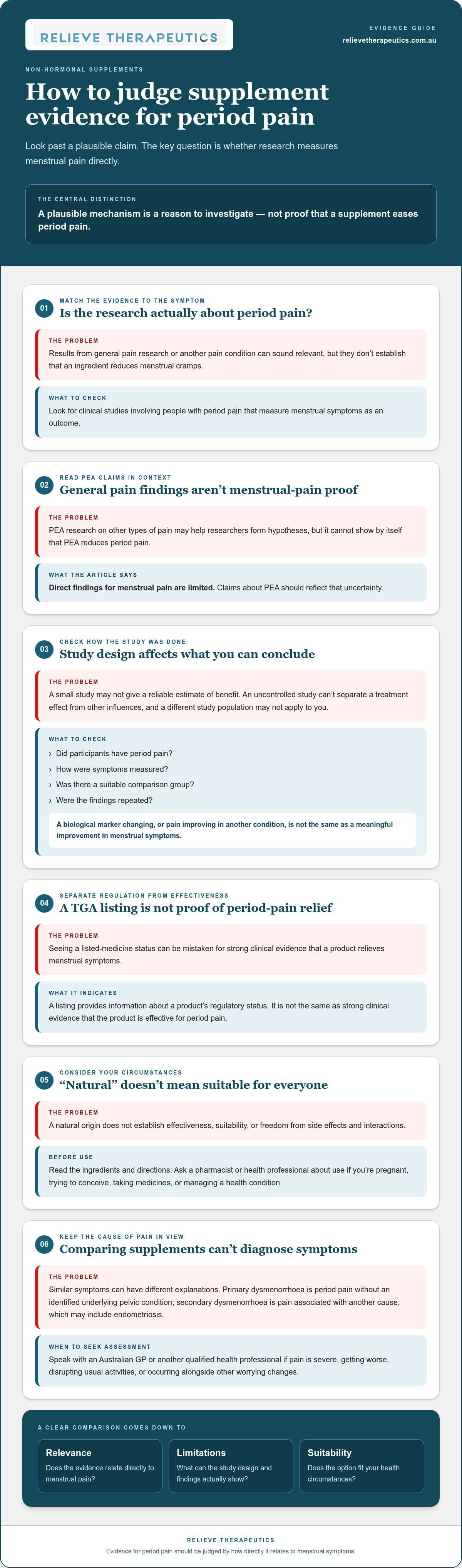
Similar symptoms can have different explanations, so comparing supplements can’t identify the cause. Consider speaking with an Australian GP or another qualified health professional if your pain is severe, getting worse, disrupting your usual activities or occurring alongside other worrying changes. An assessment can help clarify what may be contributing and which options are appropriate.
What “non-hormonal” means when considering a supplement
“Non-hormonal” describes an approach that doesn’t rely on hormonal medicines to manage symptoms. It can include different options, such as supplements, non-hormonal pain medicines or supportive measures. These options aren’t interchangeable: they can have different evidence, purposes and safety considerations. A supplement is intended to add dietary ingredients, but that doesn’t make it a clinically proven treatment for menstrual pain.
That distinction matters. A natural origin doesn’t establish effectiveness, suitability or freedom from side effects and interactions. A product may also be unsuitable alongside particular medicines or health conditions. Read the ingredients and directions, and discuss use with a pharmacist or health professional if you’re pregnant, trying to conceive, taking medicines or managing a health condition.
In Australia, some complementary medicines are regulated as listed medicines. A listing provides information about a product’s regulatory status, but it isn’t the same as strong clinical evidence that the product relieves period pain. The useful comparison is not simply “natural” versus “hormonal”. Consider how directly the evidence relates to menstrual pain, what remains uncertain and whether the option fits your circumstances. The following sections apply that approach to individual supplements.
How period pain develops, and what supplement evidence can show
Understanding a possible pain mechanism can explain why an ingredient attracts research, but it can’t show on its own that a supplement eases menstrual symptoms. For a fair comparison, look for clinical studies that measure period pain directly. Don’t assume results from research on other pain conditions will apply.
Why menstrual cramps happen
Prostaglandins are signalling substances involved in the menstrual cycle. As the uterine lining sheds, prostaglandin activity can contribute to uterine muscle contractions. Stronger contractions may be associated with cramping and, temporarily, reduced blood flow to the uterus. The NHS describes this link between prostaglandins, uterine contractions and period pain. It explains one possible mechanism, but not everyone’s symptoms or whether there’s an underlying condition.
This biology also helps explain why anti-inflammatory medicines are commonly used for period pain: they can reduce prostaglandin production. But an ingredient that appears to influence inflammation or pain signalling in laboratory research or general pain studies isn’t automatically effective for menstrual cramps. A plausible mechanism is a reason to investigate, not proof of a useful outcome.
How to interpret research on PEA and period pain
For PEA, the key question is whether clinical studies specifically assess dysmenorrhoea and measure menstrual pain as an outcome. Evidence from other types of pain may help researchers form hypotheses, but it can’t establish that PEA reduces period pain. Direct findings for menstrual pain are limited, so claims should reflect that uncertainty.
Study design matters, too. A small study may not give a reliable estimate of benefit. An uncontrolled study can’t separate a treatment effect from other influences, and findings in a different population may not apply to you. Check whether participants had period pain, how symptoms were measured, whether there was a suitable comparison group and whether findings were repeated. A change in a biological marker or pain in another condition isn’t the same as a meaningful improvement in menstrual symptoms.
For background on proposed mechanisms, you can read about how PEA works for pain and PEA and endocannabinoid signalling. These explain general pain-related concepts, not clinical proof of benefit for period pain. If you’re researching a non-hormonal supplement for period pain, keep that distinction in mind. Relieve Therapeutics offers PEA capsules in 60, 120 and 180 capsule supplies for readers considering PEA as an option to research, not as a proven menstrual-pain treatment. Explore the PEA capsule options alongside the evidence and its limitations.
Comparing non-hormonal period-pain options without overreading the evidence
There isn’t a reliable basis for naming one supplement the best choice for everyone. Reviews of dietary approaches report possible benefits for some options, but the overall evidence for supplements in dysmenorrhoea isn’t strong enough to establish any as a proven treatment. The comparison below focuses on how directly each option has been studied for period pain and where uncertainty remains.
| Option | Evidence for period pain | Key caveat |
|---|---|---|
| Magnesium | Evidence is limited and doesn’t establish a consistent benefit for menstrual pain. | Evidence for a role in the body isn’t the same as evidence that a supplement eases cramps. Consider your health circumstances and other products you take. |
| Ginger | Some reviews describe potential benefit, but the evidence is low quality and not conclusive. | Study results don’t guarantee an effect for an individual. Check the product directions and discuss suitability if you take medicines or have a health condition. |
| Omega-3 | Fish oil has some low-quality evidence suggesting possible benefit; a clear, dependable effect hasn’t been established. | Findings depend on the product and study. They shouldn’t be treated as proof that every omega-3 supplement will help. |
| PEA | Evidence for pain conditions generally doesn’t establish effectiveness for dysmenorrhoea. Direct menstrual-pain evidence remains limited. | PEA is an option to research, not an established period-pain treatment. Don’t infer menstrual benefit from findings in unrelated pain conditions. |
What to compare across supplement options
Look beyond a headline or a proposed mechanism. Ask whether a study involved people with period pain, measured menstrual symptoms, used a suitable comparison group and produced consistent findings across studies. A result from a small or differently selected population may not apply to your situation. Evidence for one ingredient, or for another type of pain, can’t automatically be transferred to a different supplement or to menstrual cramps.
“Non-hormonal” describes an approach, not a guarantee. It doesn’t mean a supplement is proven, suitable for everyone or free from interactions. Supplements also aren’t interchangeable with prescribed treatment. If you take medicines, have a health condition or are unsure about an ingredient, discuss it with a pharmacist or health professional before use.
Where PEA fits
Relieve Therapeutics is an Australian online retailer offering PEA capsules in 60, 120 and 180 capsule supplies. These are dietary supplement options to consider in light of the evidence, not established treatments for period pain. A guide to evaluating PEA capsules can help frame product-related questions, but it isn’t evidence of menstrual-pain benefit. You can view the available PEA capsule options with that distinction in mind.
A practical Australian checklist for choosing a period-pain supplement
A structured check can help you compare a product’s claims with what it contains and what the research supports. Use these steps before deciding whether a non-hormonal supplement for period pain is appropriate for you.
- Define your goal. Be specific about what you hope to change, such as cramping, the number of days pain affects your routine or your ability to sleep. A clear goal makes it easier to judge whether an option is relevant and whether anything changes over time.
- Review the evidence. Look for research on the ingredient and, especially, on menstrual pain. Note who took part, what symptoms researchers measured and whether findings are consistent. A claim based on general pain research may not answer your question about period symptoms.
- Read the full label. Check the active ingredient, amount per serving, directions, warnings and other listed ingredients. Don’t rely on the front label alone. Compare the product’s claims with the evidence and the permitted indications that apply to the medicine. Promotional wording isn’t proof of benefit.
- Consider your circumstances. Supplements can have side effects or interact with medicines, and an ingredient may not suit everyone. Speak with a GP or pharmacist before starting one if you take medicines, have an existing health condition, are pregnant or trying to conceive, or are uncertain about its suitability.
- Track symptoms and response. Keep a brief record across your cycles before and after making a change. Note when pain starts, how long it lasts, its impact on daily activities, bleeding changes, what you used and any unwanted effects. This record can help you and a health professional assess patterns without relying on memory.
Check Australian product information
The Therapeutic Goods Administration (TGA) regulates therapeutic goods in Australia. Use its public Australian Register of Therapeutic Goods (ARTG) search to look up a product by its exact name and compare the listing details with the label. Check the current status and permitted indications, then consider whether the claims are supported by relevant clinical evidence. ARTG information is a regulatory reference, not a personal recommendation or a guarantee that a product will work for your period pain. Details and requirements can change, so use current TGA information rather than relying on an old screenshot or promotional summary.
Know when to seek an assessment
Arrange an assessment with an Australian health professional if your pain is severe, new, persistent or worsening, or disrupts your everyday life. Unusually heavy bleeding or other concerning changes are also reasons to seek advice. These symptoms don’t identify a specific cause on their own. A clinician can assess possible explanations and discuss suitable care. Bring your symptom record and the supplement label, especially if you’re considering using it alongside other medicines.
If PEA is one of the options you’re researching, you can explore PEA capsule options while keeping the evidence and product information in view.
Considering Relieve Therapeutics PEA capsules as one informed option
Palmitoylethanolamide (PEA) is a dietary supplement ingredient that has attracted interest in pain research. Relieve Therapeutics is an Australian online retailer specialising in PEA dietary supplements, with capsule supplies in 60, 120 and 180 capsule options. These counts describe the number of capsules, not a recommended dose, product strength or expected duration of use.
For period pain, the central question is whether the evidence directly supports a menstrual-pain benefit. Research involving other pain conditions may provide background, but it doesn’t establish that PEA treats dysmenorrhoea. Consider the capsules as an option to investigate, not an established period-pain treatment or a substitute for assessment and appropriate care.
Questions to consider before choosing PEA capsules
- Does the research relate to your concern? Look for studies that specifically examine menstrual pain and relevant symptoms. Don’t treat findings from unrelated pain conditions as proof of a period-pain effect.
- Does it suit your circumstances? Consider your medicines, health conditions and other supplements. A pharmacist or GP can help you assess possible interactions and whether using a supplement is appropriate for you.
- What does the product information actually say? Read the label and directions rather than inferring an amount or schedule from the capsule count. The 60, 120 and 180 capsule options don’t, by themselves, indicate a dose or predict an outcome.
A measured next step is to review PEA dosage information for general context. Information about dosing across pain research isn’t individual medical advice, and it shouldn’t be treated as a dosing recommendation for period pain. If you’re considering PEA alongside medicines or have questions about suitability, speak with a health professional before starting.
A considered next step with Relieve Therapeutics
The three supply choices offer different capsule counts: 60, 120 or 180. Consider the evidence and its limitations, review the product information and think through your personal health circumstances before choosing. Capsule quantity alone can’t tell you whether PEA is right for you or whether it will help menstrual symptoms.
If you’ve weighed those factors and want to review the available options, Explore Relieve Therapeutics PEA capsules. Keep your decision grounded in the evidence, label information and professional advice where needed.
Make your next step informed and personal
Choosing a non-hormonal supplement for period pain doesn’t need to be an all-or-nothing decision. Gather the product information and research that matter to you, then discuss any uncertainties with a GP or pharmacist before deciding whether to try a supplement. If you make a change, keep your expectations measured and note what you use and how you feel. That record can guide a follow-up conversation.
PEA may interest you if you’re exploring supplements, but evidence for other types of pain doesn’t establish a benefit for menstrual pain. Let that distinction guide your decision, alongside your health circumstances and professional advice. A supplement shouldn’t replace assessment or care.
If you’ve considered these factors and would like to review the available PEA options, explore Relieve Therapeutics PEA capsules. A thoughtful, evidence-aware next step can help you feel more confident about your choices.
Frequently Asked Questions
Can a non-hormonal supplement help with period pain?
Some supplements have been studied for menstrual pain, but current evidence doesn’t establish a dietary supplement as a reliably effective option for everyone. If you’re considering a non-hormonal supplement for period pain, look for research on the specific ingredient and menstrual symptoms, rather than relying on general pain claims. Keep a note of what you try and any changes, and seek professional advice if pain continues to affect your wellbeing.
Is PEA proven to relieve period pain?
No. PEA isn’t established as a proven treatment for period pain. Research into PEA and other types of pain can’t confirm that it helps dysmenorrhoea. If you’re considering it, distinguish general pain research from studies that directly measure menstrual symptoms, and don’t assume a particular result. A GP or pharmacist can help you weigh the evidence alongside your health circumstances and other care options.
Are natural supplements safer than hormonal treatments for period pain?
Not necessarily. “Natural” describes an ingredient’s origin, not its safety or suitability, and supplements can cause side effects or interact with medicines. Hormonal treatments also have potential benefits and risks that vary between people. Neither category is automatically safer for everyone. Your medical history, preferences, other medicines and the cause of your pain all matter, so discuss the options with a health professional rather than comparing them by label alone.
What should I check on an Australian period-pain supplement label?
Check the ingredient list, amount per serving, directions, warnings and any other active ingredients. Look up the product’s exact name in the Therapeutic Goods Administration’s Australian Register of Therapeutic Goods (ARTG), and compare the entry with the packaging. An AUST L listing indicates a listed medicine, but it isn’t proof that the product has been clinically shown to relieve period pain. Be cautious of claims that go beyond the evidence.
When should I see a doctor about period pain?
Arrange an assessment if pain is severe, new, persistent or worsening, or interferes with work, study, sleep or daily activities. Seek advice for unusually heavy bleeding or other changes that concern you, too. A symptom record can help you describe when pain occurs, how it affects you and what has changed. A clinician can assess possible causes and discuss appropriate care; symptoms alone can’t confirm a diagnosis.
Can I take a period-pain supplement with my usual medicines?
Possibly, but it depends on the supplement’s ingredients and your medicines, health conditions and circumstances. Before starting, show a pharmacist or GP the product label and a current list of prescription medicines, over-the-counter products and other supplements you use. This is especially important if you’re pregnant, trying to conceive or managing a long-term condition. Don’t stop or change prescribed treatment to make room for a supplement without professional advice.