

“Natural” doesn’t automatically mean non-drowsy, effective or risk-free. If pain relief needs to fit around work, driving or everyday routines, it’s understandable to look for options that support comfort without leaving you feeling sleepy. Finding non-drowsy natural pain relief means weighing the approach, the evidence and your own health needs, rather than relying on a label alone.
Options range from heat or gentle movement to topical products and oral supplements. They differ in how they’re used, the evidence behind them and their possible effects. Natural ingredients can still cause side effects or interact with medicines, so it’s sensible to consider your health circumstances and discuss questions with a healthcare professional.
This guide compares common natural approaches, explains how to assess their trade-offs and looks at where palmitoylethanolamide (PEA) may fit as one supplement option. You’ll also find practical questions to help you make an informed choice without assuming one approach suits everyone.
Key Takeaways
- Compare heat or cold, movement, relaxation practices, topical products and supplements by how they’re used and the evidence behind them.
- Treat “non-drowsy natural pain relief” as a goal, not a guarantee. Options can affect people differently and may have safety considerations.
- Match an approach to your pain and daily routine, then keep track of comfort, function and alertness.
- Before adding a supplement, consider your medicines and health conditions, and discuss possible risks with a healthcare professional.
- PEA is one supplement option to explore. The stated serving contains 600 mg PEA, 150 mg Quercetin and 30 mg Luteolin.
What does non-drowsy natural pain relief actually mean?
Non-drowsy natural pain relief is the aim of easing discomfort while staying alert, not a guarantee that an option cannot cause sleepiness or other side effects. The phrase covers several approaches. Look beyond the label and consider how an option is used, what evidence supports it and whether it fits your health circumstances.
These approaches generally fall into three groups. Non-drug strategies, such as gentle movement, heat or relaxation exercises, use physical or behavioural methods. Topical products are applied to the skin and may contain different active ingredients. Oral supplements are swallowed and their ingredients are absorbed through the digestive system. These options work differently and shouldn’t be treated as interchangeable. This Analgesic overview outlines the broad category of pain-relieving approaches, including alternative medicine.
Your priorities can help narrow the options. You may need to stay focused during a shift, drive, care for family or manage everyday tasks. The cause and duration of pain matter too, as do other medicines, health conditions and individual responses. An approach that doesn’t affect one person’s alertness may affect someone else differently.
Why alertness matters when choosing pain support
Feeling drowsy, dizzy or less focused can affect more than comfort. It may make it harder to concentrate at work, care for family, drive or keep to your usual routine. If staying alert is important, consider when and how an option is used. Check product-specific information about possible effects rather than relying on broad claims.
Read the label and consumer medicine information where available. If you’re unsure how a product could affect you, speak with a pharmacist or another health professional, especially if you take other medicines or have an ongoing health condition. Don’t assume an option is categorically non-drowsy unless reliable information supports that claim for the specific product and its intended use.
Natural does not automatically mean safe or effective
Supplements can cause side effects and may interact with medicines. A plant-derived or naturally occurring ingredient can still have biological effects, and suitability depends on the ingredient, the person and how it’s used. Topical products have their own cautions, while non-drug methods may not suit every cause of pain.
Evidence also needs context. Traditional use shows how an ingredient has been used over time, but doesn’t prove benefit by itself. Early research may suggest a possibility, while well-designed human studies can provide stronger evidence. Study size, duration, outcomes and limitations all matter. Natural origin alone cannot establish an option’s safety, efficacy or suitability for you. If pain is persistent, worsening or affecting daily function, seek professional assessment rather than relying on a “natural” label to guide your choice.
Which natural pain-relief options can you compare?
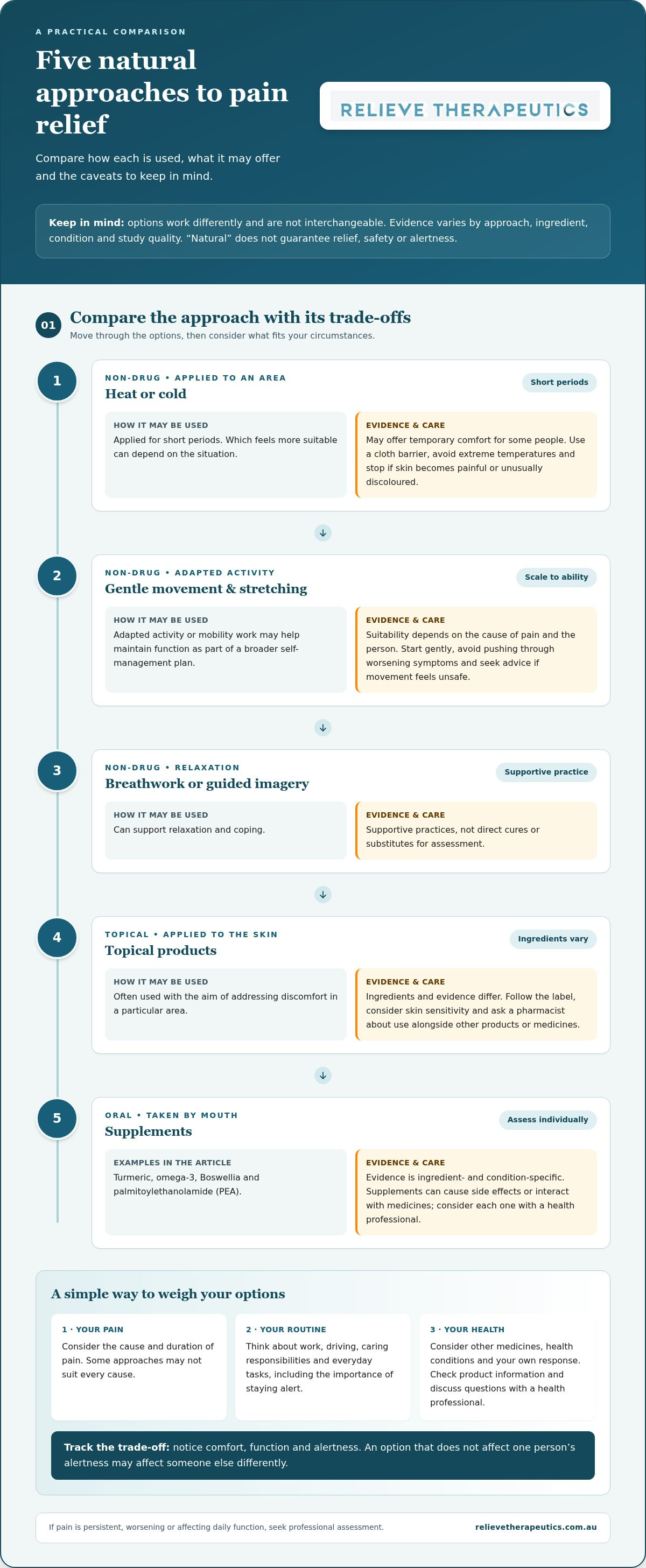
There isn’t one approach that suits every type of pain or routine. The comparison below separates practical non-drug methods from topical products and oral supplements, while keeping evidence and safety in view. Research strength varies by approach, ingredient, condition and study quality. The categories shouldn’t be read as equally supported or as guarantees of relief.
| Option | How it may be used | Evidence and caveats |
|---|---|---|
| Heat or cold | Applied for short periods to an area of discomfort. Which feels more suitable can depend on the situation. | May offer temporary comfort for some people. Protect skin with a cloth barrier, avoid extreme temperatures and stop if the skin becomes painful or unusually discoloured. |
| Gentle movement and stretching | Adapted activity or mobility work may help maintain function as part of a broader self-management plan. | Suitability depends on the cause of pain and the person. Start gently, avoid pushing through worsening symptoms and seek advice if movement feels unsafe. |
| Relaxation practices | Breathwork or guided imagery can support relaxation and coping. | These are supportive practices, not direct cures or substitutes for assessment. MedlinePlus describes a range of Non-Drug Pain Management approaches, including relaxation techniques. |
| Topical products | Applied to the skin, often with the aim of addressing discomfort in a particular area. | Ingredients and evidence differ. Follow the label, consider skin sensitivity and ask a pharmacist about use alongside other products or medicines. |
| Oral supplements | Taken by mouth. Examples include turmeric, omega-3, Boswellia and PEA. | Evidence is ingredient- and condition-specific, not interchangeable. Supplements can have side effects or interact with medicines, so assess each one individually with a health professional. |
Non-drug approaches for everyday support
Heat may feel soothing for stiffness, while some people prefer cold for a recently irritated area. Neither is the right choice for every cause of pain. Use a wrapped heat or cold pack rather than placing it directly on skin, and take care if sensation is reduced. Gentle movement can be scaled to your ability. Guided imagery or slow breathing may support relaxation, but shouldn’t be presented as a cure.
Topical products and oral supplements
A topical product is used on the skin, while an oral supplement is taken internally. That difference doesn’t establish which is more effective or safer. Turmeric, omega-3, Boswellia and PEA are examples to compare, not universal recommendations. Their evidence, cautions and possible interactions differ. If you’re considering a supplement, discuss the specific ingredient with a pharmacist or health professional, particularly if you take medicines or have an existing condition.
For readers considering PEA among supplement options, Relieve Therapeutics’ PEA capsules are available in 60-, 120- and 180-capsule supplies. Whichever approach you consider, don’t use it instead of assessment if pain is persistent, worsening or affecting daily function.
Does non-drowsy or natural mean the option is risk-free?
No. “Natural” describes an origin, not a guarantee of safety, effectiveness or compatibility with other treatments. A supplement can still cause side effects, and its ingredients may interact with medicines or be unsuitable for some health conditions. Likewise, don’t assume that a product marketed as non-drowsy has no effect on alertness. Check product-specific information and consider how it may affect you.
A non-prescription supplement is still an active product, not a risk-free one. Its potential benefits and cautions depend on the ingredient, the person using it, the amount taken and the reason for use. Choosing non-drowsy natural pain relief calls for more than a reassuring label or a long list of studies.
How to read evidence without overinterpreting it
Research findings need context. A small or short study can offer an early signal, but may not show whether an effect is reliable or lasts over time. Larger, well-controlled studies can provide stronger evidence, while systematic reviews assess findings across multiple studies. Even then, results may apply only to the people, condition and outcomes studied.
Relieve Therapeutics reports more than 600 clinical and peer-reviewed studies on PEA across pain conditions. That figure points to a body of research to explore, but doesn’t mean every condition has been proven to respond or that an individual result is predictable. To interpret a specific study, look at who took part, how long it ran, what outcome researchers measured and what limitations they reported. Don’t treat research on one condition or group as proof of benefit for another.
PEA may cause mild gastrointestinal discomfort, headache or dizziness. These possible effects matter if you’re managing work, driving or other tasks that require focus. If you notice an unwanted effect after starting a supplement, seek advice from a health professional about what to do next.
When professional guidance matters
Get medical advice for pain that is persistent, severe, unexplained or changing, rather than relying on self-care alone. An assessment can help identify the cause and guide suitable support. Seek advice promptly if pain comes with concerning new symptoms or affects your ability to manage everyday activities.
Before combining a supplement with medicines, ask a pharmacist, GP or other qualified health professional to review the ingredients and your circumstances. Share the product label and a list of medicines and supplements you already take. This can help you discuss possible interactions and avoid overlapping ingredients.
If you’re pregnant or breastfeeding, seek professional advice before using PEA. Suitability can depend on individual circumstances, and a qualified professional can help you weigh the available information. A supplement should not replace prescribed care or tailored medical advice.
How can you choose an option that fits your pain and routine?
Start with the problem you’re trying to solve, not the promise on a label. This five-step framework can help you weigh comfort, alertness, safety and daily function. It can organise your questions, but it can’t diagnose the cause of pain or replace an assessment when one is needed.
- Describe the pain. Note where it is, when it began, whether it comes and goes, what seems to trigger or ease it, and how it affects sleep, work or movement. These details can help a health professional understand the pattern.
- Set an alertness goal. Be specific about what you need to do, such as drive, concentrate at work or care for someone. Consider whether an option’s timing or possible effects could interfere with those tasks.
- Review the options. Compare approaches that suit the situation, weighing how they’re used, the evidence for the relevant type of pain and any practical limitations. A focused guide to non-opioid pain relief supplements can help you compare supplement categories without assuming they’re interchangeable.
- Check safety. Review product information and discuss medicines, health conditions and other supplements with a pharmacist, GP or other qualified health professional. In Australia, check the product’s specific TGA status and permitted claims rather than assuming all products in a category have the same regulatory status.
- Reassess your response. Keep a brief record of comfort, daily function and any unwanted effects. Note what you tried and when, so you and your health professional can judge whether the approach seems useful or needs review.
Match the approach to the pain context
Location and triggers can offer useful clues, but they don’t confirm a diagnosis. Musculoskeletal discomfort and nerve-related pain may need different assessment, so avoid choosing a supplement based on a symptom description alone. Occasional discomfort that settles may call for a different response from pain that persists, worsens or disrupts daily activities. Seek clinical advice for ongoing or changing pain instead of relying solely on self-management.
Check suitability and review your response
Bring your notes and a list of medicines and supplements to a conversation with a health professional. Ask about possible interactions, relevant precautions and what changes should prompt follow-up. A diary can make gradual shifts easier to spot: record whether a usual task feels more manageable, whether discomfort changes and whether you notice side effects. Don’t treat a short-term change as proof that an option is suitable long term.
For Australian products, a TGA listing can provide useful regulatory context, but it isn’t the same as proof that a product will work for every person or condition. Read the label and consider its claims in light of your circumstances. If you’re considering PEA, explore Relieve Therapeutics’ PEA capsules as one supplement option.
Where might PEA fit among natural pain-relief options?
Palmitoylethanolamide (PEA) is one non-prescription supplement option to consider alongside other approaches to pain support. It isn’t a cure, a guaranteed source of relief or a replacement for prescribed care or individual medical advice. Whether it’s appropriate depends on your health circumstances, medicines and reasons for considering it. If alertness is a priority, don’t assume a supplement is free from side effects or will affect everyone in the same way.
What to know about Relieve Therapeutics PEA capsules
PEA Capsules 600 mg with Luteolin - Palmitoylethanolamide Ultra-Micronised contains 600 mg PEA, 150 mg Quercetin and 30 mg Luteolin per serving. The recommended use is two capsules daily, providing 600 mg PEA total. These figures describe the product’s stated composition and use, not an expected outcome for every person.
The capsules are produced in a GMP-certified Australian facility, and each batch receives third-party quality-control testing for purity, potency and heavy metals. Relieve Therapeutics offers the PEA capsules in 60-, 120- and 180-capsule supplies. These details can help you compare the product and pack sizes, but they don’t establish that it will suit every person or guarantee a particular result. For a closer look at what to consider when assessing quality, see this guide to high-quality PEA capsules in Australia.
Research into PEA covers different pain conditions, but findings need to be considered in context. Study size, duration, participants and measured outcomes all affect what a result can tell us. A body of research isn’t proof that every condition responds, or that one person’s experience predicts another’s. PEA may also cause mild gastrointestinal discomfort, headache or dizziness, so it shouldn’t be described as side-effect-free or assumed to be non-drowsy for everyone.
A considered next step for Australian readers
If you take medicines, have a health condition or are considering adding more than one supplement, discuss suitability with a pharmacist, GP or other qualified health professional. They can help review the ingredients alongside your personal circumstances. If you’re pregnant or breastfeeding, seek professional advice before using PEA. Keep following prescribed care unless the clinician responsible for your treatment advises otherwise.
For a plain-language explanation of the proposed science, explore how PEA works for pain. Understanding the research and possible limitations can help you decide what questions to raise and whether PEA belongs in a broader plan for non-drowsy natural pain relief.
Explore Relieve Therapeutics PEA capsules.
Take your next step with confidence
Choosing support for pain doesn’t need to mean making a rushed decision or expecting one option to suit every situation. Consider what matters most in your day, whether that’s staying focused, moving more comfortably or understanding the likely trade-offs. If you’re unsure, take your questions and current medicines list to a pharmacist or healthcare professional before adding a supplement.
PEA may be worth exploring as one part of that conversation. Read the product information carefully, consider whether it fits your circumstances and keep individual advice at the centre of your decision. The aim of non-drowsy natural pain relief is not simply to avoid feeling sleepy, but to choose thoughtfully and protect your ability to manage the activities that matter to you.
If you’d like to learn more about the PEA option from Relieve Therapeutics, explore Relieve Therapeutics PEA capsules. Compare the available capsule sizes and read the product information to decide whether this option fits your needs.
Frequently Asked Questions
Can natural pain relief make you drowsy?
Yes, some natural pain-relief products or supplements may affect alertness, although responses differ between people. “Natural” doesn’t guarantee that you’ll stay clear-headed, and a product’s effects can depend on its ingredients and your circumstances. If you’re trying something new, consider the timing and avoid driving or operating machinery until you know how it affects you. Check the label for warnings, including advice about dizziness or drowsiness.
What is the best non-drowsy natural pain relief for chronic pain?
There isn’t one best option for everyone with chronic pain. The cause, health history, current medicines and daily priorities all influence what may be appropriate. A practical starting point is to discuss persistent pain with a GP or other healthcare professional, then weigh approaches against a specific goal, such as sleeping more comfortably or maintaining usual activities. Non-drowsy natural pain relief is a personal aim, not an assured outcome.
Is PEA a non-drowsy pain relief supplement?
PEA shouldn’t be assumed to be non-drowsy for everyone. Individual responses vary, and possible side effects include mild gastrointestinal discomfort, headache or dizziness. If alertness is important for your work or routine, discuss PEA with a healthcare professional before use and pay attention to how you feel. Seek advice if you experience unwanted effects, particularly if they could affect activities such as driving.
Can I take natural pain supplements with prescription medicines?
Possibly, but check with a pharmacist or doctor before combining them. Supplement ingredients can affect how medicines work or add to unwanted effects, and the answer depends on the specific products and your health. Bring the supplement packaging or ingredient list and your current medication list to the conversation. Don’t stop, replace or change a prescribed medicine without guidance from the clinician who manages your care.
How long can natural pain-relief supplements take to work?
There’s no single timeframe: it depends on the supplement, the person and the reason for taking it. For PEA, Relieve Therapeutics notes that some people may notice changes within days, while others may take several weeks; this isn’t a promise of benefit. Follow the product’s stated directions and keep track of any changes. Ask a healthcare professional how long a reasonable trial might be for your circumstances.
Are natural pain-relief supplements regulated in Australia?
Yes. The Therapeutic Goods Administration (TGA) regulates complementary medicines, including most natural pain-relief supplements. Many are listed medicines with an AUST L number. Listing involves assessment of safety and quality, but the TGA doesn’t assess efficacy before sale in the same way it assesses registered medicines. Check a product’s specific Australian status and permitted claims rather than assuming that all supplements are assessed identically.
When should I seek medical advice for persistent pain?
Arrange medical advice if pain continues, worsens, changes unexpectedly or interferes with sleep, mobility or everyday responsibilities. Assessment is also sensible when the cause isn’t clear or self-management isn’t helping. Seek urgent care for sudden severe pain or pain with alarming symptoms, such as difficulty breathing, fainting or new weakness. If you’re unsure how quickly to seek help, contact a healthcare professional for guidance.