

If you’re researching natural supplements for neuropathy Australia has to offer, start with safety and evidence, not the word “natural”. High-dose, long-term vitamin B6 use has been associated with peripheral neuropathy, showing why it’s important to check ingredients and consider your health circumstances before trying a supplement.
It can be difficult to separate meaningful evidence from confident online claims. You may be looking for options that could support comfort, while also wondering whether a supplement might interact with medicines or delay an important diagnosis.
Neuropathy has many possible causes, so identifying what’s behind your symptoms is an essential first step. This guide covers what is known about commonly discussed options, including palmitoylethanolamide (PEA), and why supplements aren’t interchangeable. It also explains how Australian complementary medicine regulation relates to product claims, which safety questions to consider, and what to discuss with your healthcare professional. The aim is to help you weigh possible benefits and risks alongside appropriate assessment of your symptoms.
Key Takeaways
- Burning, tingling or numbness can have different causes. These symptoms are a reason to seek assessment, not a way to diagnose yourself.
- When comparing natural supplements for neuropathy Australia readers may encounter, consider PEA, vitamin B12 and alpha-lipoic acid as distinct options, not interchangeable remedies.
- Look beyond proposed mechanisms and traditional use. Check what human studies measured and where evidence remains limited.
- Before trying a supplement, discuss your symptoms, medicines and the product label with your GP, pharmacist or treating specialist.
- Check Australian medicine listing details and take vitamin B6 safety seriously, as high-dose, long-term use has been linked to nerve symptoms.
What is neuropathy, and why does its cause matter when considering supplements?
Neuropathy describes a problem affecting nerves, often those outside the brain and spinal cord. When nerves that carry sensation are damaged or disrupted, signals may be altered or misread. Neuropathic pain is pain linked to this nerve dysfunction. It differs from pain caused by tissue injury or inflammation, although both types can occur together. The overview of peripheral neuropathy outlines its broad range of causes and classifications.
That range matters when considering supplements. Diabetes, vitamin B12 deficiency, some medicines and other health conditions can all be associated with nerve problems, but they don’t necessarily call for the same response. A supplement might be relevant in one situation and unhelpful or unsuitable in another. It can’t identify the cause of symptoms or address every underlying condition.
How can neuropathy feel, and what may cause it?
Nerve-related sensations vary from person to person. You might notice burning or tingling, numbness, pins and needles, or unusual sensitivity to touch. Symptoms can affect different areas and may change over time. These sensations can have other explanations too, so a symptom pattern alone can’t confirm neuropathy or reveal its cause.
Diabetes and vitamin B12 deficiency are two possible causes. Other conditions and some medicines may also be relevant. A GP or treating specialist can assess your symptoms and health history, and decide whether further checks are appropriate. Don’t stop a prescribed medicine or start a supplement based only on an online symptom list.
Why investigate the cause before choosing a supplement?
Correcting a confirmed nutrient deficiency is different from taking that nutrient without evidence you need it. If B12 deficiency is contributing to nerve symptoms, a clinician can advise on addressing the deficiency. Taking B12 without a confirmed need may not address a different cause. Similarly, symptoms associated with diabetes call for attention to the broader condition, not just an attempt to ease sensations.
Your medicines, existing conditions, other supplements and whether symptoms are new or progressing can all affect what’s appropriate. Before adding anything, share a complete list of what you take with your healthcare professional, including non-prescription products. Seek assessment if symptoms persist, worsen or concern you.
Identifying the cause matters because a supplement that suits one underlying problem may do nothing for another, and could distract from care that’s needed. When weighing natural supplements for neuropathy Australia readers may encounter, consider possible support only as part of an informed care plan, not as a substitute for diagnosis or cause-specific treatment.
Which natural supplements for neuropathy are discussed, and what does the evidence say?
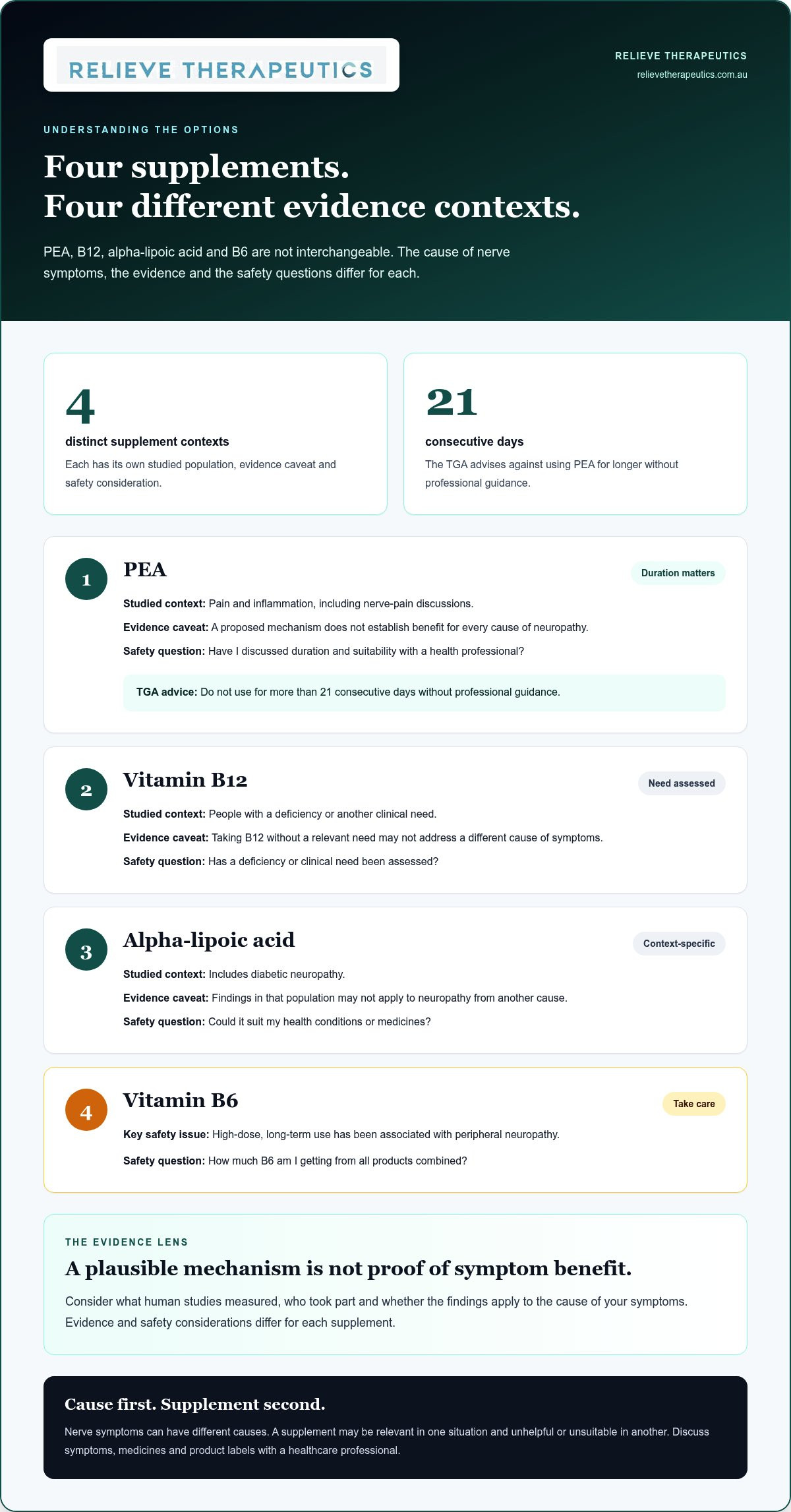
Supplements aren’t interchangeable. The reason an ingredient is studied, the people included in a study and the outcomes measured all matter. A proposed effect on nerve biology isn’t proof that a supplement improves symptoms. For an Australian overview of causes and assessment, see Healthdirect’s Peripheral neuropathy explained.
What should readers know about PEA and neuropathic pain?
Palmitoylethanolamide (PEA) is a fatty acid amide produced naturally in the body and found in some foods. It’s discussed for its potential role in pain and inflammation, but a plausible biological mechanism doesn’t guarantee a clinical benefit. Human research needs to be considered in context, including the condition studied, study quality and outcomes. Findings in one pain population may not apply to every type of neuropathy. In Australia, the TGA advises against using PEA for more than 21 consecutive days without professional guidance.
How do B12, alpha-lipoic acid and other nutrients differ?
Vitamin B12 is most relevant when a deficiency or another individual clinical need is established. Alpha-lipoic acid has been studied in contexts including diabetic neuropathy, but results from that population can’t automatically be applied to neuropathy from another cause. Other nutrients and botanicals, such as vitamins B6 and D, magnesium and curcumin, have also been discussed or studied. Evidence and safety considerations differ for each, so don’t assume one is a substitute for another.
| Supplement | Population or context studied | Evidence caveat | Key safety question |
|---|---|---|---|
| PEA | Pain and inflammation, including nerve-pain discussions | Proposed mechanisms don’t establish benefit for every neuropathy cause. | Have I discussed duration and suitability with a health professional? |
| Vitamin B12 | People with deficiency or a clinical need | Taking it without a relevant need may not address another cause. | Has deficiency or need been assessed? |
| Alpha-lipoic acid | Studied in contexts including diabetic neuropathy | Findings may not transfer to other types of neuropathy. | Could it suit my health conditions or medicines? |
| Vitamin B6 | Supplement use | High-dose, long-term use has been associated with peripheral neuropathy. | How much B6 am I getting from all products combined? |
These are discussion points, not treatment recommendations. If you’re comparing natural supplements for neuropathy Australia readers can access, take the product label and a list of medicines and supplements to your GP, pharmacist or treating specialist. If PEA is one option you’re considering, you can view the available PEA capsule options and discuss suitability with your healthcare professional.
Are natural supplements for neuropathy effective and safe? What the evidence can and cannot show
“Natural” describes a source, not a guarantee of effectiveness, safety or suitability. Whether a supplement could be relevant depends on the cause of neuropathy, the ingredient and the person taking it. Findings for one group, such as people with diabetic neuropathy, don’t automatically apply to someone whose symptoms have another cause. Healthdirect’s information on peripheral neuropathy explains why assessing the condition and its possible causes matters.
How can you judge the strength of supplement evidence?
Look for human clinical studies, then check who took part, how many people were included, how long the study ran and what outcomes researchers measured. A change in a laboratory marker or a proposed effect on nerve pathways isn’t the same as a meaningful improvement in symptoms or daily function. Evidence for an isolated ingredient also doesn’t automatically establish the effect of a finished product, which may differ in formulation.
Biological plausibility can explain why a supplement is studied, but it doesn’t prove that it delivers a clinical benefit. Traditional use and early research may help guide further study, but marketing language alone can’t establish effectiveness. Be cautious of claims that promise a cure, apply to every type of neuropathy or guarantee a particular timeline.
What safety questions matter before trying a supplement?
Supplements can cause unwanted effects or interact with medicines. Suitability may also depend on pregnancy, existing health conditions, or kidney or liver concerns. Before starting one, share the product label and a complete list of medicines and supplements with your GP, pharmacist or treating specialist. Don’t stop prescribed treatment or use a supplement instead of assessment, especially if symptoms are worsening.
In Australia, complementary medicines may be listed or registered on the Australian Register of Therapeutic Goods (ARTG). Listed medicines carry an AUST L number and are assessed for quality and safety, but not efficacy. Registered medicines carry an AUST R number and are evaluated for quality, safety and efficacy. A listing isn’t proof that a product will benefit you or suit your circumstances. Check the label and product details rather than assuming a particular product has either status.
Vitamin B6 is an important safety consideration: high-dose, long-term use has been associated with peripheral neuropathy. Check whether it appears in more than one product. If you’re researching natural supplements for neuropathy Australia-wide, use evidence as a starting point, then discuss the specific product and your health circumstances with a professional. That conversation can help you weigh possible benefits against uncertainty and risk.
How should Australians assess supplements and seek care for neuropathy?
A practical sequence can keep supplement decisions grounded: arrange an assessment, explore possible causes, review medicines and existing conditions, then consider whether there’s evidence to discuss a particular supplement. A GP, pharmacist or treating specialist can help weigh these factors in the context of your health, rather than relying on a symptom description or online claim alone.
What should you discuss with an Australian healthcare professional?
Before an appointment, note when symptoms began, where you feel them, how they’ve changed and how they affect daily activities. Bring a current list of medicines and supplements, including each product’s ingredients, dose and how long you’ve used it. Photos of labels can be useful if you don’t have the packaging with you.
Consider asking:
- What could be causing these symptoms, and are any investigations appropriate?
- Could a medicine, supplement or health condition affect my symptoms or the safety of a new product?
- If we consider a supplement, what outcome should I monitor and when should we review the plan?
If symptoms come on suddenly or worsen rapidly, seek urgent medical assessment rather than waiting to see whether a supplement helps. For symptoms that persist or concern you, arrange a clinical review.
How can you assess an Australian supplement responsibly?
Read the full label, not just the front-of-pack claim. Check the ingredient list, directions, warnings and whether other products you take contain the same ingredient. Treat claims that promise a cure or guaranteed results with caution. In Australia, if a product claims to be included in the Australian Register of Therapeutic Goods, check its AUST L or AUST R number and the product details. A listing doesn’t establish that it’s suitable for you or effective for your particular cause of neuropathy.
Keep the label or a clear photo to share with your healthcare professional. Be especially thorough if you’re pregnant, have a long-term health condition, or have concerns involving your kidneys or liver. Don’t change prescribed treatment without discussing it with the clinician responsible for your care.
Use this process to assess natural supplements for neuropathy Australia readers may be considering: clarify the cause, check safety and claims, then discuss the evidence and a review plan. If PEA is among the options you’re exploring, view the available PEA capsule options as part of that informed conversation.
Where does PEA fit in a considered approach to natural neuropathy support?
Palmitoylethanolamide (PEA) may be one option to discuss with a healthcare professional, but it isn’t a cure for neuropathy or a substitute for diagnosis and appropriate care. It’s a fatty acid amide made naturally in the body and found in some foods. Researchers have explored its potential role in pain and inflammation, but a proposed mechanism doesn’t establish that it will improve nerve symptoms for a particular person.
What role could PEA have in a broader support plan?
Human research on PEA needs to be considered in context. Studies may differ in the conditions included, product formulations and outcomes measured. Evidence about pain in one group can’t confirm an effect for every neuropathy cause, nor show that PEA repairs nerve damage or addresses an underlying condition. PEA may be discussed as a possible element of broader support, with realistic expectations and professional guidance. A practical guide on how to take PEA for nerve pain can help you prepare questions, but it can’t replace individual advice.
In Australia, the TGA’s ingredient guidance advises that PEA should not be used for more than 21 consecutive days without professional guidance. Discuss longer-term symptoms and options with a healthcare professional rather than extending use on your own.
What is a sensible next step for readers considering PEA?
Before deciding, discuss PEA with your GP, pharmacist or treating specialist. Explain why you’re considering it, what medicines and supplements you take, and any relevant health conditions. Ask whether it may be suitable for you, what outcome would be reasonable to monitor, and when to review the plan. Keep following care advised for the underlying cause of your symptoms.
Relieve Therapeutics is an Australian retailer offering PEA capsules in 60, 120 and 180-capsule options. These quantities describe capsule count only; they don’t establish which option, if any, is right for you. After discussing suitability and safety with a healthcare professional, you can Explore Relieve Therapeutics’ PEA capsules.
For readers comparing natural supplements for neuropathy Australia-wide, PEA is best approached as a discussion, not a promise. Evidence, the likely cause of symptoms and personal health circumstances all belong in that decision.
Make your next step an informed one
Choosing among natural supplements for neuropathy Australia readers can access starts with understanding that nerve symptoms may have different causes. A supplement that’s relevant to a confirmed deficiency, for example, isn’t automatically appropriate for someone with another type of neuropathy. Evidence also varies between ingredients, study populations and outcomes, so proposed mechanisms and confident marketing claims shouldn’t be mistaken for proven benefit.
Before trying anything, speak with your GP, pharmacist or treating specialist about your symptoms, health history, medicines and the evidence for the specific supplement. This helps keep possible support in perspective and reduces the risk of overlooking an underlying cause or safety concern.
PEA may be one option to discuss, not a cure or replacement for diagnosis and appropriate care. Relieve Therapeutics is an Australian retailer specialising in PEA dietary supplements, with capsule options in 60, 120 and 180-count quantities. Once you’ve considered suitability and safety with a healthcare professional, explore Relieve Therapeutics’ PEA capsules.
A clear conversation and a considered next step can help you make choices with greater confidence.
Frequently Asked Questions
Can natural supplements help neuropathy?
Some supplements may be relevant for particular causes of neuropathy, but the evidence and potential benefit vary by ingredient and person. Vitamin B12, for example, may be appropriate when a deficiency is established, while other options need further research. If you’re researching natural supplements for neuropathy Australia readers can access, first ask a healthcare professional what may be causing your symptoms and whether a supplement fits your care plan.
Which supplements are commonly discussed for neuropathy?
Commonly discussed options include vitamin B12, alpha-lipoic acid, acetyl-L-carnitine and PEA. They’re studied for different reasons and in particular contexts, so evidence for one ingredient or neuropathy type doesn’t establish benefit for another. B12, for example, is especially relevant where deficiency is present. Popularity isn’t a measure of effectiveness. Compare the human evidence and safety considerations for the specific supplement with your healthcare professional.
Is PEA effective for neuropathic pain?
PEA has been studied for pain, including some forms of neuropathic pain, but research findings can’t guarantee an individual benefit. Consider the quality and size of studies, how long they ran, who took part and what outcomes were measured. Evidence may not apply across different causes of nerve symptoms. Discuss current research and your health circumstances with a healthcare professional, and don’t treat PEA as a cure or replacement for prescribed care.
Can vitamin B12 deficiency cause neuropathy?
Yes, vitamin B12 deficiency can affect the nervous system and is one possible cause of neuropathy. Tingling or numbness alone can’t confirm that you’re deficient, as similar symptoms may have other explanations. A healthcare professional can consider your symptoms, diet, medicines and health history, and advise whether testing or supplementation is appropriate. Don’t rely on high-dose supplements to identify or address the cause without a clinical assessment.
Are natural supplements safe to take with nerve pain medicines?
Not always. A supplement may interact with medicines or be unsuitable for someone with particular health conditions. The risks depend on the ingredient and individual circumstances. Before adding one, show your GP or pharmacist the exact product label and a list of your medicines and other supplements. Include how much you take and for how long. Don’t stop or change prescribed treatment without advice from the clinician managing your care.
How do I know whether a supplement is right for my neuropathy?
Start by discussing what may be causing your symptoms, because evidence for one condition may not apply to another. Then review the specific supplement’s human research, ingredients, warnings and possible interactions with a healthcare professional. Agree on what outcome to monitor and when to review your plan. A supplement shouldn’t delay assessment of new or worsening symptoms, or replace care for an underlying condition.
Should I stop my prescribed treatment and try a natural supplement instead?
No. Don’t stop, reduce or replace prescribed treatment without first speaking with the clinician responsible for your care. Neuropathy can have causes that need investigation or ongoing management, and supplements don’t reliably address them. If you’re interested in a natural option, ask whether it could be considered alongside your current plan and what safety checks are needed. This helps you consider possible support without disrupting care that may be important.