

The bathroom cabinet may be the least suitable place for your PEA capsules. If you’re wondering how to store PEA capsules correctly, start with the storage directions on your product label. General advice shouldn’t override instructions for the product you have.
Heat and moisture are practical considerations in Australia, where a hot day or a steamy room can make some storage spots less suitable. A straightforward routine can help: read the directions, choose a place that fits them, and return the closed container there after use. This guide covers choosing a spot at home, travelling with capsules, checking the expiry date and responding to possible heat or moisture exposure.
Keep capsules cool, dry and out of direct sunlight unless the product label gives different directions. Treat that as general guidance, not a product-specific temperature limit. Refrigeration isn’t a default solution either: follow the storage instructions supplied with your capsules.
Key Takeaways
- To learn how to store PEA capsules correctly, begin with the directions on your specific product label.
- In Australian conditions, check whether a storage spot is exposed to summer heat, humidity, steam or direct sunlight.
- Build a simple routine: follow the directions, choose a suitable location and close and return the container after use.
- A brief exposure to warmth or moisture doesn’t automatically mean capsules are spoiled. Check the product information and seek advice if you’re concerned.
- When travelling, keep the labelled product identifiable and avoid leaving it in a hot vehicle or direct sun for extended periods.
How to store PEA capsules correctly: start with the product label
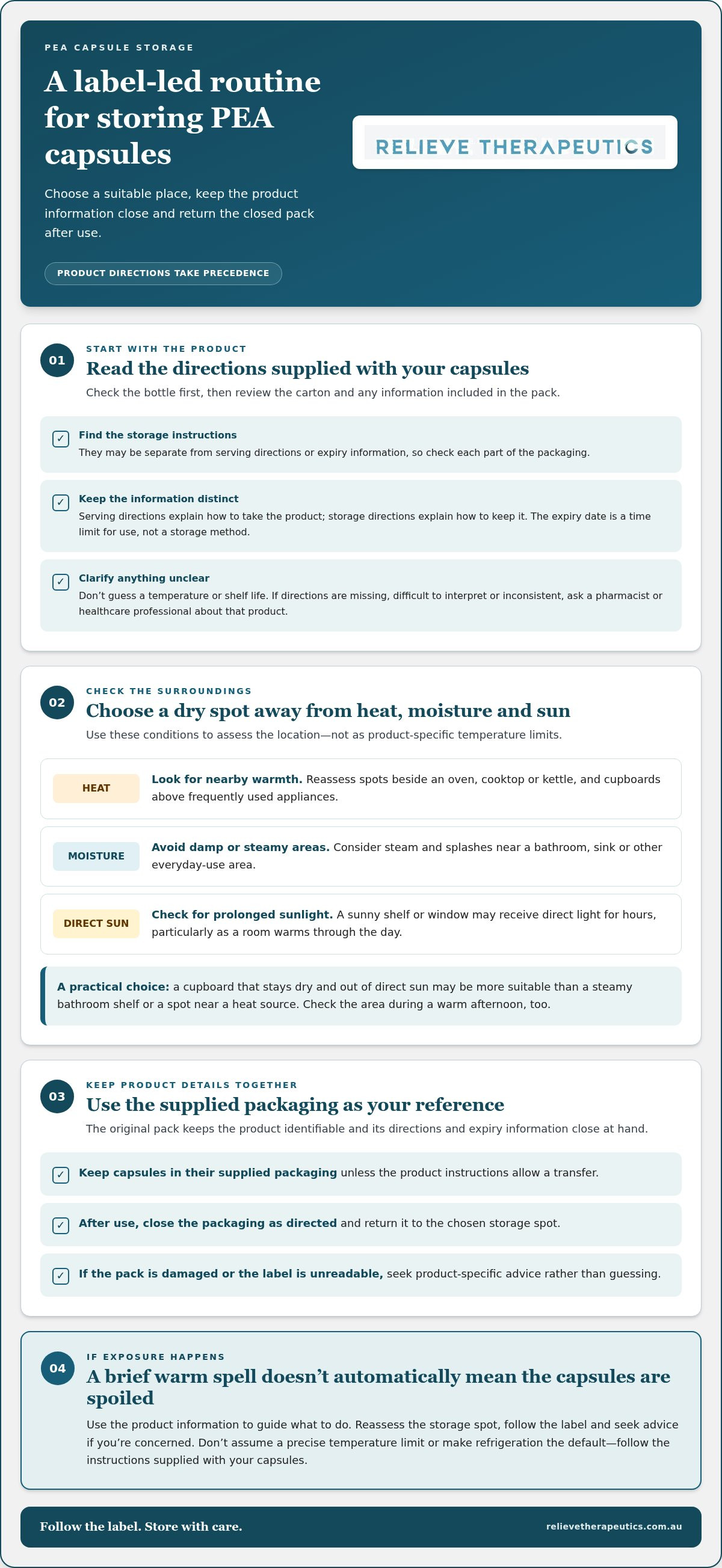
Follow the storage directions printed on the label for your specific PEA capsules. That’s the clearest starting point for how to store PEA capsules correctly, because instructions can vary between products. General guidance can help you assess a storage spot, but it doesn’t replace product-specific directions.
In practice, store the capsules as directed and avoid unnecessary exposure to heat, moisture and direct sunlight. The product label takes precedence over generic online advice because it relates to the particular capsules you have, rather than supplements as a broad category.
PEA is short for palmitoylethanolamide. For background on the ingredient, see this overview of Palmitoylethanolamide (PEA). For storage, the instructions supplied with your capsules are the relevant guide.
Where to find PEA capsule storage instructions
Check the bottle label first, then look over the carton and any product information included in the pack. Storage directions may be separate from serving instructions or expiry information, so read each section rather than relying on the most prominent line.
Serving directions explain how to take the product; storage directions explain how to keep it. The expiry date indicates a time limit for use, not the storage method. If you have more than one piece of packaging, keep the relevant information together so you can refer to it later.
What to do when storage directions are unclear
Don’t fill in missing details with a guessed temperature or shelf life. If the label doesn’t specify a precise temperature, don’t assume a common guideline applies to that particular product. Another brand’s directions aren’t a substitute either.
If the label, carton and enclosed information appear to conflict, or an instruction is difficult to interpret, ask a pharmacist or healthcare professional about the specific product. General advice can provide context, but it shouldn’t override product directions or professional guidance.
- Read: Check all storage information supplied with the capsules.
- Separate: Distinguish storage directions from serving instructions and the expiry date.
- Clarify: Seek professional guidance if instructions are missing, unclear or inconsistent.
This label-led approach applies to Relieve Therapeutics PEA capsules, too. Read the information supplied with your pack instead of assuming a particular temperature or handling requirement. That keeps your storage routine grounded in the product directions and avoids turning general supplement advice into a product-specific rule.
Heat, humidity and light: storage conditions to manage
Once you’ve checked the product directions, assess where the capsules are kept. Repeated exposure to heat, moisture or direct sunlight is worth avoiding, as these conditions may affect supplement ingredients over time. A brief warm spell or moment in the sun doesn’t automatically make capsules unusable. Use these risks as a reason to choose a more suitable, stable spot and follow the label.
Keep capsules away from repeated heat, moisture and direct sunlight. This is especially useful during an Australian summer, when a room can warm up through the day or a sunny shelf can receive hours of direct light. Treat those conditions as prompts to reassess the location, not as product-specific temperature limits.
Choosing a suitable spot at home
A cupboard that stays dry and out of direct sun may be more suitable than a shelf near a steamy bathroom or sunny window. Assess kitchen spots beside an oven, cooktop, kettle or sink too, as they may be exposed to warmth, steam or splashes during everyday use. Choose a location that follows the product directions and doesn’t regularly become warm or damp.
If the label specifies a particular storage condition, follow it even if another spot seems more convenient. Check the area during a warm afternoon, not just when the room feels cool. A cupboard above a frequently used appliance, for example, may be exposed to warmth that isn’t obvious at first glance.
Why the original packaging matters
Keeping capsules in their supplied packaging helps you identify the product and keep its directions and expiry information close at hand. This is useful if you have several supplements at home or need to check the instructions later. Don’t assume a container has a particular protective feature unless the product information says so.
After use, close the packaging as directed and return it to the chosen storage spot. Avoid transferring capsules into another container unless the product instructions allow it. A transfer can separate them from useful product information, including the expiry date. If the packaging is damaged or the label is unreadable, seek product-specific advice rather than guessing at the storage requirements.
- Check the surroundings: Look for direct sun, steam, splashes and nearby heat sources.
- Choose consistency: Prefer a dry spot that doesn’t regularly become warm or damp.
- Keep information together: Store capsules in their supplied packaging and keep the directions accessible.
These small choices make how to store PEA capsules correctly easier to put into practice without inventing a temperature or assuming every product has identical requirements. If you’re considering Relieve Therapeutics PEA capsules, explore the PEA capsule range and follow the storage directions supplied with your product.
Common PEA capsule storage mistakes and how to avoid them
Storage slips happen: a bottle gets left in the car after an errand, or capsules are moved into a different container for convenience. These situations call for a calm check, not an immediate assumption that the product is unusable. Refer to the label for storage directions, and ask a pharmacist if the capsules or packaging raise concerns.
Leaving capsules in a car or near a window
A parked car can experience changing conditions, while a sunny windowsill may receive direct light and warmth. Neither location alone confirms that capsules have been spoiled, and there’s no universal safe exposure time to apply. Once you notice the bottle, return it to a suitable storage place that follows the label. If exposure was prolonged or you’re unsure about the product, check its directions and seek pharmacist advice.
Transferring capsules or leaving the bottle open
Moving capsules can make it harder to identify the product, find its storage directions or check its expiry date. A separate organiser isn’t automatically unsuitable, but keep the original packaging and product information available, and follow any label instructions about transferring capsules. After handling them, close the supplied container as directed and put it away rather than leaving it open while you do other tasks.
Don’t rely on appearance alone. A capsule that looks unchanged doesn’t confirm that it has been stored appropriately or is suitable to use. A brief stay in a less-than-ideal location doesn’t prove it has been damaged either. If you notice a change in the capsules or packaging, or the exposure leaves you uncertain, check the label and ask a pharmacist or healthcare professional for product-specific guidance.
A quick response can help prevent a small storage lapse from becoming an ongoing habit. Note what happened, such as where the bottle was kept and whether the container was open, then compare the situation with the product directions. Don’t invent a temperature or exposure limit if the label doesn’t provide one.
- Car or sunny spot: Return the bottle to its usual storage place and check the label if exposure concerns you.
- Capsules transferred: Keep the original packaging and directions available so the product remains identifiable.
- Unexpected appearance or uncertainty: Don’t decide suitability by sight alone; seek advice from a pharmacist.
These habits make how to store PEA capsules correctly easier to manage day to day. Focus on what you can verify: the product directions, the condition of the packaging and whether you need professional advice. That’s more reliable than making a snap judgement based only on where the bottle was left.
Storing PEA capsules at home and while travelling
A reliable routine makes storage easier to manage at home and away. For how to store PEA capsules correctly, use the product label as your reference and make the habit simple enough to repeat: check the directions, choose a suitable place, and return the closed container there after use.
A quick daily storage checklist
Start with the label and select one regular location that meets its instructions. Keep the bottle away from avoidable exposure, then return it to that place after taking out a capsule. Before travelling, check that you can still identify the product and read its directions and expiry details. These steps help keep useful information with the capsules.
- Read: Refer to the storage directions on your product.
- Choose: Use a consistent spot that follows those directions.
- Return: Close the container as directed and put it back after use.
Taking PEA capsules away from home
For a short outing, consider whether you need to take the product with you. If you do, carry it in packaging that keeps the product identifiable and its directions accessible. Keeping the labelled packaging with the capsules makes this straightforward. If you use a separate organiser, retain the original packaging or product information so you can still check the instructions and expiry details.
Travel conditions can be less predictable than your usual storage spot. Avoid leaving capsules in a vehicle or exposed to direct sun for extended periods, particularly during warm Australian weather. Don’t assume a particular travel bag or location guarantees suitable storage conditions. On arrival, check the packaging for noticeable changes and refer to the label if you have concerns. Appearance alone can’t confirm product quality or suitability.
For longer trips, plan around the directions supplied with the product rather than guessing at a temperature or handling requirement. If your travel plans make those instructions difficult to follow, or you’re unsure what to do after possible exposure to heat or moisture, ask a pharmacist about the specific product. The label and professional guidance are more reliable than a general travel rule.
Keep the routine practical: carry the labelled product, limit unnecessary exposure and check the packaging when you unpack. For broader information about use, consult a PEA dosage for pain guide separately, while following your product label for storage.
If you’re looking for PEA capsules to include in your routine, explore the PEA capsule range and follow the storage directions supplied with your product.
Relieve Therapeutics PEA capsules: follow the label and store with care
Relieve Therapeutics offers ultra-micronised PEA capsules in 60, 120 and 180 capsule options. Each serving contains 600 mg PEA, 150 mg Quercetin and 30 mg Luteolin. These details identify the product, but they don’t determine where or how it should be stored. For storage, follow the directions supplied with your pack.
Applying label-led storage to Relieve Therapeutics capsules
Read the storage directions supplied with your pack and follow them rather than applying a temperature, shelf life or packaging assumption from another product. Use the instructions provided with the capsules you have. If you’re comparing general advice with the label, treat general guidance as context, not a substitute for those directions.
The ingredient amounts describe what’s in each serving, not a storage instruction. Keep the product identified and its directions available so you can refer to the right information later. That’s particularly useful if you keep several supplements at home or travel with them.
In practical terms, how to store PEA capsules correctly starts with reading the product information, following its directions consistently and avoiding assumptions where details aren’t provided. Don’t add a precise storage temperature or shelf-life claim that the label doesn’t state.
When to seek product-specific advice
If the capsules have been exposed to unusual heat or moisture and you’re unsure what that means, check the product directions and speak with a pharmacist or healthcare professional. A brief exposure or a particular location alone doesn’t establish that capsules are spoiled. Appearance alone can’t confirm their quality or suitability either.
Check the label and packaging if the bottle, capsules or information appear changed or damaged. If the directions are unclear, or you can’t confidently identify the product or its expiry details, seek professional advice rather than guessing. Keep the pack available so you can describe the product and circumstances clearly.
- Use the current directions: Follow the storage information supplied with your specific pack.
- Keep details accessible: Retain product identification and expiry information for reference.
- Ask if uncertain: Seek pharmacist or healthcare professional guidance after unusual exposure or if the packaging or capsules appear changed.
These steps keep storage decisions grounded in the product information and help avoid turning broad supplement advice into an unsupported brand-specific claim. If you’d like to learn more about PEA capsule quality, the high quality PEA capsules guide is a related topic to explore.
For a straightforward next step, explore the Relieve Therapeutics PEA capsule range and use the label supplied with your product as your storage guide.
Make your storage routine easy to maintain
A useful routine is one you can keep up without adding another task to your day. Choose a natural cue, such as putting the product away after use or checking its label when you organise your pantry. If your household routine changes, make sure the storage habit still fits the instructions.
That small pause can help you stay attentive to the product information over time, rather than relying on memory or a general rule found online. Keep the label available for future reference, especially if you travel or move the product to a different spot.
Explore Relieve Therapeutics PEA capsules, then follow the storage directions supplied with your product. Choose a routine that feels practical and return the labelled container to its suitable storage spot after each use.
Frequently Asked Questions
Can I store PEA capsules in the fridge?
Only refrigerate PEA capsules if the product label specifically directs you to. Chilling isn’t a default storage method, and moving a cold container into warmer air can cause condensation. If the directions don’t mention refrigeration, follow the storage conditions they do provide instead. If the capsules have already been refrigerated and you’re unsure whether moisture may have affected them, check the packaging and ask a pharmacist for product-specific guidance.
Is it safe to keep PEA capsules in a pill organiser?
A pill organiser may help with routine organisation, but it can separate capsules from their product identification, directions and expiry details. If you use one, keep the original packaging and information available, and check the product label for instructions about transferring capsules. Avoid filling an organiser far in advance if you can’t keep track of which product is in each compartment or how long it has been stored there.
Can heat damage PEA capsules?
Repeated or prolonged heat exposure may affect supplement ingredients, but a warm day or brief exposure doesn’t automatically mean capsules are damaged. There’s no universal safe exposure time or temperature to apply to every PEA product. To understand how to store PEA capsules correctly, use the product’s own directions. If capsules have been left somewhere unusually hot and you’re concerned, check the label and seek advice from a pharmacist.
Should I throw away PEA capsules if they look different?
Don’t decide whether capsules are suitable to use based on appearance alone. If you notice a change in the capsules, bottle or packaging, check the product label and expiry information, and avoid guessing about the cause. A visible change can’t confirm product quality either way. If you’re uncertain, especially after possible exposure to heat or moisture, show the packaging to a pharmacist or healthcare professional and ask for product-specific advice.
Can I leave PEA capsules in my car while travelling?
It’s better not to leave PEA capsules in a parked car, where conditions can fluctuate, particularly on a warm Australian day. Take the labelled product with you where practical, and avoid leaving it in direct sun for extended periods. There isn’t a general time limit that can confirm a bottle left in a vehicle is unaffected. If you’re concerned after a trip, check the packaging and ask a pharmacist if needed.
Where should I keep PEA capsules away from children?
Choose a location children can’t readily see or reach, such as a high cupboard or locked storage space, while still following the product’s label directions. Don’t leave the bottle on a bedside table, kitchen bench or in a bag accessible to children. Keep capsules in their labelled packaging so they remain identifiable, and return them to the chosen spot straight after use. Never rely on a child-resistant feature unless the packaging specifically states it has one.