

A few days without a noticeable change doesn’t necessarily tell you whether PEA is helping. If you’re wondering how long does PEA take to work, it’s understandable to want a clear timeframe, especially when discomfort affects your daily life. The difficulty is that responses vary, and research doesn’t establish a guaranteed day when benefits should begin.
It’s easy to mistake an unusually good or difficult day for a lasting change. PEA studies generally assess outcomes over several weeks, so don’t assume an immediate effect. One person’s experience also can’t predict another’s. Instead, look for a consistent pattern while keeping expectations realistic.
This guide explains what the evidence can and can’t tell you about response timing, why experiences differ, and how to observe changes in a practical way. You’ll also learn when it’s sensible to speak with a qualified health professional, particularly if you’re unsure whether PEA is suitable for you or are considering changes to other treatments.
Key Takeaways
- There’s no single timeframe that applies to everyone. Separate a first noticeable change from a sustained pattern and from the timepoints researchers use to measure outcomes.
- When asking how long does PEA take to work, remember that a study’s endpoint isn’t a promise of when an individual will notice a difference.
- No immediate change doesn’t prove PEA won’t help, but continuing to take it doesn’t guarantee a later benefit either.
- Record a baseline, note changes in daily function and relevant context, then review the pattern rather than judging by one unusually good or difficult day.
- Use the limits of the evidence and your personal health context to guide next steps. Capsule quantity doesn’t indicate faster onset or a stronger response.
How long does PEA take to work? Start with realistic expectations
There’s no timeframe that can be promised for everyone asking how long does PEA take to work. Research describes groups of participants using particular formulations and study schedules. It can show when researchers looked for changes, but it can’t predict the day an individual will notice one. A study assessment point is a research milestone, not a personal deadline.
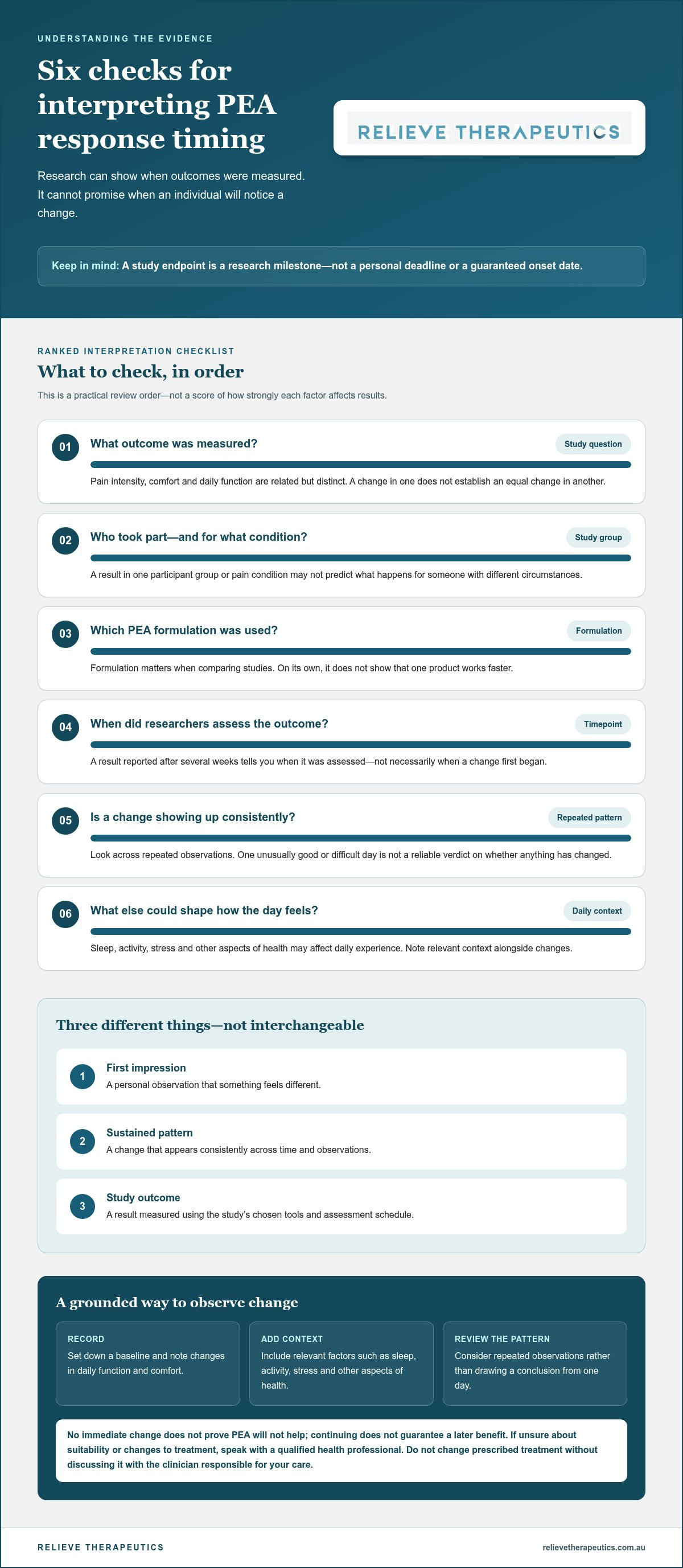
It helps to distinguish three things: a first impression that something feels different, a sustained pattern across time, and an outcome measured using a study’s chosen tools. These aren’t interchangeable. A change you notice is worth recording, but it doesn’t prove PEA caused it. Similarly, a result across a study group doesn’t guarantee you’ll experience the same effect.
Waiting can be frustrating, particularly when discomfort affects ordinary routines. You don’t need to force a positive interpretation or make a decision based on an arbitrary countdown. Consider your health circumstances and seek advice from a qualified health professional if you’re unsure whether to continue, stop or change a supplement. Don’t change prescribed treatment without discussing it with the clinician responsible for your care.
What does “taking effect” mean when using PEA?
A noticeable change is a personal observation, such as finding a usual task more manageable or experiencing a difference in comfort. That observation may matter to you, but it isn’t proof of a treatment effect or evidence that an underlying condition has changed. A change in symptoms and a change in the condition itself are different questions; one can’t automatically be inferred from the other.
Daily experiences naturally fluctuate. Sleep, activity, stress and other aspects of health may affect how a day feels. One easier day doesn’t establish a reliable improvement, just as one difficult day doesn’t settle whether anything has changed. Look for a pattern across repeated observations rather than treating a single day as a verdict.
Why can PEA response timing differ between people?
People differ in their health, symptoms, other care and circumstances, so a result observed in a study group may not map neatly onto an individual. Study design matters too: participants, PEA formulation, duration and the way outcomes are assessed can vary. These differences make it difficult to assign one onset window to everyone or compare findings as if they answered exactly the same question.
PEA is discussed in relation to biological processes involving lipid signalling. The overview of Palmitoylethanolamide (PEA) provides background on its proposed mechanisms, but a mechanism alone can’t establish when someone will feel a change. Timing needs to be assessed using relevant human research, and the available findings shouldn’t be turned into a guaranteed response schedule.
For a fair assessment, keep the question specific: what change would matter in your daily life, and is it appearing consistently? This keeps expectations grounded without dismissing your experience or assuming that waiting will necessarily lead to a benefit.
What PEA research can tell us about the time to response
PEA research can describe changes measured in particular groups, but it can’t provide a dependable countdown for every person. Studies may differ in the health conditions they investigate, the PEA formulation used, how long participants take it and which outcomes researchers measure. Those differences matter: an assessment of pain intensity in one group can’t automatically predict changes in comfort or function for someone with another condition.
A trial endpoint tells you when researchers measured an outcome, not when an individual is guaranteed to feel a change. That distinction is central when interpreting claims about how long does PEA take to work. A result recorded at a follow-up visit shows what was observed by that point in the study. It doesn’t establish the first day a participant noticed a difference or set a deadline for everyone else.
How to read timelines reported in PEA studies
Check what a reported timepoint represents. Researchers might measure symptoms at the start and at later follow-ups, then compare results across those assessments. If a paper reports an outcome after several weeks, that tells you when it was assessed, not necessarily when it began. Participant numbers, study duration, formulation and the outcome measure all affect how confidently the findings can be interpreted.
For example, a pain score and a daily-function measure answer related but distinct questions. A change in one doesn’t establish an equal change in the other. Before applying a finding to yourself, consider whether the participants’ condition and the measured outcome resemble your circumstances. Without those details, a timeframe can sound more precise than the evidence allows.
Why research findings do not create one universal PEA timeline
PEA studies investigate different populations and questions, so comparing their findings requires care. A study of a specific formulation or pain condition may not tell us how a different formulation performs for another condition. Small samples, short follow-up periods or varied methods can also limit what a result says about longer-term use or the timing of an individual response. Don’t treat a benefit observed in one research setting as proof that another person will have the same experience.
Formulation can be relevant when interpreting a study, but it isn’t enough to claim that one product works faster. That conclusion would require direct, appropriate comparisons rather than assumptions based on how a product is made. For a concise explanation of proposed biological pathways, see how PEA works for pain. Understanding a mechanism still doesn’t reveal an individual onset date.
Use research as context, not a personal forecast. If you’re considering PEA capsules, the available quantities of 60, 120 and 180 capsules are supply options, not indicators of faster onset or stronger response. You can view PEA capsule options while keeping timing expectations separate from pack size.
Is PEA not working if you feel no immediate difference?
No immediate change doesn’t establish whether PEA will help you. But the reverse is also true: continuing to take it doesn’t guarantee a later benefit. If you’re asking how long does PEA take to work, remember that research timing can’t predict an individual response with certainty. Neither a quiet start nor the hope of a future effect is proof.
Individual experience can guide personal decisions, but it isn’t a substitute for clinical evidence. A change you notice matters as part of your experience, yet it can’t confirm by itself that PEA caused the change. Likewise, not noticing a difference straight away doesn’t tell you what will happen later.
What can make a change difficult to notice?
Symptoms can fluctuate for reasons unrelated to a supplement. Activity, sleep, stress and the natural course of a health issue may all affect how you feel from one day to the next. An easier or harder day is information, but it doesn’t identify the cause.
It can also be difficult to interpret changes if you begin several new approaches or alter existing routines at the same time. If your health circumstances allow, avoid changing multiple things simultaneously without guidance, as this can make cause and effect difficult to separate. Consider practical function as well as your overall impression: for example, whether a usual daily task feels more manageable, or whether you need to pause or adapt it. These observations don’t diagnose a condition, but they can make your review more specific.
When should you review your expectations?
Choose a review point that takes account of the product directions and advice from a qualified health professional, rather than relying on a universal trial length. If your symptoms worsen, you develop a concerning reaction or you’re uncertain about suitability, seek professional advice rather than feeling obliged to persist. Don’t change prescribed medicines or other treatment without speaking with the clinician overseeing your care.
At review, consider what you hoped might change, what you’ve observed over time and whether other factors shifted. This can help you have a clearer conversation with a health professional about next steps. The PEA dosage guidance covers intake information separately; follow product directions and get personalised advice where needed.
If you’re considering PEA capsules, you can explore the available PEA capsule options with realistic expectations. Pack quantity doesn’t tell you whether PEA will work for you or how soon you might notice a change.
How to track your experience with PEA without overinterpreting it
A brief, consistent record can help you describe what you’ve noticed without asking any one day to provide an answer. It isn’t a medical assessment and can’t show on its own whether PEA caused a change. Think of it as a practical way to organise observations before reviewing your experience or discussing it with a health professional.
A simple record of symptoms and daily function
Start with a baseline: before or at the beginning of use, note what you’re hoping to understand about your symptoms and everyday activities. Choose one or two measures that matter to you, then describe them consistently each time. For example, you might record your general comfort and whether a particular routine task felt manageable, difficult or needed adapting.
Keep entries brief. A few notes can be more useful than documenting every sensation. Add context when it helps make sense of the day, such as an unusual level of activity or disrupted sleep. Treat these details as possible context, not proof of what caused a change.
- Baseline: Record your usual symptoms and relevant daily function.
- Observations: Note changes using the same descriptions, and include helpful context.
- Review: Look for a pattern across entries rather than treating one reading as a result.
This routine can keep the question “how long does PEA take to work?” grounded in your own observations. It won’t establish a guaranteed onset or replace evidence from clinical research. Mixed notes are useful to recognise too. You don’t need to force them into a positive or negative conclusion.
When to speak with a health professional
Seek advice from a qualified health professional if symptoms persist, worsen or are unexplained, or if you’re unsure whether PEA is suitable for you. A doctor or pharmacist can consider your medicines, health conditions and other supplements as part of the discussion. Bring your notes if they help you explain what has changed and when.
Follow the product label, and get professional advice before changing how you use a supplement. PEA supplements don’t replace assessment of a health concern, diagnosis or prescribed treatment. Don’t stop or alter prescribed medicines without speaking with the clinician responsible for your care. If you experience a concerning reaction, seek prompt professional advice.
If you’re considering PEA capsules, explore the available PEA capsule options alongside the product directions and advice relevant to your circumstances. A tracking record can help you reflect, but make decisions about starting, continuing or stopping with your health context in view.
Choosing your next step if you are considering PEA
Deciding whether to try a supplement is personal. The evidence can offer context, but it can’t predict your individual response or provide a guaranteed answer to “how long does PEA take to work?” Before deciding, consider why you’re interested in PEA, what you already use for your health, and whether your circumstances call for individual advice. There’s no need to rush.
Questions to consider before starting a supplement
A few practical questions can help you prepare:
- What are you hoping to understand or change? Identifying a specific concern or daily activity gives you a clearer basis for reviewing your experience.
- What else is part of your current care? Consider medicines, other supplements, diagnosed conditions and any planned changes to treatment.
- What information do you need first? Read the product directions and speak with a doctor or pharmacist if you’re unsure about suitability, interactions or how a supplement fits alongside your current care.
If you decide to use PEA, set a review approach that suits your circumstances instead of assuming you should notice a change by a particular date. Decide what you’ll observe and when you’ll discuss your experience with a qualified health professional. That review point is for reflection, not a promise of when an effect should appear. Follow product directions, and don’t stop or adjust prescribed treatment without advice from the clinician responsible for your care.
Where to find more information about PEA capsules
Relieve Therapeutics offers PEA capsules in 60-, 120- and 180-capsule quantities. These are supply options only. The number of capsules in a supply doesn’t indicate faster onset, a stronger response or a better personal outcome. Choosing a quantity can’t guarantee whether PEA will be suitable for you or whether you’ll notice a change.
Keep the decision grounded in three things: what the evidence can reasonably tell you, what the product directions say, and your own health context. If you’re uncertain, a doctor or pharmacist can help you consider your questions alongside your medicines and health conditions. Supplements don’t replace diagnosis or prescribed treatment.
If you’ve considered these points and want to review the available options, explore PEA capsule quantities. Take the time you need to make an informed choice, and seek qualified advice if you’re unsure about the next step.
Make your next step a considered one
Rather than looking for a date that guarantees an answer to how long does PEA take to work, decide what information would help you make a sound choice. Write down the specific question you want answered, such as whether PEA is appropriate alongside your current care or what change would be meaningful to you. A doctor or pharmacist can help you weigh that question against your health circumstances and other treatments.
There’s no need to turn uncertainty into pressure. A considered next step might be learning more, discussing your options with a health professional, or deciding a supplement isn’t right for you at present. Whatever you choose, keep prescribed care and professional guidance central, and reassess as your needs change.
If you’d like to review product information as part of your decision, explore PEA capsules from Relieve Therapeutics. Move forward at a pace that feels informed and right for you.
Frequently Asked Questions
Can PEA work after the first dose?
It’s possible to notice a change early, but feeling something after one dose doesn’t prove PEA caused it or show whether the effect will last. Symptoms can shift for many reasons, and research doesn’t establish a reliable first-dose response for everyone. When assessing your experience, consider whether a change continues across different days and activities. Follow the product directions rather than taking extra in the hope of a quicker effect.
How long should I try PEA before deciding whether it helps?
There’s no universal trial length that suits every person or health concern. The answer to how long does PEA take to work depends on evidence that can’t set a personal deadline. Check the product directions and discuss a review plan with a doctor or pharmacist, particularly if you have a health condition or use other medicines. Agree on what you’ll monitor and when to reassess, rather than continuing indefinitely without a clear reason.
Can PEA take longer to work for some people?
People may notice changes at different times, but available research can’t reliably predict who may respond later or whether they will respond at all. Studies vary in their participants, health conditions, formulations and assessment schedules, which limits comparisons between individuals. If you’re not noticing a difference, don’t assume that waiting longer will necessarily bring one. Consider your experience alongside product directions and advice suited to your circumstances.
What should I do if I notice no change while taking PEA?
Review your notes, the product directions and your reason for trying PEA, then consider discussing the situation with a qualified health professional. Tell them how you’ve been using it, what you hoped might change, and whether your medicines or routines changed at the same time. Don’t increase the amount or extend use simply because you haven’t noticed an effect. Seek advice sooner if symptoms worsen or you experience a concerning reaction.
Can PEA be taken with other medicines?
Ask a doctor or pharmacist before combining PEA with medicines, especially if you take regular prescriptions, use several supplements or have an ongoing health condition. Even where a major interaction hasn’t been established, that doesn’t confirm every combination is suitable for you. Share the names and amounts of what you take, including non-prescription products. This gives the health professional relevant context to assess your situation and explain whether any precautions are appropriate.
Does PEA work differently for different types of pain?
Research findings may differ by condition, so evidence for one type of pain shouldn’t be assumed to apply to another. Studies can also use different PEA formulations and measure different outcomes, such as reported pain or daily function. That makes direct comparisons difficult and means research can’t tell every person what to expect. If pain is persistent, changing or unexplained, seek an assessment to understand its cause rather than relying on a supplement to identify it.
Is PEA a replacement for prescribed pain treatment?
No. PEA supplements shouldn’t replace a prescribed medicine, a diagnosis or care recommended for your condition. Don’t stop, reduce or change prescribed treatment without first speaking with the clinician who manages it. If you’re considering adding PEA, tell your doctor or pharmacist so they can consider it alongside your treatment plan and health history. Seek prompt medical advice for severe or sudden symptoms, or if your condition is getting worse.